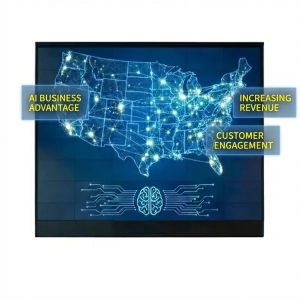
 Across the United States, forward-thinking companies are turning artificial intelligence into a measurable AI business advantage — increasing revenue, improving operational efficiency, and strengthening customer engagement in competitive markets.
AI is no longer experimental technology reserved for enterprise giants. It is now an accessible growth strategy for small businesses, mid-sized firms, and national organizations that want to lead rather than follow.
Research from McKinsey & Company (2023) shows that AI adoption has accelerated dramatically, with generative AI driving measurable operational improvements across industries.
Source: https://www.mckinsey.com/capabilities/quantumblack/our-insights/the-state-of-ai
The question is no longer whether to adopt AI.
The question is how quickly you can implement it strategically.
What Is an AI Business Advantage?
An AI business advantage occurs when organizations use artificial intelligence to improve speed, precision, and scalability across operations.
According to Davenport and Ronanki (2018) in Harvard Business Review, the most successful AI implementations focus on practical use cases such as process automation, customer insight, and cognitive engagement — not experimental moonshots.
Source: https://hbr.org/2018/01/artificial-intelligence-for-the-real-world
When implemented strategically, AI creates measurable improvements in: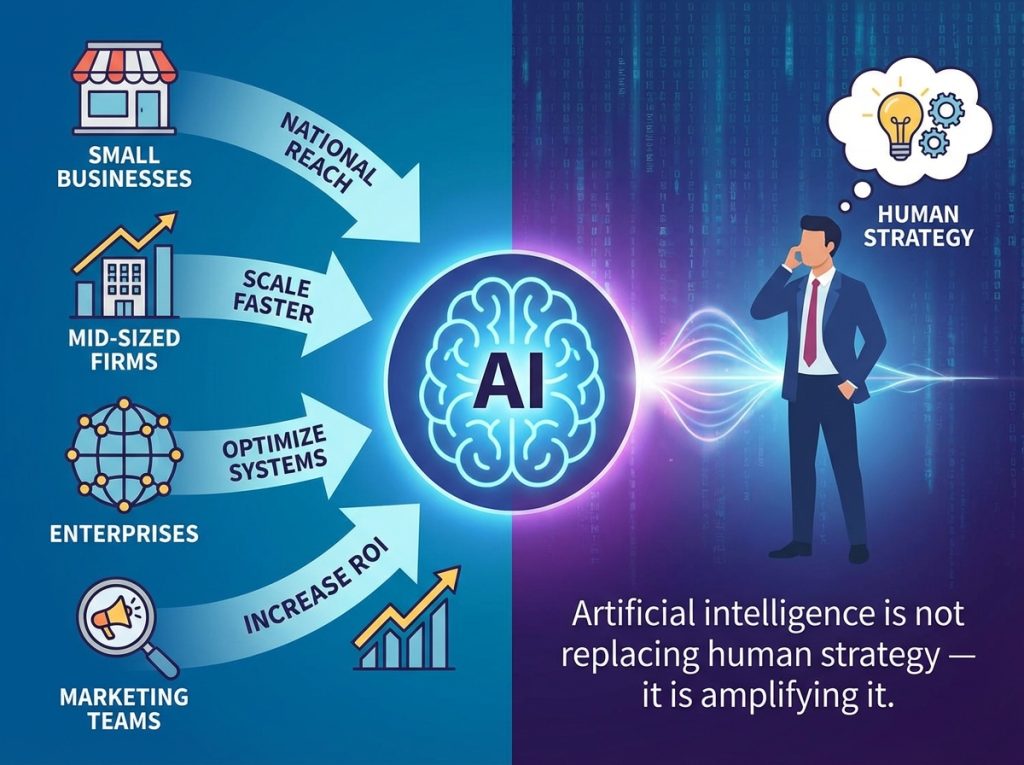
- Lead response time
- Conversion rates
- Customer retention
- Marketing ROI
- Operational efficiency
This is how competitive gaps widen nationally.
AI Adoption Is Accelerating Nationwide
Economic research reinforces this shift.
A National Bureau of Economic Research working paper (Brynjolfsson, Li, & Raymond, 2023) found that generative AI tools significantly improved productivity in customer support environments, particularly among less-experienced workers — effectively narrowing performance gaps and increasing output.
Source: https://www.nber.org/papers/w31161
Similarly, PwC estimates that artificial intelligence could contribute up to $15.7 trillion to the global economy by 2030, with substantial impact across the United States.
Source: https://www.pwc.com/gx/en/issues/data-and-analytics/publications/artificial-intelligence-study.html
Businesses that delay implementation risk falling behind faster-moving competitors.
AI Statistics: The Research Behind the AI Business Advantage
Below are data-backed insights demonstrating why AI is becoming a national competitive differentiator:
🔹 1. AI Is a Top Strategic Priority
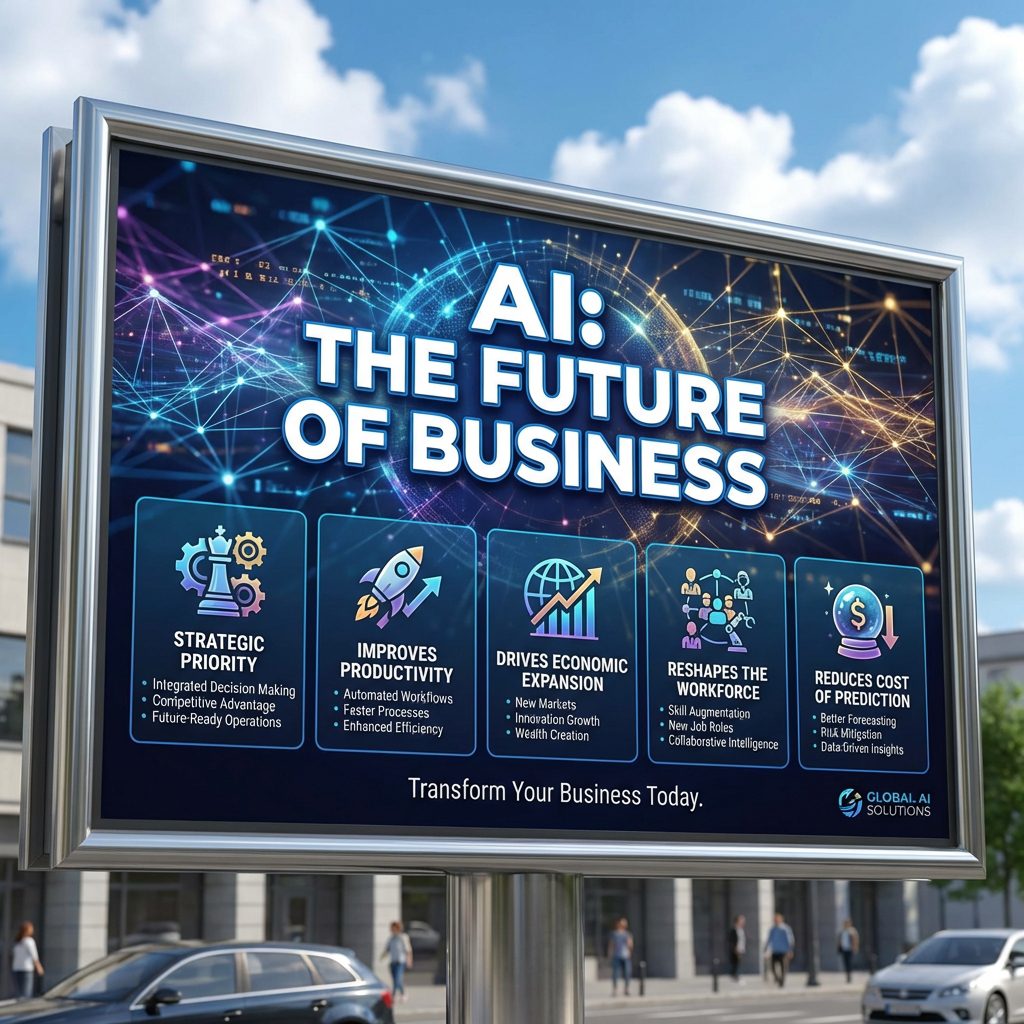
McKinsey (2023) reports that AI adoption has more than doubled in recent years, with organizations increasingly integrating AI into core business functions.
https://www.mckinsey.com/capabilities/quantumblack/our-insights/the-state-of-ai
🔹 2. AI Improves Productivity
NBER research (2023) found measurable productivity gains when generative AI tools were introduced into customer support workflows.
https://www.nber.org/papers/w31161
🔹 3. AI Drives Economic Expansion
PwC projects AI could add $15.7 trillion to global GDP by 2030.
https://www.pwc.com/gx/en/issues/data-and-analytics/publications/artificial-intelligence-study.html
🔹 4. AI Will Reshape the Workforce — Positively
The World Economic Forum (2023) reports that while AI will displace certain roles, it is projected to create millions of new jobs globally, resulting in a net positive employment shift.
https://www.weforum.org/reports/the-future-of-jobs-report-2023/
🔹 5. AI Reduces the Cost of Prediction
Agrawal, Gans, and Goldfarb (2018) argue that AI dramatically lowers the cost of prediction, enabling better decision-making at scale — a foundational driver of competitive advantage.
https://hbr.org/product/prediction-machines/10187-HBK-ENG
Practical Implementation: The Real Differentiator
Research consistently shows that AI success is not about experimentation — it’s about targeted implementation.
 E-Internet Marketing Services LLC, focuses on helping businesses nationwide implement AI in measurable, revenue-driven ways:
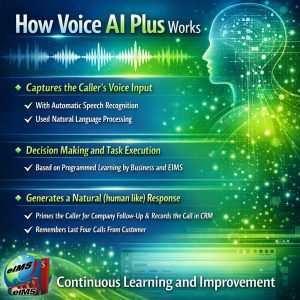
- AI-powered voice systems
- Marketing automation
- Predictive analytics
- SEO enhancement
- Intelligent customer engagement
This aligns with Harvard Business Review’s recommendation to focus on high-impact, operational use cases first (Davenport & Ronanki, 2018).
Implementation creates advantage.
Hesitation creates vulnerability.
AI Levels the Playing Field
In Prediction Machines (Agrawal et al., 2018), AI is framed as an economic shift that reduces uncertainty and improves decision-making precision.
That precision allows:
- Small businesses to compete nationally
- Mid-sized firms to scale faster
- Enterprises to optimize complex systems
- Marketing teams to increase ROI
Artificial intelligence is not replacing human strategy — it is amplifying it.
Education Drives Adoption
Understanding AI removes hesitation.
Rick Samara’s book, AI for Beginners Demystified, supports business leaders who want clarity before implementation — a strategy aligned with broader research showing that AI adoption increases when leaders understand practical application rather than abstract theory.
Clarity builds confidence.
Confidence drives action.
Action creates advantage.
The Bottom Line: AI Business Advantage Is Now a National Reality
The research is clear:
- AI improves productivity
- AI increases economic output
- AI enhances decision-making
- AI strengthens competitiveness
The companies that implement AI intentionally today will define tomorrow’s market leaders.
The AI business advantage is not theoretical.
It is measurable.
And it is accelerating nationwide.
Conclusion: The AI Business Advantage Belongs to Those Who Act
The research is clear. The economic indicators are clear. The competitive landscape is clear.
The AI business advantage is no longer theoretical — it is measurable, scalable, and already transforming companies across the United States.
Organizations that strategically implement artificial intelligence are:
- Increasing productivity
- Improving customer responsiveness
- Enhancing marketing performance
- Reducing operational inefficiencies
- Strengthening long-term competitive positioning
Meanwhile, businesses that delay adoption risk falling behind faster-moving competitors who are already leveraging AI to amplify performance.
Artificial intelligence is not about complexity — it is about clarity and execution. The companies that win in today’s market are not necessarily the largest or the most technical. They are the most intentional.
The AI business advantage belongs to leaders who take action.
Ready to Build Your AI Business Advantage?
If you’re ready to move from curiosity to implementation, now is the time.
E-Internet Marketing Services LLC specializes in practical, revenue-focused AI implementation for businesses nationwide. From AI-powered customer engagement systems to advanced SEO and marketing automation, we help organizations turn artificial intelligence into measurable growth.
Schedule a consultation today and discover how your business can:
- Capture more leads
- Respond faster than competitors
- Increase operational efficiency
- Scale without sacrificing service quality
👉 Book your AI Strategy Consultation now at:

The future belongs to businesses that implement — not hesitate.
Let’s build your AI business advantage. 🚀
Further Reading on AI Business Advantage
Agrawal, A., Gans, J., & Goldfarb, A. (2018). Prediction machines: The simple economics of artificial intelligence. Harvard Business Review Press. https://hbr.org/product/prediction-machines/10187-HBK-ENG
Brynjolfsson, E., Li, D., & Raymond, L. R. (2023). Generative AI at work. National Bureau of Economic Research Working Paper No. 31161. https://www.nber.org/papers/w31161
Davenport, T. H., & Ronanki, R. (2018). Artificial intelligence for the real world. Harvard Business Review, 96(1), 108–116. https://hbr.org/2018/01/artificial-intelligence-for-the-real-world
McKinsey & Company. (2023). The state of AI in 2023: Generative AI’s breakout year. https://www.mckinsey.com/capabilities/quantumblack/our-insights/the-state-of-ai
PwC. (2023). Sizing the prize: What’s the real value of AI for your business? https://www.pwc.com/gx/en/issues/data-and-analytics/publications/artificial-intelligence-study.html
World Economic Forum. (2023). The future of jobs report 2023. https://www.weforum.org/reports/the-future-of-jobs-report-2023/