If you’re a first-year college student, think of AI like a freshman who just figured out where the dining hall is. It has potential, but it still needs experience, feedback, and occasional correction to avoid doing something… embarrassing.
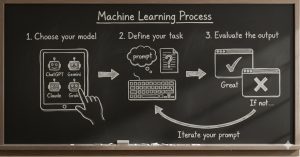 Why AI Can’t “Set It and Forget It”
AI Learns From Data, Not Vibes
AI systems learn patterns by analyzing data and feedback. When new information emerges—new behaviors, new environments, new rules—AI systems must be updated or retrained to remain accurate and useful. Without ongoing learning, AI systems become outdated, biased, or ineffective.
In short:
No new learning = no improvement.
This isn’t a flaw. It’s just how AI works.
The World Changes Faster Than AI Models
AI doesn’t operate in a static environment. Language evolves. Consumer behavior shifts. Technology advances. If AI models aren’t continuously refined, they reflect yesterday’s world, not today’s.
That’s why organizations that use AI responsibly emphasize regular updates, monitoring, and retraining, rather than assuming that a single model will remain reliable indefinitely.
Continuous Learning Makes AI More Accurate
Feedback Helps AI Improve Performance
One of the most significant benefits of continuous learning is improved accuracy. As AI systems receive feedback — especially from humans — they can correct errors, refine predictions, and make better decisions over time.
This approach is often referred to as “human-in-the-loop” learning, in which people guide AI improvements rather than allowing systems to operate without oversight.
Think of it like getting feedback on an essay. Without comments, you’d probably keep making the same mistakes. AI is no different.
Here is How You Can Help the AI Model Learn
Most models provide access or feedback via Thumbs Up and Thumbs Down buttons near the bottom of their responses. Here is the single best  example I can recommend to support continuous learning in AI, and it’s easy to do. You just need to be conscious of this and use it to provide feedback. Thumbs Up: Tells the system, “This was a helpful and safe response.” Thumbs Down: Tells the system, “This was not helpful, factually wrong, or unsafe.” When you click one of these, you often get a text box. Completing this is valuable for the developers. It’s important to know that your response won’t be added to their knowledge base immediately. Your feedback is aggregated to help the system become more intelligent and secure over time.
Reducing Errors Over Time
Ongoing learning helps AI:
-
Catch mistakes earlier
-
Adapt to new patterns.
-
Reduce repeated errors
Without continuous updates, AI systems risk becoming confidently wrong — which is arguably worse than being unsure.
Ethical AI Depends on Ongoing Development
Bias Doesn’t Fix Itself
AI systems can unintentionally reflect biases present in their training data. Continuous learning and evaluation allow developers to identify and reduce these issues over time.
Responsible AI development includes:
Ethical AI isn’t a one-time achievement — it’s an ongoing responsibility.
Accountability Requires Maintenance
Organizations that deploy AI are responsible for its behavior in the real world. Continuous development helps ensure AI systems remain aligned with human values, laws, and expectations.
In other words, if humans are accountable, AI must continue to learn.
AI Learning Mirrors Human Learning (Uncomfortably Well)
Practice Beats Perfection
AI doesn’t improve because it’s “smart.” It improves through practice, repeatedly. That’s the same reason students do problem sets, labs, and revisions.
Both humans and AI:
If this sounds familiar, congratulations — you and AI are basically study buddies.
Growth Is a Process, Not a Download
There’s no instant “knowledge update” button for AI (or people). Progress happens gradually, through exposure, correction, and refinement.
That’s why continuous learning isn’t optional — it’s essential.
Why Continuous AI Learning Matters for the Future
Better Tools, Not Replacements
Research consistently emphasizes that AI works best when it augments human abilities rather than replaces them. Continuously developed AI becomes increasingly useful as a tool, supporting creativity, efficiency, and problem-solving.
Preparing for a Changing Workforce
As AI evolves, so do the skills needed to work alongside it. Understanding that AI must continuously learn helps demystify the technology and reduces fear about its role in society.
AI isn’t “taking over.”
It’s still learning, just faster than you cram for finals.
Final Takeaway
Continuous learning is what turns AI from a static program into a useful, adaptable tool. Without it, AI systems become outdated, inaccurate, and potentially harmful. With it, AI improves, adapts, and becomes more aligned with human needs. Trends shift. Technology moves fast. If AI systems don’t keep learning, they reflect yesterday’s reality, not today’s.
One of the most powerful ways AI improves is through feedback, especially human feedback or “human-in-the-loop” learning. When people review outputs, correct errors, and guide updates, AI systems learn what works and what doesn’t. AI gets better when humans help it learn.
That’s why continuous learning in AI is essential for keeping systems relevant in real-world environments such as education, healthcare, business, and everyday technology.

 Please do me a small favor. Pretend you finished high school three months ago, and you now find yourself as a first-year college student just getting started. You don’t need a college degree to learn AI, but stick with me on this. If you prefer, just consider yourself a newbie in any endeavor you pursue.