Gaining a Strategic Edge in the Digital World
Artificial intelligence (AI) is everywhere today, from suggesting your next Netflix show to powering self-driving cars. But if you’re just watching from the sidelines, you’re missing out on its real power. As an AI enthusiast and author of “AI for Beginners Demystified,” I’ve seen people shift from passive users—asking simple questions of chatbots—to active creators who build and deploy AI to gain real advantages in life, business, creativity, and competition. This article will guide you through that transformation in plain language, step by step. By the end, you’ll have the tools to use AI not just for quick wins, but to outsmart rivals in our fast-paced digital landscape.
Understanding AI Basics
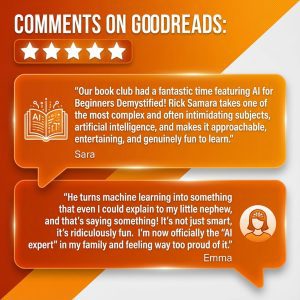
Before diving in, let’s demystify AI. It’s not magic; it’s computers learning from data to make decisions or create things. If you read AI for Beginners Demystified, you have a strong baseline understanding of Artificial Intelligence. I’m not ringing my own bell here; all of my reviews consistently say that.
 Now that you have established this baseline, you should be energized to learn more about this new technology. I devoted Chapter 11 of my book, “Deepening Your Understanding of AI,” to help you get started. In that Chapter, I explained the Value of Certifications and have expanded on their value here on our website in our article, The Value of AI Certifications in Today’s Job Market: Future-Proofing Your Career.
In this article, I break down the Value of AI Certifications from the perspective of someone who wants to stay current, stay employable, and keep moving up in their career, including non-technical roles such as marketing, HR, and management. People are worried. Some should be. They are saying, “I want to stay relevant in a world where AI is changing faster than my coffee cools.”
That is so, so true! This is a technology moving ahead at lightning speed! Keeping up with AI is like trying to map a coastline during a permanent high tide. In other words, the “shape” of what is possible is changing so fast that our old maps (skills, laws, ethics) are underwater by the time they are printed.
AI mimics human thinking but at super speed. It includes machine learning (where systems improve with experience), natural language processing (for understanding text like this article), and generative AI (which creates new content, such as images or code). Think of it as an intelligent assistant that gets better the more you use it. By the way, all the images in this article were created using AI. We use Galaxy AI as mentioned in an earlier article.
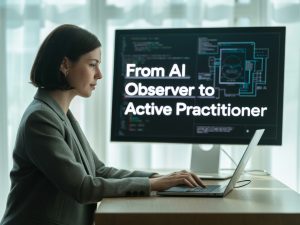 Why Move from Observer to Practitioner?
Staying passive means relying on others’ AI tools, such as ChatGPT, for emails. Becoming active lets you customize AI for your needs—say, automating your business reports or predicting market trends. In 2025, businesses that use AI strategically see improvements in efficiency and decision-making, turning data into a competitive advantage.
Getting Started: Your First Steps
No need for a PhD. Anyone can begin with a plan and basic skills.
Create a Learning Plan
Start by setting goals: Do you want to automate tasks or build AI models? Master prerequisites like basic programming (Python is great for beginners) and math concepts like statistics. Dedicate time weekly—aim for 5-10 hours.
Explore Free Resources
Online platforms make it easy. Coursera’s “AI For Everyone” is perfect for non-tech folks, explaining concepts without code. Google’s AI skills hub offers interactive labs. For hands-on experience, try Udacity’s 2025 AI roadmap, which covers common pitfalls like skipping basics.
Essential AI Tools for Practitioners
Tools are your entry point. Start simple, then scale.
Beginner-Friendly AI Platforms
Use ChatGPT or Google’s Gemini for everyday tasks. That’s what I do. Prompt them more specifically for better results, such as “explain personal AI agents with examples.” For business, tools like Microsoft Copilot integrate AI into workflows if you are an advocate of Microsoft’s suite of tools.
Advanced Tools for Strategy
In business, AI excels at automation—tools like ChatGPT for content creation and HighLevels AI Employee and CRM platform for workflow automation save time. For data analysis, HighLevel’s platform uncovers insights that give you an edge in the market. In 2025, agentic AI (autonomous agents) will handle complex tasks, such as market analysis.
Building Skills Through Hands-On Practice
Theory is good, but doing is better. Projects turn knowledge into skills.
Start with Simple Projects
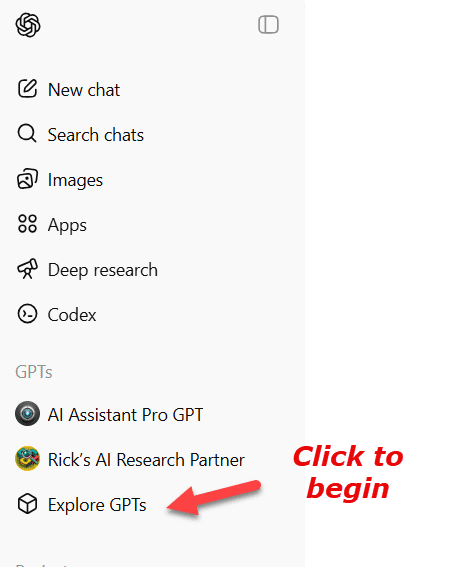 Build a personal AI agent using ChatGPT. Here is a great way to get started. The main purpose here is to build your agent and teach it all about you simply. I’ll show you how with this simple example. I’ll build your agent with you. We will call the agent, ‘XXX AI Assistant.’ You can name it anything you wish. I now have two personal agents. The proper term is GPT. They are AI Assistant Pro GPT and Rick’s AI Research Partner.
Click on ‘Explore GPTs’ to begin. In the next step, you will see + Create. ChatGPT will work with you to design your GPT. It will ask you if you want it to create a profile picture for your new GPT. You will have choices to make. It’s easy. Just work through it. The most important thing is to tell your GPT about yourself. Use the Plus + button in the Ask anything box.
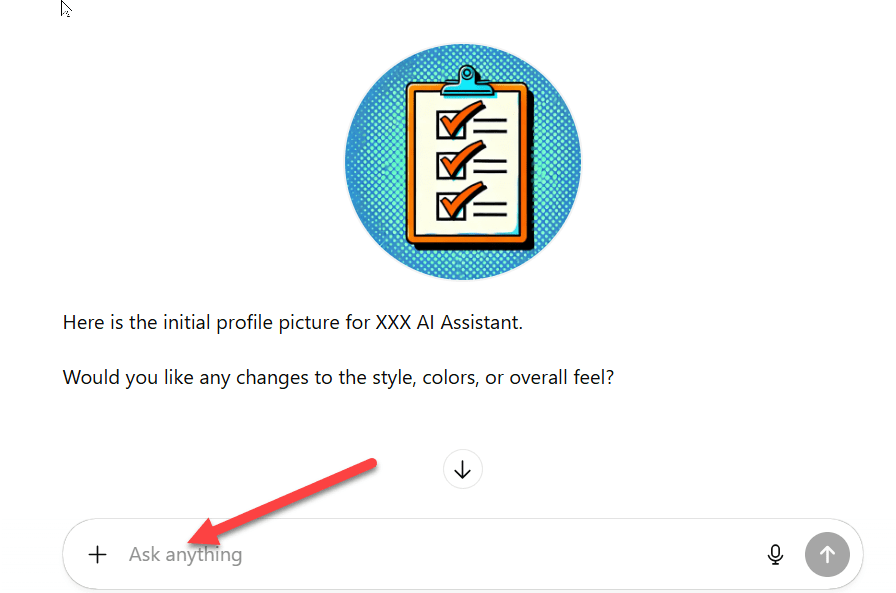
That Plus + button is very important. In my case, I instructed it to use the voice and tone I use in my book. I told it to use friendly, simple English and to use humor—things like that. (See more in our artitle titled: Personal AI Agent: From Beginner to Intermediate User). Here, you can upload any type of document or picture to enable your GPT to capture your personality. For example, I uploaded my entire book using the Plus + button. It will only accept files such as image files, Word documents, and PDFs. I wanted to add a recent article that I published on my website. To do that, I copied and pasted the article link and told ChatGPT to add the article to my profile. Don’t worry about completing it in one sitting. You can always add to it later, but simply typing “Add this to my profile…). This is an ongoing process. Have fun!
Note: This is a quickly changing technology. And, for the most part, we are teaching as we are learning. Consequently, termonology sometimes change to reflect accuracy. The proper termonolgy describing moving forward from an AI Beginner is “Practitioner.”
Applying Other AI Applications for Strategic Advantage
This is where AI can become a game-changer. Use it to outpace competitors. These are just thoughts for now to plant some ideas in your head as you decide where you want to go in the future.
AI in Business Operations
Automate customer service with AI chatbots or predict trends with analytics. Companies like Coca-Cola use AI for marketing, optimizing campaigns for better ROI. In finance, AI delivers real-time market intelligence.
Case Studies of Transformation
EY transformed internally with AI, improving client solutions across functions. Goldman Sachs uses AI assistants for faster decisions. These examples demonstrate how AI can provide competitive advantages, such as efficiency in global business services.
Ethical and Strategic Integration
Focus on responsible AI—data bias can harm. In strategy, AI accelerates analysis, but human oversight is key. For creators, Notion AI turns into business intelligence.
Overcoming Challenges
Roadblocks are normal. Procrastination? Use AI prompts for motivation. No experience? Start small—many AI practitioners began as novices. Data governance tools such as Microsoft Purview help ensure secure AI use.
Looking Ahead: Your AI Future 
By 2025, AI will be integral to business predictions and innovations. As an AI practitioner, you’ll adapt faster. Start today: Pick one tool, one project, and build from there. The digital landscape rewards those who act.
In summary, shifting to active AI use isn’t hard—it’s about consistent steps. You’ll gain not just efficiency but a strategic advantage.
Sources and Citations
- [4] Nate’s Substack. “The Complete AI Reading Guide for 2025.” https://natesnewsletter.substack.com/p/the-complete-ai-reading-guide-for
- [6] Ethan Mollick. “Using AI Right Now: A Quick Guide.” https://www.oneusefulthing.org/p/using-ai-right-now-a-quick-guide
- [7] Udacity. “How to Learn AI in 2025: A Roadmap for Beginners and Developers.” https://www.udacity.com/blog/2025/05/how-to-learn-ai-in-2025-a-roadmap-for-beginners-and-developers.html
- [10] Advantage Technology. “Top 10 AI Tools for Business in 2025.” https://www.advantage.tech/top-10-ai-tools-for-business-in-2025/
- [11] Alumio. “Comparing best AI tools for business 2025.” https://www.alumio.com/blog/comparing-best-business-ai-tools-2025
- [13] McKinsey. “Seizing the agentic AI advantage.” https://www.mckinsey.com/capabilities/quantumblack/our-insights/seizing-the-agentic-ai-advantage
- [15] Syracuse University. “Key Benefits of AI in 2025: How AI Transforms Industries.” https://ischool.syracuse.edu/benefits-of-ai/
- [16] TTMS. “Top 15 AI Tools for Business in 2025.” https://ttms.com/top-15-ai-tools-for-business/
- [17] PwC. “2025 AI Business Predictions.” https://www.pwc.com/us/en/tech-effect/ai-analytics/ai-predictions.html
- [20] Coursera. “How to Learn Artificial Intelligence: A Beginner’s Guide.” https://www.coursera.org/articles/how-to-learn-artificial-intelligence
- [21] Reddit. “I want to get into AI but have no idea how.” https://www.reddit.com/r/ArtificialInteligence/comments/11wgx6u/i_want_to_get_into_ai_but_have_no_idea_how/
- [22] Quora. “How to start an AI career with no experience.” https://www.quora.com/How-do-I-start-an-AI-career-with-no-experience
- [23] Magai. “Generative AI for Beginners: From Zero to Hero in 8 Simple Lessons.” https://magai.co/generative-ai-for-beginners/
- [24] Google AI. “Learn essential AI skills.” https://ai.google/learn-ai-skills/
- [25] AWS. “AWS Certified AI Practitioner.” https://aws.amazon.com/certification/certified-ai-practitioner/
- [27] LearnDataSci. “The 9 Best AI Courses Online for 2025: Beginner to Advanced.” https://www.learndatasci.com/best-artificial-intelligence-ai-courses/
- [35] Analytics Insight. Post on X. https://x.com/analyticsinme/status/1962123204488794551
- [36] Maliha Haroon. Post on X. https://x.com/Malihaharoo8165/status/1961830402131439963
- [44] Rob Llewellyn. “AI For Business – 30 Case Studies That Led To Competitive Advantage.” https://robllewellyn.com/ai-for-business/
- [45] EY. “Inside the process: how EY navigated its own AI-driven transformation.” https://www.ey.com/en_ca/insights/ai/case-study-how-ey-transformed-with-ai
- [47] McKinsey. “How AI is transforming strategy development.” https://www.mckinsey.com/capabilities/strategy-and-corporate-finance/our-insights/how-ai-is-transforming-strategy-development
- [50] The Hackett Group. “Gen AI Acceleration for Competitive Edge.” https://www.thehackettgroup.com/insights/the-acceleration-of-generative-ai-how-businesses-are-scaling-for-competitive-advantage/
- [51] Rotman School of Management. “Generative AI for Business.” https://execonline.rotman.utoronto.ca/generative-ai-for-business-driving-growth-and-competitive-advantage
- [53] PwC Canada. “Using AI as a catalyst for financial transformation.” https://www.pwc.com/ca/en/services/consulting/alliances/amazon-web-services/using-ai-as-a-catalyst-for-financial-transformation-case-study.html
- [54] Modus Systems. Post on X. https://x.com/ms_itconcierge/status/1965392348436717770
- [61] Lakwad. Post on X. https://x.com/LakwadNotion/status/1960751100413534665