 Let’s be honest. Most people who say they’re “learning AI” are really just poking it with a stick. If you have already read my book, AI for Beginners Demystified, you now have a strong baseline.
They ask it to write a funny poem. (I did that in my book as an illustration.)
They generate a social media caption.
They marvel at how it rewrites an email.
Then they go right back to doing everything the old way. Suppose that’s you, no judgment. That’s how experimentation starts. But learning AI in 2026 isn’t about entertainment. It’s about elevation. We’ve officially moved past the “Wow, that’s cool” stage of artificial intelligence. Now we’re in the “What can this actually fix?” stage.
The real shift in learning AI in 2026 isn’t about mastering tools. It’s about upgrading how you think. Beginners ask AI for answers. Practitioners ask it to analyze patterns, test ideas, and build repeatable systems.
One approach produces content.
The other produces capability.
This article isn’t going to hand you a list of cool features. It’s going to show you how to move from experimenting with AI to actually applying it, whether you’re running a company, organizing a bowling league, leading a nonprofit, or planning the most stressful (and joyful) day of your life.
Ready to stop playing with AI? Good. Let’s build something useful.
If you’re serious about learning AI in 2026, let me give you the shortcut:
Don’t ask it for answers.
Ask it to build systems with you.
Most beginners treat AI like a trivia machine. They ask for definitions, fun facts, maybe a social media caption. That’s fine for day one.
But the real shift—from AI beginner to AI practitioner—happens when you stop experimenting casually and start applying AI intentionally.
And here’s the key:
Business is just one example.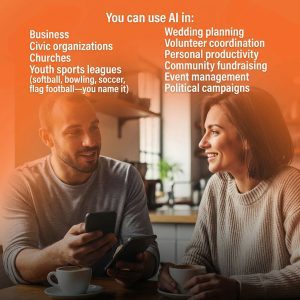
You can use AI in:
- Civic organizations
- Churches
- Youth sports leagues (softball, bowling, soccer, flag football—you name it)
- Wedding planning
- Volunteer coordination
- Personal productivity
- Community fundraising
- Event management
- Political Campaigns
The only real constraint is your imagination—and maybe your Wi-Fi.
Let’s make this practical.
The 3-Step Plan for Learning AI in 2026
This isn’t theory. It’s a framework you can use immediately.
Step 1: Identify a Friction Point (Not a Curiosity)
When people begin learning AI in 2026, they ask:
- “What can AI do?”
- “What are the best tools?”
- “What’s new this month?”
Practitioners ask:
“What problem keeps slowing us down?”
That question changes everything.
Examples:
Civic Organization
- Difficulty coordinating volunteers
- Low event turnout
- Poor communication among members
Just use this [prompt] and follow along. Learn to engage with your favorite Chatbot. We use ChatGPT. [I’m having difficulty coordinating volunteers, suffer from low event turnout, and we have poor communication among members. How can you help?] Note: Delete the brackets!
Church
- Weekly bulletin preparation takes too long
- Sermon research scattered across sources
- Youth ministry struggling with engagement
Sports League
- Schedule conflicts
- Confusing communication with parents
- Tracking stats manually
Wedding Planning
- Vendor comparison overload
- Guest list chaos
- Budget creep
Small Business
- Lead follow-up inconsistency
- Repetitive content creation
- Customer service bottlenecks
If you’re running a business, you may also want to review how AI integrates into digital strategy here:
🔗 https://einternetmarketingservices.com/ai-marketing-strategy/
But don’t stop at business thinking. AI is operational leverage for any organized effort.
Your first assignment in learning AI in 2026:
Write down one recurring frustration.
That’s your entry point.
Step 2: Ask AI to Analyze, Not Just Produce
Here’s where most people stall.
They say:
“Write me a schedule.”
“Create a flyer.”
“Draft an email.”
That’s surface-level use. Instead, try this:
For a Church
“Here are the last 12 weeks of attendance numbers. Analyze trends, identify patterns, and suggest 3 engagement strategies.”
For a Soccer League
“Here are our game schedules and field availability. Optimize a conflict-free schedule and identify potential problem weeks.”
For a Civic Group
“Analyze our past 6 event descriptions and identify which messaging themes drove the highest turnout.”
For a Wedding
“Compare these five vendor proposals and summarize cost drivers, potential risks, and negotiation opportunities.”
See the difference?
You’re not asking AI to replace thinking.
You’re asking it to process complexity and solve your problem.
When learning AI in 2026, your goal is to collaborate with it—like an analytical assistant that never sleeps.
If you’re applying AI to business growth specifically, this SEO resource can help you connect AI workflows to visibility and traffic:
🔗 https://einternetmarketingservices.com/search-engine-optimization/
But remember—SEO is one lane. AI applies to every lane.
Step 3: Build One Repeatable Workflow – EXAMPLES to Follow!
This is where you become a practitioner.
Not by using AI occasionally. But by creating one repeatable process.
Examples:
Church Workflow
Sermon theme → Research support passages → Community application ideas → Discussion questions → Social media recap.
Softball League Workflow
Player registration data → Team balancing analysis → Schedule optimization → Automated parent update email.
Wedding Workflow
Guest list spreadsheet → Budget tracking → Seating optimization → Vendor follow-up timeline.
Civic Organization Workflow
Volunteer signups → Skill categorization → Task assignment → Reminder messaging.
Business Workflow
Customer inquiry → AI qualification summary → Follow-up email draft → CRM entry.
Pick one.
Document the steps. Time it. Refine it weekly.
Within 90 days, learning AI in 2026 won’t feel experimental—it will feel operational.
Learning AI in 2026: A Simple Weekly Practice Model
If you want structure, try this routine:
Monday: Identify one bottleneck.
Tuesday: Feed relevant data into AI.
Wednesday: Ask it to analyze and propose a structured solution.
Thursday: Implement a test version.
Friday: Measure and refine.
Repeat.
You’ll move from “AI curious” to “AI capable” faster than you think.
Common Mistakes When Learning AI in 2026
Let’s save you some frustration.
- Tool-hopping instead of process-building
- Expecting perfection from the first output
- Not giving AI enough context
- Failing to measure results
- Limiting AI to content creation
AI is a pattern recognition engine.
If you give it patterns, it will give you insight.
If you give it vague prompts, it will give you vague answers.
That’s not AI’s fault. That’s operator error. (Yes, I said it.)
The Bigger Picture
Learning AI in 2026 is less about mastering a specific tool and more about developing a mindset:
- Define problems clearly
- Provide structured input
- Ask for analysis
- Test ideas quickly
- Iterate intentionally
This applies whether you’re:
- Growing a company
- Organizing a church retreat
- Running a bowling league
- Planning a wedding
- Leading a nonprofit
- Coaching a youth team
AI isn’t just a business accelerator.
It’s an organizational amplifier.
Ready to Apply AI With Structure?
If you’re ready to move beyond experimentation and start building real systems, we can help.
We work with clients nationwide via video conferencing to:
- Identify high-impact AI opportunities
- Build practical implementation plans
- Create repeatable workflows
- Integrate AI into business, nonprofit, and organizational environments
- Measure ROI and refine processes
If you’re committed to learning AI in 2026, start with one problem. Build one workflow. Improve it weekly. The only real limit is how creatively you decide to apply it.
Whether you’re running a company, leading a church, managing a sports league, or coordinating community initiatives, we’ll help you turn AI from curiosity into capability.

Because learning AI in 2026 isn’t about watching what happens. It’s about building what’s possible.
Further Reading
Brynjolfsson, E., & McAfee, A. (2014). The second machine age: Work, progress, and prosperity in a time of brilliant technologies. W.W. Norton & Company. https://wwnorton.com/books/the-second-machine-age/
Davenport, T. H., & Ronanki, R. (2018). Artificial intelligence for the real world. Harvard Business Review. https://hbr.org/2018/01/artificial-intelligence-for-the-real-world
Mollick, E. (2023). Using AI to work smarter. Harvard Business School Working Knowledge. https://hbswk.hbs.edu/
OpenAI. (2024). Prompt engineering best practices. https://platform.openai.com/docs/guides/prompt-engineering