Why the Value of AI Certifications Is Rising So Quickly
In this article, I’ll break down the Value of AI Certifications from the perspective of someone who wants to stay current, stay employable, and keep moving up in their career, including non-technical roles like marketing, HR, and management. People are worried. Some should be. They are saying, “I want to stay relevant in a world where AI is changing faster than my coffee cools. Everywhere I look, job descriptions are quietly slipping in “AI skills preferred,” and I know that if I want to stay competitive and actually advance, I can’t rely on experience alone.” AI Certifications are one of the clearest ways to signal that you are serious about AI, not just “AI-curious.”
AI is now a baseline expectation, not a bonus skill.
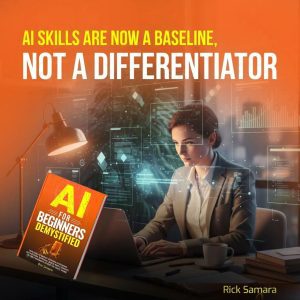 Employers are hiring for AI-related skills even as the broader tech job market cools. One recent analysis found that job postings referencing AI skills climbed while overall tech hiring declined, highlighting AI as a bright spot in a dimmer market. Another survey reported that 71% of business leaders would prefer a candidate with fewer years of experience if they have strong AI skills.
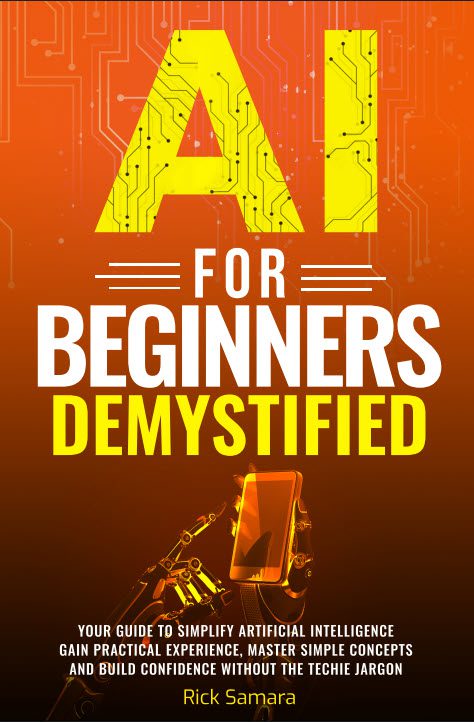
There is a section in my book, AI for Beginners Demystified, on the value of AI certification (p. 106). However, as AI adoption grows, certifications are becoming increasingly critical. According to a 2024 AWS survey of 3,297 employees and 1,340 organizations in the U.S., employers’ findings revealed that:
- 92% of organizations intend to use AI-powered solutions by 2028.
- Employers believe that employees in specific departments, such as sales and marketing (86%) and human resources (78%), will gain substantial benefits from AI implementation.
According to an article in Forbes on AI Certifications, by Rachel Wells, “AI Certifications are the new degrees.” They are cheaper, quicker to complete, offer more value to employers, and increase your chances of getting hired by 94% compared to the undergraduate route.
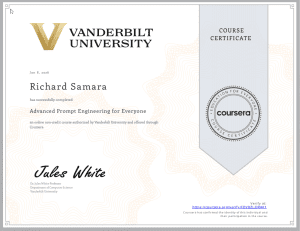 I’m not just a book writer. I practice what I preach. Since my book was published, I’ve taken four different certification courses. I wanted to explore these courses myself. I was looking for short courses that I could complete in a couple of weeks without breaking the bank. They are available, but I prefer to experiment with quick, affordable courses. I focused on courses that I felt would be most beneficial to me. I took one course on social media marketing, but the other three were focused on writing prompts or prompt engineering. All four of these courses were offered through Coursera. The Value of AI Certifications depends heavily on where you’re starting and where you want to go. These courses aligned with my goals, and I recommend you do the same-identify your objectives before choosing a certification or course.
So, if you walk into an interview without demonstrable AI capability, you are telling your prospective employer: ” I’m not just behind—I’m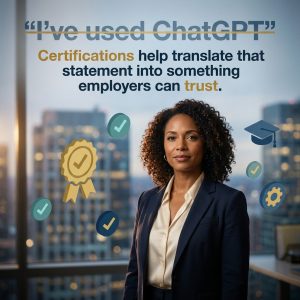 invisible.” The Value of AI Certifications is that they transform “I’ve been playing with ChatGPT” into “I have structured, validated skills.” An excellent way to develop generative AI skills is to explore the Galaxy Suite of Tools. However, beware. As of this writing, there are over 3,900 generative AI tools in Galaxy, and this number continues to grow. It’s very easy to get sidetracked and overwhelmed. Before you pursue this, I highly recommend you read our article: What is Galaxy AI? Pros and Cons of this Popular Suite of AI Tools.
Employers are literally paying more for certified AI skills
One compensation study found that more than 100 AI-related skills and certifications command average pay premiums of 7–23% above base salary. That’s not a motivational quote; that’s a pay stub difference.
When you look at your own career trajectory, a certification that boosts your earning potential and keeps you marketable is not a “nice-to-have”—it’s an income-protection strategy.
AI skills demand is growing across roles, not just for data scientists
A U.S. workforce analysis from the Federal Reserve Bank of Atlanta shows that employer demand for AI skills is rising steadily in online job postings across many roles, not just strictly technical ones. Another report notes that one in four employers is hiring for digital skills—including AI—despite overall tech hiring being under pressure.
At the same time, many workers are using AI tools without formal training; one study found that while a large majority of employees use generative AI, only a minority receive structured guidance or education. That gap is precisely where the Value of AI Certifications shows up: they turn ad-hoc experimentation into structured, demonstrable competence.
How AI Certifications Help You Stay Competitive
They formalize skills you’re already trying to learn
You can learn a lot from YouTube, blog posts, and random prompts, but employers have no way to measure that. An AI certification guides you through a structured path (fundamentals, hands-on labs, assessments), and provides a verifiable credential at the end.
Universities and training providers emphasize that AI-focused certifications help professionals build both literacy (understanding what AI can do) and practical application (using it in their jobs). For someone trying to stay current, a certificate is like saying, “Yes, I know what I’m doing, and here’s proof.”
They differentiate you in a crowded market.
AI is now mentioned in countless job ads, but not all candidates can substantiate it. When you bring a recognized certification, especially from a central platform like Microsoft, Google, IBM, or Coursera, you immediately feel recognized and respected as someone who invested real effort, effort that employers value highly.
Several career-focused analyses show that certifications demonstrate dedication, basic competence, and a willingness to stay current. These are traits employers seek when choosing whom to promote or hire for AI-intensive roles. The value of AI certifications isn’t just technical; it’s also about reputation.
They help future-proof your role, not just your résumé
Reports on AI and the labor market consistently highlight two messages: some tasks will be automated, and new opportunities will appear for people who can work effectively with AI systems. Career guidance articles now explicitly recommend upskilling through AI certificates and micro-credentials to “future-proof” one’s job.
In plain language: AI might not take your job—but someone who knows how to use AI better might. For you, the Value of AI Certifications is that they keep you on the right side of that equation.
Types of AI Certifications and What They Signal
Foundational AI literacy and “AI for everyone” programs
If you’re not a hardcore programmer and may never be, foundational certifications are a smart starting point. They typically cover:
- Basic concepts: machine learning vs. deep learning, supervised vs. unsupervised learning
- How generative AI tools work conceptually
- Responsible AI and data ethics
- Practical use cases in business, marketing, operations, HR, and more
Examples include:
- AI literacy and “AI for business” certificates from universities and professional education units, which focus on understanding AI’s role in work rather than coding.
- Generative AI for Everyone style programs from providers that focus on prompt engineering and blend conceptual explanations with practical examples.
These foundational programs are ideal if you want to speak intelligently about AI in strategy meetings, contribute to AI-enabled projects, and avoid sounding like you think “GPU” is a new energy drink.
Platform-specific AI and ML certifications (Azure, AWS, Google)
If you want to be taken seriously in technical or hybrid roles with strong technical components, platform certifications are crucial. They tell employers you can work inside the ecosystems they already use.
Examples:
- Microsoft Certified: Azure AI Engineer Associate – validates that I can design and implement Azure AI solutions using services like Azure AI Search and Azure OpenAI, and that I understand responsible AI principles in production systems.
- Cloud provider certifications for machine learning and data engineering, such as AWS machine learning credentials or Google Cloud’s data/AI paths, are commonly recommended in industry discussions as strong differentiators for AI-related roles.
These certifications signal that you’re not just “AI aware,” you can actually deploy, monitor, and maintain AI solutions in real environments. That’s the kind of Value of AI Certifications that shows up directly in job descriptions.
Machine learning and deep learning specializations
If your goal is to move into AI engineering, data science, or technical leadership, you need deeper, model-level competence. Popular programs include:
- Machine Learning Specialization by Andrew Ng on Coursera, which covers core ML concepts and practical modeling techniques.
- IBM Machine Learning Professional Certificate, which offers hands-on experience with ML workflows and neural networks.
- Curated lists of top data science and ML certifications that highlight programs from Coursera, edX, Udacity, MITx, and others selected for content quality and professional value.
These programs are more demanding, but they also signal that you can handle more than just “click the AI button.” They show you understand the models, the math, and the trade-offs involved in building AI systems.
Choosing the Right AI Certification for Your Career Goals
Step 1: Start from your role and target role, not from a course catalog
The Value of AI Certifications depends heavily on where you’re starting and where you want to go:
- If you’re in a non-technical role (marketing, HR, operations): A foundational AI or “AI for business” credential plus one platform-agnostic course on generative AI can help you use tools more effectively and speak credibly about AI projects.
- If you’re in IT, data, or software: A cloud-specific certification (Azure, AWS, Google) plus at least one ML or data science certificate gives you both the platform skills and the modeling mindset.
- If you’re pivoting into AI roles: You’ll likely need a combination—foundational cert, ML specialization, and at least one cloud AI certification to show you can operate across stack layers.
Picking unquestioningly from a “Top 10 AI Certifications” list is like choosing a career based on which job has the best snacks. Tempting, but not very strategic.
Step 2: Check employer alignment and recognition
Several career and training resources stress that not all AI certifications carry the same weight with employers; choosing widely recognized ones from respected vendors or universities matters.
Before committing, you should:
- Search your target job titles on major job boards and see which certifications are mentioned.
- Look at LinkedIn profiles of people in roles you want and see what credentials they hold.
- Confirm the certification is current and aligned with modern tools (for example, AI certifications that now cover generative AI and modern cloud services, not just classic ML).
Step 3: Balance learning value, time, and cost
Some AI certifications can be completed in weeks, others in months. Providers and analysts often recommend choosing programs that combine:
- Hands-on labs or projects
- Assessments or exams that actually test skills
- Content that maps clearly to real job tasks and tools
Given limited time and budget, treat the Value of AI Certifications like any other investment: what specific roles or pay outcomes could this realistically unlock for you in the next 12–24 months?
How Can You Use AI Certifications Strategically in Your Career Story
On LinkedIn and your résumé
In my case, all the AI Certification courses I completed were immediately uploaded to my LinkedIn profile from Coursera.
Don’t just create a “Certifications” section and dump acronyms there. Instead;
List the certification with provider, year, and focus area (e.g., “Azure AI Engineer Associate – Azure AI services, vision, NLP, generative AI”).
- On your resume, connect each certificate to concrete achievements: “Used skills from X certification to build a prototype AI-based lead scoring model that improved conversion by Y%.”
AI credentials should read like part of a coherent growth story, not like I went shopping during a Black Friday sale on online courses.
In performance reviews and promotion conversations
When you talk with your manager about promotions or new responsibilities, certifications help you make a stronger case:
- “Over the last six months, I completed [Certification] and applied it to [Project], resulting in [Outcome]. I’d like to expand this work by taking on more responsibility in AI initiatives.” This is very powerful!
Research and employer surveys consistently point out that certified professionals are often first in line for AI-heavy projects and advancement opportunities.
As proof that you’re committed to continuous learning
AI is evolving so quickly that anything you learned two years ago needs to be refreshed. Widely cited career guidance now encourages professionals to treat AI upskilling, through certificates and short programs, as an ongoing part of career development rather than a one-time event.
Put simply: Your future boss doesn’t just want to know what you know; they want to know how fast you can learn what’s coming next. Certifications give a visible signal that you’re not waiting to be dragged into the future. You are walking there on purpose.
Conclusion: The Real Value of AI Certifications for Your Career
The Value of AI Certifications isn’t that they magically guarantee a six-figure salary or a job title with “Chief” in it. It’s that they:
- Convert self-study and curiosity into verifiable, structured skill sets
- Differentiate yourself in a market where many people claim AI skills, but fewer can prove them
- Support higher earning potential and better access to AI-intensive roles
- Help you stay relevant, and even advance, while AI reshapes the job market
AI may not replace specific jobs, but it will certainly reward those who invest in learning it. For someone who wants to stay current, stay competitive, and keep moving forward, AI certifications are no longer optional. They’re the new baseline for a serious, future-focused career.
References
American University Kogod School of Business. (2025, May 23). The value of adding an AI certification to your resume. American University. https://kogod.american.edu/news/the-value-of-adding-an-ai-certification-to-your-resume
CompTIA. (2025). AI Essentials training to bridge the workforce skills gap. ITPro. https://www.itpro.com/business/careers-and-training/comptia-launches-ai-essentials-training-to-bridge-workforce-skills-gap
Federal Reserve Bank of Atlanta. (2025, May 21). By degree(s): Measuring employer demand for AI skills by educational requirements. https://www.atlantafed.org/cweo/workforce-currents/2025/05/21/by-degrees-measuring-employer-demand-for-ai-skills-by-educational-requirements
Kossen, M. (2025, October 20). AI certifications outpace non-certified AI skills in pay growth. NetworkWorld. https://www.networkworld.com/article/4073963/ai-certifications-outpace-non-certified-ai-skills-in-pay-growth.html
ManpowerGroup Experis. (2025, September 30). AI is driving demand for digital skills, as the U.S. tech hiring outlook shows resilience. ManpowerGroup. https://investor.manpowergroup.com/news-releases/news-release-details/ai-drives-digital-skills-demand-us-tech-hiring-outlook-shows
Microsoft. (2025, April 30). Microsoft Certified: Azure AI Engineer Associate. Microsoft Learn. https://learn.microsoft.com/en-us/credentials/certifications/azure-ai-engineer/
National University. (2025, May 30). 59 AI job statistics: Future of U.S. jobs. National University. https://www.nu.edu/blog/ai-job-statistics/
PECB. (2025). The growing demand for AI skills and certifications. PECB. https://pecb.com/en/article/the-growing-demand-for-ai-skills-and-certifications
University of Texas at San Antonio. (2023). Is an artificial intelligence certification valuable for my career? UTSA Professional and Continuing Education. https://www.utsa.edu/pace/news/artificial-intelligence-certification-valuable-for-my-career.html
Wells, R. (2024, November 5). In 2024, 71% of employers prefer AI skills over experience. Forbes. https://www.forbes.com/sites/rachelwells/2024/11/05/71-of-employers-prefer-ai-skills-above-experience-in-2024/
Coursera. (2025). 7 popular machine learning certifications: Your 2026 guide. Coursera. https://www.coursera.org/articles/machine-learning-certification
Refonte Learning. (2025, May 12). Top certifications in data science and machine learning for 2025. Refonte Learning. https://www.refontelearning.com/blog/top-certifications-in-data-science-and-machine-learning-for-2025
Aynsoft. (2025). Top 10 AI courses & certifications worth taking in 2025. Aynsoft. https://aynsoft.com/top-10-ai-courses-certifications-worth-taking-in-2025/
City University of Seattle. (2025, November 8). How to embrace AI in career development and future-proof your job. CityU. https://www.cityu.edu/blog/future-proof-your-career-ai-skills/