 AI expectations in the workplace are rising as employers increasingly require AI use. Employees should clarify expectations, ask managers practical questions, use approved tools, and experiment strategically. Professionals who combine AI skills with human judgment can turn employer-required AI adoption into a long-term career advantage.
“AI may change how work gets done, but career advantage increasingly belongs to professionals who combine AI capability with distinctly human judgment.”
Introduction to AI Expectations in the Work Place
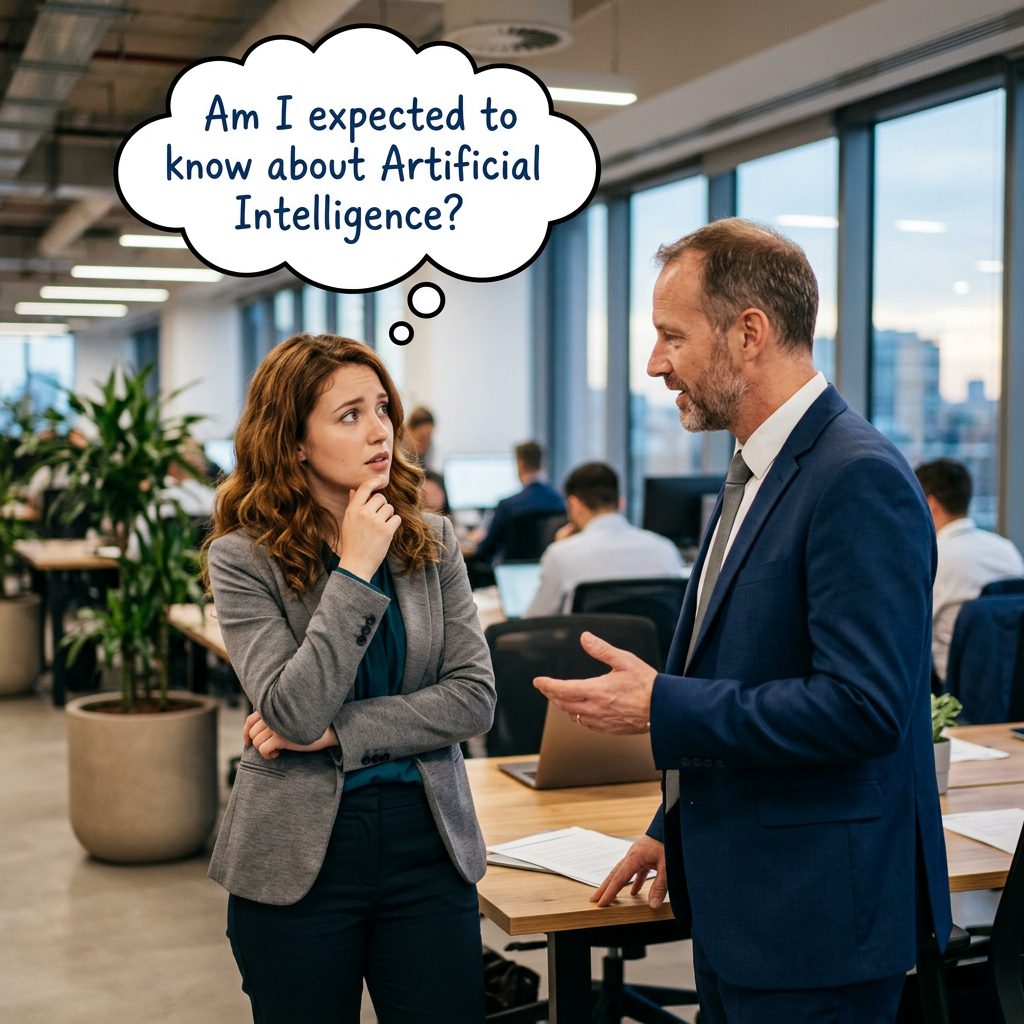
Artificial intelligence has moved from experimentation to expectation. In many organizations, using AI is no longer framed as optional professional development. It is becoming part of how work gets done. According to Owl Labs, 64% of employers encourage AI use (https://owllabs.com), and according to HRTech Edge, 58% require it (https://hrtechedge.com).
>>>Valuable Downloadable Checklist on Things to Ask Your Employer Below<<<
Employers are literally paying more for certified AI skills
One compensation study found that more than 100 AI-related skills and certifications command average pay premiums of 7–23% above base salary. That’s not a motivational quote; that’s a pay stub difference.
When you look at your own career trajectory, a certification that boosts your earning potential and keeps you marketable is not a “nice-to-have”—it’s an income-protection strategy.
That shift raises practical questions for professionals:
- What does it mean when an employer requires AI use?
- How do you clarify what is expected of you?
- How do you use AI to increase your value rather than dilute it?
These questions sit at the center of AI expectations in the workplace.
The opportunity is bigger than compliance. Professionals who learn to work well with AI often gain leverage in speed, analysis, communication, and decision support. The real issue is not whether AI belongs in your work. It is how to use it intelligently while strengthening the distinctly human capabilities that matter most.
Why Employers Are Requiring AI Use
Productivity Pressures
Organizations are under constant pressure to do more with limited time and resources.
AI tools can help with:
- Drafting first versions faster
- Summarizing large amounts of information
- Automating repetitive administrative tasks
- Accelerating research and analysis
From management’s perspective, requiring AI may look less like experimentation and more like operational modernization.
Competitive Pressure
If competitors use AI to reduce turnaround time, improve customer support, or speed product development, organizations may feel compelled to respond.
This is especially visible in:
- Consulting
- Marketing
- Software development
- Customer support
- Finance
- Knowledge work generally
In many industries, AI adoption is increasingly tied to competitiveness.
Efficiency Expectations
Employers may also assume AI should raise output.
That can create ambiguity.
If AI helps complete tasks faster, are performance expectations changing too?
This is one reason clarifying expectations matters.
Workplace Transformation Trends
Many organizations are treating AI the way they once treated:
- Spreadsheets
- Search engines
- Collaboration software
- Cloud tools
At first, optional. Then standard. Eventually expected.
AI is following a similar path.
How Employees Should Clarify Employer Expectations?
When an employer says, “Use AI,” that instruction can mean very different things.
It could mean:
- Use AI for drafting
- Use AI for research
- Use approved enterprise tools only
- Increase output targets
- Experiment and report lessons learned
Those are not the same expectation.
Clarification is essential.
Ask Which Tasks Should Use AI
Start with scope.
Ask:
- Which tasks should AI support?
- Which tasks should remain fully human-led?
- Are there tasks where AI should not be used at all?
Without clarity, people either underuse AI or overapply it.
Neither helps.
Clarify Whether Productivity Expectations Are Changing
This is a critical question many employees avoid asking.
Ask directly:
- Does AI change expected output volume?
- Are turnaround times changing?
- Will productivity be measured differently?
This is not resistance. It is expectation management.
Ask What Must Be Human Reviewed
One of the most practical questions you can ask:
Which outputs require human review before use?
Examples:
- Client communications
- Financial analysis
- Legal-sensitive materials
- Hiring decisions
- External content
This protects quality and judgment.
Confirm Approved Tools
Do not assume public tools are acceptable.
Ask:
- Which tools are approved?
- Are there enterprise licenses?
- Are there restrictions around uploading company data?
Tool clarity matters for security, privacy, and compliance.
Understand Policy Boundaries
Ask about:
- Confidential information
- Customer data
- Intellectual property
- Bias risk
- Compliance rules
AI expectations are not just about productivity. They often intersect with governance.
Ask How AI Use Affects Performance Evaluation
This is often overlooked.
Ask:
- Is effective AI use now part of performance expectations?
- Will experimentation be recognized?
- Are new skills being valued in promotion decisions?
The answers can reveal whether AI literacy is becoming a career signal.
How Does Experimentation With AI Builds Career Advantage?
This is where the opportunity shifts.
The professionals gaining the most from AI often treat it less as a tool they were forced to adopt and more as a capability they are learning to develop.
Skill Development
Experimentation builds new forms of professional leverage.
Examples:
- Better prompting
- Faster research workflows
- Improved synthesis
- Stronger first drafts
- Smarter decision support
- Multimodal content
These compound over time.
Workflow Improvement
Professionals who test AI in small ways often uncover significant gains.
Examples: A project manager may use AI to:
- Draft status updates
- Turn meeting notes into action items
- Create first-pass risk logs
The value is not replacing judgment. It is reducing friction.
Strategic Thinking
Advanced AI use often shifts from execution help to thinking support.
Examples: Using AI to:
- Pressure-test ideas
- Compare scenarios
- Explore blind spots
- Generate alternatives
That is higher-value use.
Becoming More Valuable, Not More Replaceable
This is a key mindset distinction.
The question is not: Will AI make my role less valuable?
The better question is: How can I use AI to increase the value I create?
That mindset changes everything.
Where Human Contribution Matters Most
The more AI becomes embedded in work, the more human strengths become differentiated.
Judgment
AI can generate options. Humans make decisions.
That distinction matters.
Creativity
Original thinking often comes from combining context, taste, experience, and insight.
That remains deeply human.
Critical Thinking
AI can produce plausible answers. Plausibility is not accuracy.
Professionals who verify, challenge, and improve outputs add value.
Ethics
Questions involving fairness, consequences, or stakeholder trust require human reasoning.
Relationship-Building
Trust is still built human to human.
Clients, colleagues, teams, and leaders often care as much about judgment and credibility as efficiency.
Decision-Making
At higher levels of responsibility, decisions are rarely purely technical.
They involve tradeoffs.
That is human territory.
Real Workplace Examples of AI Expectations in the Work Place
Scenario 1: Marketing Professional
A content strategist is told to use generative AI for first drafts.
Instead of treating it as compliance, she uses AI to:
- Speed research
- Test headline variations
- Improve content briefs
Result: She does not just produce faster. She produces more strategically.
Scenario 2: Financial Analyst
An analyst uses AI to summarize reports and model alternative assumptions.
But he keeps all interpretation and recommendation human-led.
Result: Efficiency improves without weakening judgment.
Scenario 3: Manager Clarifying Expectations
A team lead tells employees to “start using AI more.”
One employee asks:
- For which tasks?
- With which tools?
- How does this affect performance expectations?
That conversation creates clarity others lacked.
Often career advantage begins with asking better questions.
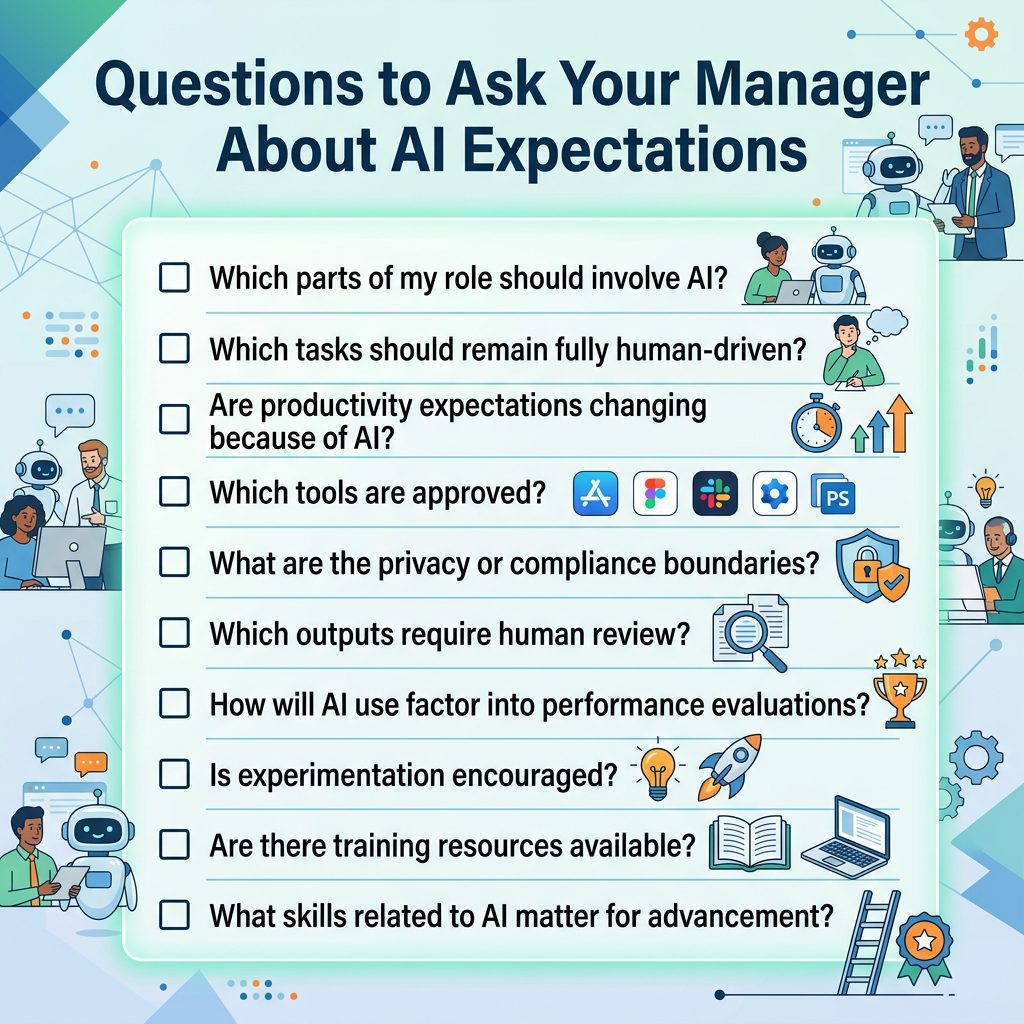
Questions to Ask Your Manager About AI Expectations in the Work Place
Use this checklist.
Practical Checklist
 Ask:
Ask:
☐ Which parts of my role should involve AI?
☐ Which tasks should remain fully human-driven?
☐ Are productivity expectations changing because of AI?
☐ Which tools are approved?
☐ What are the privacy or compliance boundaries?
☐ Which outputs require human review?
☐ How will AI use factor into performance evaluations?
☐ Is experimentation encouraged?
☐ Are there training resources available?
☐ What skills related to AI matter for advancement?
Click to Get Your Downloadable Checklist
This is not about challenging management. It is about aligning expectations.
How to Approach Required AI Use Strategically?
If your employer requires AI use, consider a four-part approach.
Learn the Rules
Understand policies, tools, and boundaries.
Start Small
Use AI in low-risk, repeatable tasks first.
Examples:
- Summaries
- Brainstorming
- Drafting
- Research support
Improve Deliberately
Treat AI use as a skill.
Practice. Test. Refine.
Focus on Human Differentiation
Do not compete with AI on speed alone.
Compete on:
- Better judgment
- Better decisions
- Better ideas
- Better relationships
That is more durable.
Common Mistakes to Avoid
Mistake 1: Using AI Without Clarifying Expectations
Assumptions create risk.
Mistake 2: Treating AI as Only a Compliance Burden
That can cause you to miss career upside.
Mistake 3: Delegating Thinking to AI
Use AI to support thinking. Do not outsource thinking.
Mistake 4: Ignoring Governance Boundaries
Speed without safeguards can create problems.
Conclusion
AI expectations in the workplace are becoming more common. That reality creates uncertainty for some professionals. It also creates opportunity. The strongest response is not passive adoption or resistance. It is intelligent engagement. Clarify expectations. Ask better questions. Experiment deliberately. Build AI literacy. Strengthen the human capabilities AI does not replace.
Action steps: 1. Ask your manager the checklist questions this week. 2. Identify one low-risk task where AI could improve your workflow. 3. Treat AI experimentation as skill-building. 4. Focus on becoming more valuable through judgment, not just faster through automation.
The professionals who benefit most from employer-required AI use may not be the earliest adopters. They may be the ones who learn how to combine AI capability with distinctly human advantage.
That is where career leverage increases!
FAQ: AI Expectations in the Workplace
Can employers require AI use?
In many organizations, employers can set expectations around tools and workflows, including AI, subject to applicable laws, policies, and industry requirements.
How should employees respond if AI use is required?
Clarify expectations, understand approved tools, start experimenting thoughtfully, and focus on using AI to increase professional value.
What if expectations are unclear?
Ask direct questions about scope, performance expectations, review requirements, and policy boundaries.
Is using AI at work a career advantage?
Often yes, especially when professionals combine AI literacy with stronger judgment, creativity, and strategic thinking.
Will AI reduce the importance of human skills?
In many cases, the opposite is true. Judgment, ethics, critical thinking, and relationship-building often become more important.
About Author:
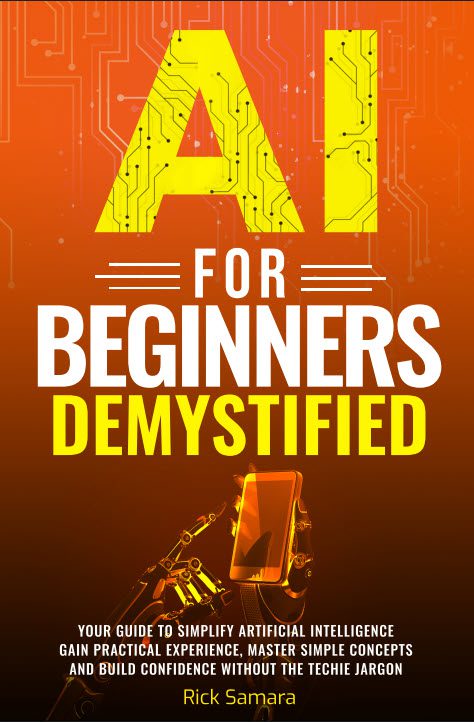
Rick Samara is a digital strategist, AI adoption analyst, and future-of-work writer focused on helping professionals and organizations navigate technological change with practical, human-centered strategies. His work covers artificial intelligence in the workplace, digital transformation, SEO, and emerging trends shaping the future of work. Through research-driven analysis and real-world examples, he helps readers turn AI disruption into career opportunity. Rick is also the author of AI for Beginners Demystified.
Further Reading
Owl Labs. (n.d.). State of hybrid work. https://owllabs.com
HRTech Edge. (n.d.). AI adoption in the workplace research. https://hrtechedge.com
McKinsey & Company. (2023). The economic potential of generative AI. https://www.mckinsey.com/capabilities/quantumblack/our-insights/the-economic-potential-of-generative-ai-the-next-productivity-frontier
Harvard Business Review. (n.d.). Artificial intelligence and the future of work. https://hbr.org
World Economic Forum. (2023). Future of Jobs Report. https://www.weforum.org/reports/the-future-of-jobs-report-2023