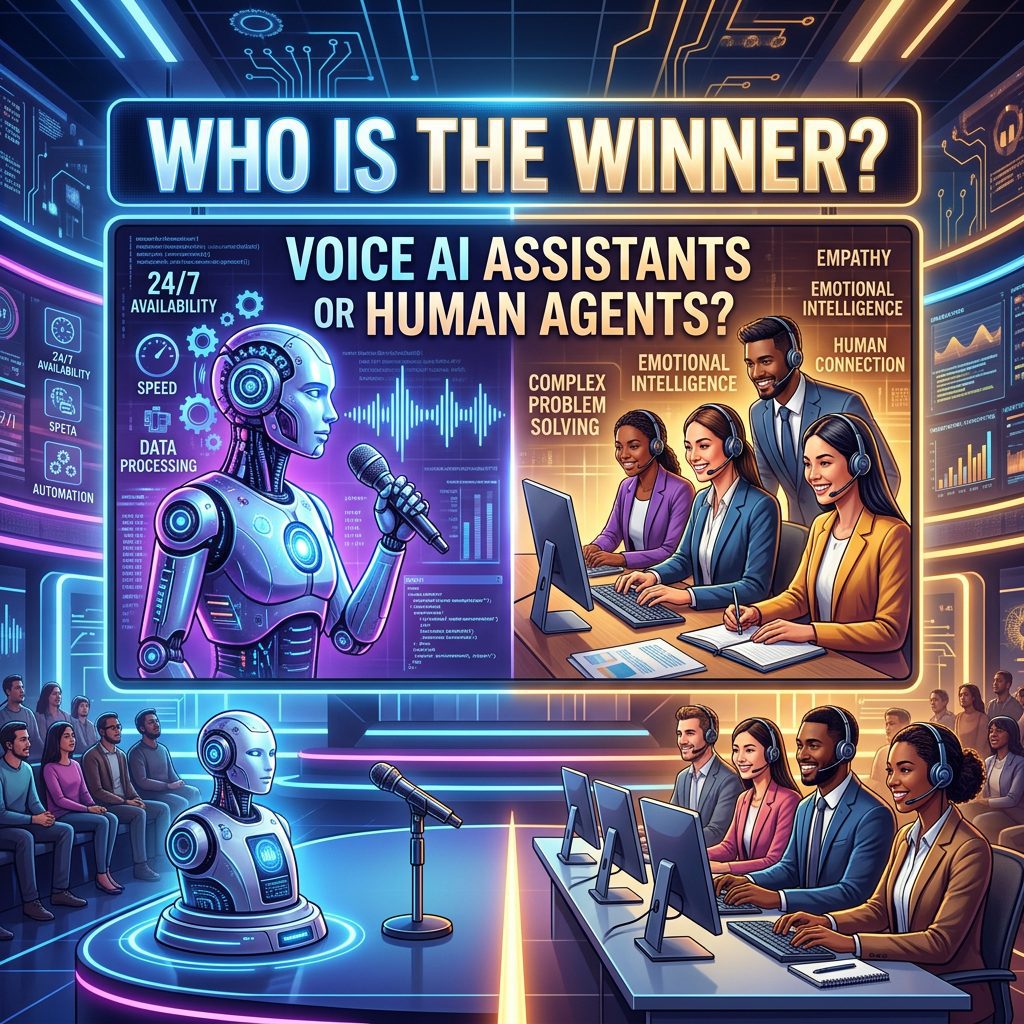
The debate between AI voice assistants and human agents is reshaping how businesses handle phone calls, support tickets, and customer questions. This article breaks it all down — no jargon, no fluff — so you can make the smartest decision for your business.
Author: Rick Samara Bio: Rick Samara is the founder of e Internet Marketing Services (EIMS), a digital marketing agency based in White Plains, Maryland. With decades of experience helping local businesses dominate their markets, Rick specializes in AI-powered marketing tools, local SEO, and customer engagement strategies that generate real revenue. He is the author of AI for Beginners Demystified. Learn more about Rick.
If you own a business, you’ve probably heard the buzz: AI voice assistants are taking over customer service. But is that actually true? And more importantly, do your customers want that?
Summary: Customers don’t actually want AI or humans — they want the right tool for the right job. AI voice assistants win on speed, availability, and cost. Human agents win on empathy, complexity, and trust. The businesses growing fastest in 2025 are using both — strategically. That’s the competitive edge you need to capture.
Is There Really a “Winner” Between AI Voice Assistants and Human Agents?
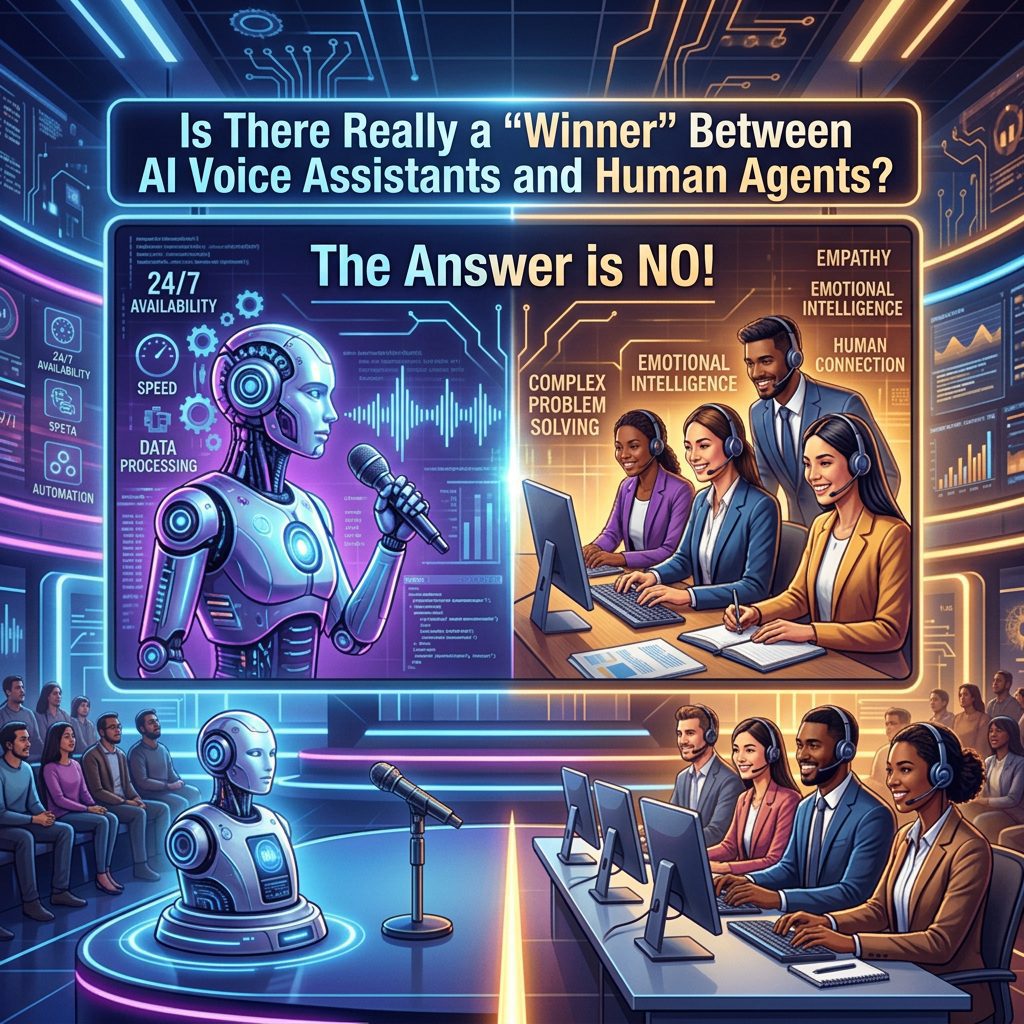 Here’s the honest answer: no — and that’s actually good news for your business.
Think of it like this: you wouldn’t use a hammer to paint your fence or a paintbrush to drive a nail. AI voice assistants and human agents are two different tools. The trick is knowing which nail you’re dealing with.
The data backs this up. According to a Cisco survey, 89% of consumers say the best support experience combines human empathy with AI efficiency (Hellorep.ai, 2025). In other words, your customers aren’t asking you to pick a side. They’re asking you to be smart about both.
What Do the Numbers Actually Say About AI Voice Assistants vs. Human Agents?
Let’s look at what the research tells us — because opinions are cheap, but data is priceless.
Where AI voice assistants win:
- Speed: 61% of new customers choose faster AI-produced responses over waiting for a human agent (Masterofcode, 2026).
- Availability: AI voice assistants never call in sick, take lunch, or sleep. They work 24/7/365 — which is exactly why tools like Voice AI Plus+ are changing the game for small businesses.
- Cost savings: Deloitte estimates AI voice tools can cut support costs by up to 30% while maintaining or improving satisfaction (Bigsur.ai, 2025).
- Scale: 75% of customer inquiries can now be resolved by AI tools without any human involvement (Masterofcode, 2026).
- Preference for simple tasks: 69% of consumers prefer AI-powered self-service tools for quick issue resolution (Masterofcode, 2026).
Where human agents still dominate:
- Complex problems: 71% of people surveyed said they’ve encountered situations where AI struggled to understand a complex issue (Nojitter, 2025).
- Emotional situations: 86% of customers say empathy and emotional connection matter more than speed (Hellorep.ai, 2025).
- Big decisions: When things go sideways — a billing dispute, a complaint, a sensitive situation — customers want a person who can listen, adapt, and actually care.
- Overall preference: 88% of people still say they prefer speaking with a human when they need support (Plivo, 2025).
Here’s the kicker: that 88% “prefer humans” stat isn’t a reason to ignore AI. It’s a reason to use AI wisely — so your human agents are free to handle the moments that actually matter.
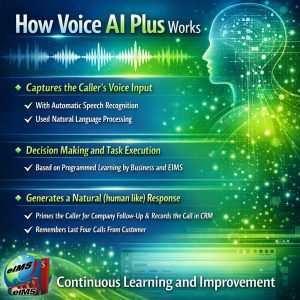
That is exactly how we tailor our Voice AI Plus service for our clients. Voice AI assistants are trained before they go to work. Every client situation is different, with different needs and requirements. So, before deploying an Voice AI assitant for a client, we work together to train the agent properly. A crucial part of this training is programming the Voice AI assistant on when to hand a conversation over to a human. We also understand that a business’s requirements change over time. So, naturally, we make changes when these requirements change.
Why Are Customers Still Skeptical of AI Voice Assistants?
Trust is the bridge between a customer and a sale. Break it, and no amount of marketing will save you.
So it’s worth understanding what makes customers nervous about AI. Here are the top friction points:
- Getting stuck in a loop — No escalation path, no human backup. Customers feel trapped.
- Inaccurate answers — 61% of people have received incorrect information from AI-powered customer service (Nojitter, 2025).
- Lack of transparency — 87% of users want to know upfront whether they’re talking to an AI or a human (Jestycrm, 2026).
- Data concerns — 28% worry about AI collecting their information without proper consent (Hiverhq, 2025).
- Accent and language barriers — 73% of users expect AI to understand regional speech patterns (Bigsur.ai, 2025) correctly.
The good news? Every single one of these problems is solvable. They’re not flaws in the concept of AI — they’re flaws in poorly designed AI deployments.
Our Voice AI assistants do not act independently without supervision. Our business clients get a CRM to support them. All conversations between their Voice AI assistant and potential or existing customers are recorded in the CRM. Therefore, any potential problem can be quickly resolved.
What Tasks Are Customers Actually Comfortable Letting AI Handle?
Not all customer interactions are created equal. Here’s a breakdown of where customers are most open to AI assistance:
- Finding information about a product or service: 39% prefer AI
- Booking an appointment: 40% preferred AI
- Making a payment: 29% prefer AI
- Completing a purchase: 26% prefer AI
- Applying for a loan: 22% prefer AI
(Masterofcode, 2026)
Notice the pattern? The more routine and transactional the task, the more comfortable customers are handing it to AI. The more money, emotion, or complexity involved, the more they want a human.
This is your roadmap.
How Should Business Owners Actually Use AI Voice Assistants?
If you’re a business owner reading this and thinking “okay, but what do I do with this information?” — here’s a practical framework.
Step 1: Audit your incoming contacts. What are your most common customer inquiries? Write them down. Be specific. “Where are you located?” is different from “Why was I charged twice?”
Step 2: Sort them into two buckets. Bucket A = routine, fast, low-emotion tasks (hours, services offered, pricing, FAQs, appointment booking, order status). Bucket B = complex, emotional, high-stakes interactions (complaints, billing disputes, cancellations you want to prevent).
Step 3: Automate Bucket A in its entirety. This is where AI voice assistants — like the Voice AI Plus+ system used by EIMS clients — shine. A well-trained AI can handle these conversations faster, more consistently, and at a fraction of the cost of a human agent or a call center.
Step 4: Empower your human agents to own Bucket B. When AI handles the volume, your team can focus on the conversations that actually build relationships — and protect revenue.
Step 5: Build in easy escalation paths. One of the most important design decisions you’ll make: make it easy for customers to say “I want to talk to a person.” Don’t trap them. Don’t make them beg. A simple “Talk to a person” option builds more trust than any AI can. This is set up in our simple programming.
Step 6: Be transparent. Tell your customers when they’re talking to AI. 87% of them want to know — and the ones who don’t mind will appreciate the honesty anyway (Jestycrm, 2026). This is easily done in the basic instructions. We walk you through the process. These are decisions that only you should make.
What Does the Hybrid Model Look Like in Practice?
The hybrid approach — AI for routine tasks, humans for complex ones — isn’t just a theory. It’s what the data says customers actually prefer.
Consider these real-world outcomes:
- A company called Nutribees used an AI customer agent and reduced human-handled support tickets by 77% while simultaneously improving customer satisfaction scores (Masterofcode, 2026).
- AI-powered call classification improves call center productivity by 1.2 hours per day, per agent (Jestycrm, 2026).
- 42% of customers say they appreciate a combination of human and AI support — not one or the other (Hiverhq, 2025).
This isn’t about replacing your team. It’s about making them more effective. Think of AI as the best assistant your human agents have ever had. It’s their assistant that handles the easy stuff so they can focus on the hard stuff.
Is the “Humans vs. AI” Debate Even the Right Question?
Honestly? No.
The businesses still asking “AI or humans?” are already behind. The businesses growing right now are asking: “How do we deploy AI so our human team can do more of what humans are actually good at?”
A plumbing company with three technicians doesn’t need to choose between a live receptionist and AI. They need a system that uses AI to answer every call, book appointments, answer FAQs, and flag emergencies — so technicians can focus on fixing pipes instead of playing phone tag.
That’s not a hypothetical. That’s exactly the kind of result EIMS has helped local businesses achieve.
How Is AI Changing the Economics of Customer Service?
Let’s talk numbers — because this is where AI gets genuinely exciting for business owners.
- Production-grade AI voice agents cost between $0.07 and $0.22 per minute to operate (Jestycrm, 2026).
Our clients have the choice of paying by the minute or going with our unlimited plan. We will discuss this with you in greater detail so you can determine the best fit for you!
- The average U.S. human customer service agent costs far more once you factor in salary, benefits, training, and turnover.
- AI agents can be deployed across hundreds of simultaneous calls without any additional cost per conversation.
- 98% of contact centers are already using AI in some form as of 2025 (Nojitter, 2025).
If your competitors are already using AI to handle volume at lower cost, and you’re not — you’re not just missing an opportunity. You’re running an inefficiency race you can’t win.
For related insights, see: AI Business Advantage: How U.S. Companies Are Using Artificial Intelligence to Outperform Competitors.
What Should You Know About Customer Trust and AI Transparency?
Trust is the currency of customer service. Here’s what the data says customers need before they’ll trust your AI:
- 73% want AI managed by humans — meaning they want oversight, not pure automation (Masterofcode, 2026).
- 68% want AI built to standard solutions — not something experimental or unpredictable.
- 87% want to know when they’re talking to AI — transparency isn’t optional anymore (Jestycrm, 2026).
- 58% of support professionals say full transparency about AI use is essential (Hiverhq, 2025).
The takeaway? Your AI voice assistant should be helpful, honest, and clearly labeled. Think of it as a staff member who introduces themselves clearly and always knows when to hand off to the boss, or a person or persons the boss asigns.
For more on AI adoption, check out: Learning AI in 2026: Stop Playing With It. Start Using It.
Key Takeaways
Here’s a quick-reference summary of everything this article covers:
- AI voice assistants are fastest and most cost-effective for routine, transactional customer interactions.
- Human agents are still essential for complex, emotional, and high-stakes conversations.
- 88% of customers say they prefer humans for support — but 89% say the best experience combines AI and human elements.
- The winning strategy is a hybrid model with clear escalation paths and full transparency.
- AI voice agents can cut support costs by up to 30% while maintaining satisfaction.
- Transparency and easy human escalation are the two non-negotiables for any AI deployment.
- Your competitors are already using AI — the question is whether you’ll use it strategically.
Frequently Asked Questions
Q: Will AI voice assistants replace human customer service agents? A: Unlikely — at least not entirely. AI is excellent at handling high-volume, routine queries, but 87% of executives believe AI will augment jobs rather than replace them (Plivo, 2025). The future is a hybrid model where AI handles volume and humans handle complexity.
Q: What percentage of customers prefer AI over humans for customer service? A: It depends heavily on the task. For simple tasks like delivery tracking, up to 49% prefer AI. For general support, 88% still prefer humans (Plivo, 2025). The key is matching the right tool to the right task.
Q: How much can AI reduce customer service costs? A: Deloitte estimates AI voice tools can reduce support costs by up to 30% (Bigsur.ai, 2025), while some companies have reduced human-handled tickets by as much as 77% (Masterofcode, 2026).
Q: Do customers want to know when they’re talking to an AI? A: Yes — overwhelmingly. 87% of users say they want to know whether they are interacting with AI or a human (Jestycrm, 2026). Transparency isn’t just ethical; it’s what customers expect.
Q: What’s the best way for a small business to start using AI in customer service? A: Start with your highest-volume, simplest customer interactions — hours of operation, pricing, appointment booking, FAQs. Automate those with an AI voice assistant, build in a clear path to speak with a human, and use the data to improve over time.
Q: How do AI voice assistants affect customer satisfaction? A: When deployed correctly, they improve it. Businesses using well-designed AI voice tools have seen higher customer satisfaction scores alongside lower costs. The key phrase is “well-designed” — poorly trained AI or no escalation path actively hurts satisfaction.
Q: Is it expensive to set up an AI voice assistant for a small business? A: It’s more affordable than most business owners expect. Production-grade AI voice agents operate at roughly $0.07 to $0.22 per minute (Jestycrm, 2026), which is a fraction of the cost of a full-time employee. Contact EIMS to learn about options suited to small businesses.
Further Reading
The following sources informed this article and are recommended for deeper exploration:
Bigsur.ai. (2025). Voice AI statistics for 2025: Adoption, accuracy, and growth trends. https://bigsur.ai/blog/voice-ai-statistics
Hellorep.ai. (2025). The future of AI in ecommerce: 40+ statistics on conversational AI agents for 2025. https://www.hellorep.ai/blog/the-future-of-ai-in-ecommerce-40-statistics-on-conversational-ai-agents-for-2025
Hiverhq. (2025). AI vs human in customer service: What our 2025 report reveals. https://hiverhq.com/blog/ai-vs-human-in-customer-service
Jestycrm. (2026). The ultimate voice agents-related statistics (2026). https://jestycrm.com/blog/voice-agents-related-statistics
Masterofcode. (2026). AI in customer service statistics [2026]. https://masterofcode.com/blog/ai-in-customer-service-statistics
Nojitter. (2025). Surveys say: People prefer talking to people. https://www.nojitter.com/contact-centers/surveys-say-people-prefer-talking-to-people
Plivo. (2025). AI agents: Top statistics you need to know in 2025. https://www.plivo.com/blog/ai-agents-top-statistics/
Verloop.io. (2025). 30+ voice AI stats for 2025. https://www.verloop.io/blog/voice-ai-statistics/
Internal Resources from e Internet Marketing Services
- Voice AI Plus+ — Never Miss a Call Again
- AI Business Advantage: How U.S. Companies Are Using AI to Outperform Competitors
- Learning AI in 2026: Stop Playing With It. Start Using It.
- AI Statistics 2026 Report: Verified Numbers and Trends
- Our Services
- Schedule a Free Consultation
© 2025 e Internet Marketing Services. All rights reserved. Regent Court, White Plains, MD 20695 | (301) 923-4333