 Understanding these trends matters not just to technology leaders but also to professionals, entrepreneurs, policymakers, and consumers. The numbers behind AI adoption and spending offer a clear picture of where the world is heading, and help individuals and organizations make informed decisions about how to prepare for an increasingly AI-driven future. Artificial intelligence is no longer a niche technology discussed only by researchers and software engineers. It is rapidly becoming a foundational force shaping business, the economy, and everyday life.
This AI statistics 2026 report compiles verified artificial intelligence numbers from reputable research and analyst sources. Every statistic below is tied to a published reference. If a commonly repeated claim cannot be verified reliably, it is not included.
Use these AI statistics 2026 insights to inform planning, budgeting, and practical adoption decisions—especially if you run a small business or lead a team.
Key AI Statistics 2026 (Verified)
- Worldwide AI spending is forecast to total $2.52 trillion in 2026 (Gartner). Read Gartner’s 2026 AI spending forecast
- Worldwide generative AI spending is forecast to reach $644 billion in 2025, up 76.4% from 2024 (Gartner). Read Gartner’s generative AI spending forecast
- 78% of organizations reported using AI in 2024, up from 55% the year before (Stanford AI Index 2025 highlight). Read the Stanford AI Index 2025 report
- 65% of respondents said their organizations regularly use generative AI (McKinsey, early 2024). Read McKinsey’s State of AI (early 2024)
- 62% of respondents said their organizations are at least experimenting with AI agents (McKinsey, 2025). Read McKinsey’s State of AI (2025)
AI Spending Statistics (2026)
Worldwide AI Spending Forecast
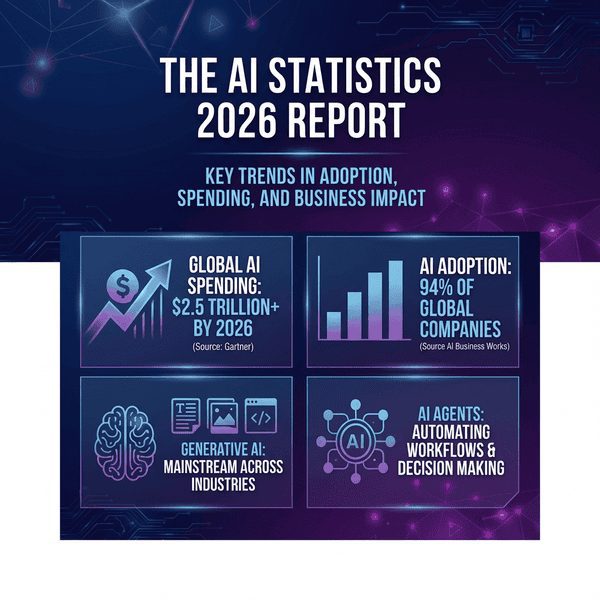
One of the most important AI statistics 2026 benchmarks is forecast spending. Gartner forecasts worldwide spending on AI will total $2.52 trillion in 2026, representing 44% year-over-year growth.
Source: Gartner press release on 2026 worldwide AI spending
 Generative AI Spending Momentum (Leading Indicator)
While this report centers on AI statistics 2026, generative AI spending in 2025 is a key lead indicator. Gartner forecasts worldwide generative AI spending will reach $644 billion in 2025, up 76.4% from 2024.
Source: Gartner press release on 2025 generative AI spending
AI Adoption Statistics
AI Use Is Becoming Mainstream
Stanford’s AI Index (2025 report highlight) states that 78% of organizations reported using AI in 2024, up from 55% the year before. This is one of the clearest AI statistics 2026 signals: AI adoption is moving from “early” to “expected.”
Source: Stanford HAI — AI Index 2025
Generative AI Usage (Survey-Based)
McKinsey’s State of AI (early 2024) reports 65% of respondents say their organizations regularly use generative AI. That figure is widely cited because it reflects regular use, not merely “testing.”
Source: McKinsey — The state of AI in early 2024
McKinsey’s 2025 State of AI adds a critical nuance relevant to AI statistics 2026: nearly two-thirds of respondents say their organizations have not yet begun scaling AI across the enterprise. In other words, usage is widespread, but scaling and repeatable ROI are still uneven.
Source: McKinsey — The state of AI in 2025
AI Investment Statistics
Investment levels often predict which capabilities will become easier, cheaper, and more widely available. Stanford AI Index 2025 highlights include:
- $33.9 billion in global private investment in generative AI, up 18.7% from 2023.
- U.S. private AI investment reached $109.1 billion in 2024, compared with $9.3 billion in China and $4.5 billion in the U.K.
Source: Stanford HAI — AI Index 2025
These AI statistics 2026 indicators matter because investment shapes the tooling landscape that small businesses eventually use: simpler interfaces, more integrations, and more AI embedded in everyday software.
AI Agents and “Agentic AI” Statistics
Experimentation and Scaling
AI agents (often called “agentic AI”) are a major theme in current AI roadmaps. McKinsey’s 2025 survey reports:
- 62% of respondents say their organizations are at least experimenting with AI agents.
- 23% report their organizations are scaling an agentic AI system somewhere in the enterprise (with an additional 39% experimenting).
Source: McKinsey — The state of AI in 2025
Risk and Forecast Signals (Gartner via Reuters)
When interpreting AI statistics 2026, it’s also important to track “friction” indicators—where projects fail or stall. Reuters reported on Gartner research stating:
- More than 40% of agentic AI projects are expected to be canceled by the end of 2027 due to cost and unclear business value.
- Gartner predicts 15% of day-to-day work decisions will be made autonomously through agentic AI by 2028.
- Gartner also predicts 33% of enterprise software will include agentic AI by 2028.
Source: Reuters report referencing Gartner agentic AI projections
For leaders using this AI statistics 2026 report, the takeaway is balanced: agents are gaining attention, but success depends on clear use cases, tight scope, and integration into real workflows.
What These AI Statistics Mean for Small Businesses
Even when the biggest AI statistics 2026 come from global surveys and enterprise forecasts, small businesses can apply the lessons quickly:
- Assume competitors are adopting. Adoption is trending toward baseline business behavior. Stanford AI Index 2025
- Budgets suggest permanence. Trillion-dollar forecasts signal AI is becoming core infrastructure. Gartner AI spending forecast
- Scaling is the real advantage. Many organizations use AI, but fewer scale it. The winners build repeatable workflows. McKinsey State of AI 2025
- Be selective with agents. Use-case clarity matters as much as tech capability. Reuters (Gartner agentic AI projections)
Conclusion
The insights in this AI Statistics 2026 Report highlight an important reality: artificial intelligence is no longer a distant innovation—it is a present-day force shaping how businesses operate, how professionals work, and how society interacts with technology. For small business owners, these statistics demonstrate that AI is becoming a competitive necessity. As adoption grows and tools become more accessible, entrepreneurs who understand and experiment with AI can improve efficiency, reduce operational costs, and better serve their customers.
For the general public, the data illustrates how deeply AI is being integrated into everyday life—from customer service systems to personalized recommendations and workplace productivity tools. Understanding these trends helps individuals become more informed users of technology and better prepared for changes in the job market and digital economy.
Anyone with an interest in artificial intelligence can use these statistics as a reliable snapshot of where the technology stands today and where it is heading next. Verified data provides clarity in a field often filled with hype and speculation. By focusing on credible numbers and research, this report offers a grounded perspective on the scale, speed, and impact of AI adoption—helping readers understand not only what is happening now, but also why artificial intelligence will continue to shape business, innovation, and society in the years ahead.
Further Reading (Sources)
- Gartner (Jan 15, 2026): Worldwide AI spending forecast ($2.52T in 2026) —
Gartner press release on 2026 AI spending - Gartner (Mar 31, 2025): Worldwide generative AI spending forecast ($644B in 2025, +76.4%) —
Gartner press release on 2025 genAI spending - Stanford HAI (AI Index 2025): Adoption and investment statistics —
Stanford AI Index 2025 report - McKinsey (May 30, 2024): “The state of AI in early 2024” (regular generative AI use) —
McKinsey State of AI (early 2024) - McKinsey (Nov 5, 2025): “The state of AI in 2025” (agents experimentation and scaling) —
McKinsey State of AI (2025) - Reuters (Jun 25, 2025): Gartner agentic AI projections and cancellation expectations —
Reuters coverage of Gartner agentic AI projections