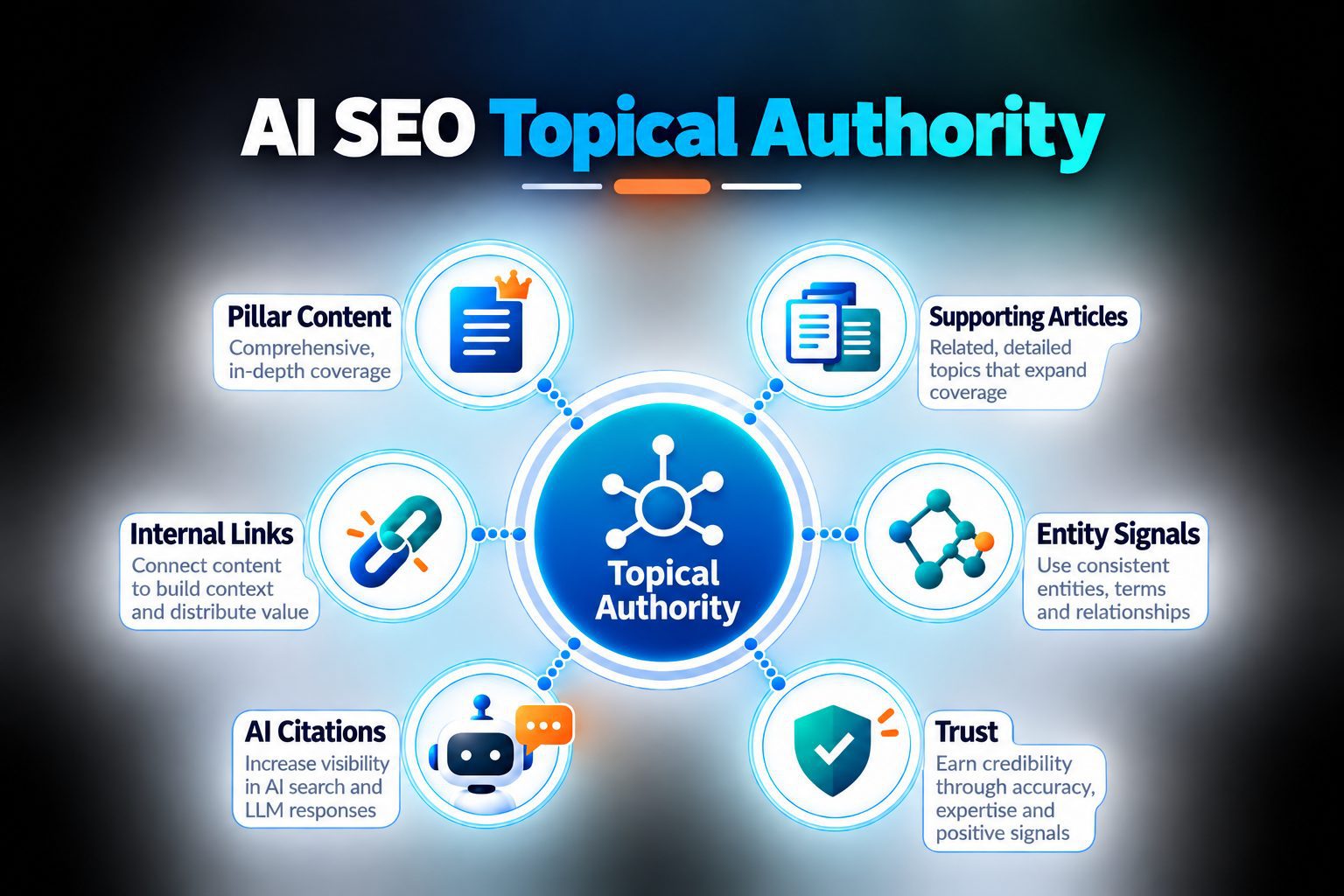
AI SEO topical authority helps Google and AI search systems understand what a business knows, what topics it consistently covers, and why its content may be useful to searchers. Instead of relying on isolated blog posts, an AI SEO agency builds connected content clusters around core subjects, supported by internal links, strong business and author entities, structured information, and credible external signals. This article explains how topical authority works, why it matters for both traditional and AI-powered search, and how businesses can build it through pillar pages, supporting articles, clear site architecture, and content that answers real customer questions.
Getting found online used to be largely about ranking individual web pages for individual keywords. That approach still matters, but search has become considerably more sophisticated. Google wants to understand whether a website actually knows its subject. AI systems such as ChatGPT, Gemini, Perplexity, and AI-powered search experiences also need enough information to determine what a business is about, what it knows, and whether its content deserves to be referenced.
That is where AI SEO topical authority becomes important.
Topical authority is built when a website covers an important subject thoroughly, connects related information logically, and provides enough consistent evidence for search engines and AI systems to understand its expertise. An AI SEO agency therefore does not simply ask:
“What keyword should we rank for?”
It also asks:
“What does this business need to demonstrate that it genuinely understands this subject?”
That is a much bigger question. That’s exactly the challenge you face if you want your business cited in AI Search. At E-Internet Marketing Services, topical authority is part of our broader Six-Layer AI SEO approach, which is designed to help businesses become easier for both traditional search engines and AI systems to discover and understand.
What Is AI SEO Topical Authority?
AI SEO topical authority is the process of building a connected body of useful content that demonstrates a website’s knowledge, relevance, and experience around a specific subject to both traditional search engines and AI-powered search systems.
Think of it as the difference between writing one good article about a subject and building a small reference library about it. Let me provide an example. Suppose an accountant publishes one article titled “Small Business Tax Tips.” That article might be useful.
But another accounting firm publishes detailed resources covering:
- small-business tax deductions,
- estimated tax payments,
- payroll taxes,
- business entity selection,
- record keeping,
- tax planning,
- IRS notices,
- quarterly filing requirements,
- common tax mistakes,
- and industry-specific tax questions.
Those pages link to one another naturally and are written by identifiable professionals associated with the accounting firm. Which website gives a search engine more evidence that it understands small-business taxation? Usually, the second one. Topical authority grows from the relationship between useful pieces of information, not merely from publishing more pages.
Google and AI Search Need Context
A search engine does not see a website exactly as a human visitor does.
It looks for relationships.
- What is this page about?
- What is the overall website about?
- Who created the information?
- What business or organization stands behind it?
- What other pages support the subject? You might notice this article links to other similar pages.
- What outside sources corroborate these relationships?
Modern AI search adds another consideration: Can the information be extracted easily enough to answer a user’s question? This is why topical authority and AI SEO fit together so naturally. A well-built topical cluster provides context repeatedly without simply repeating the same article twenty different ways. The objective is coverage, not duplication.
 Start With a Strong Pillar Page
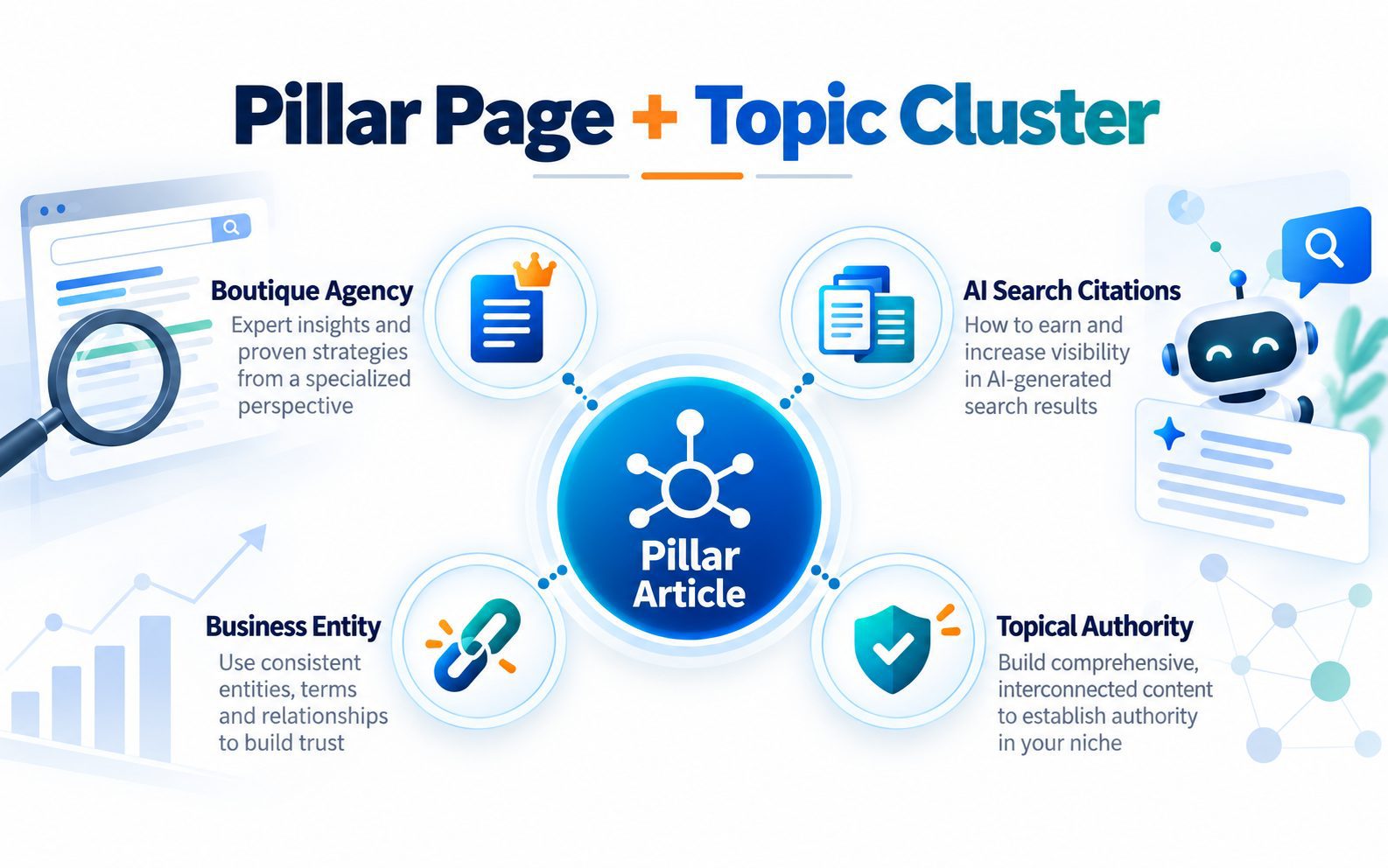
One of the simplest ways to build topical authority is through a pillar-and-cluster structure. A pillar page covers a broad subject comprehensively. Supporting articles then explore important subtopics in greater depth. For example, our own AI SEO Agency: A Comprehensive Tutorial to Getting Found in Google and AI Search serves as the primary resource for our AI SEO topic.
This article, the one you are reading, is designed to support that broader subject by examining one specific component: topical authority.
That relationship matters. The pillar establishes the broad subject. The supporting content provides depth.
Internal links connect the two.
Over time, that creates a web of related information rather than a collection of isolated blog posts.
Build Supporting Content Around Real Questions
A content cluster should not be created simply because a keyword tool produced 150 phrases. That is how websites end up with articles such as:
- “Best AI SEO”
- “Top AI SEO”
- “AI SEO Services”
- “AI SEO Services Near Me”
- “Best AI SEO Services Near Me”
Technically, those are different keyword combinations. To a human reader, they are largely the same question wearing different hats. A better approach is to identify the different questions a prospective customer genuinely needs answered.
For an AI SEO agency, that could include subjects such as:
- How does AI SEO differ from conventional SEO?
- How do AI search engines choose sources?
- How does a business establish itself as an entity?
- How does structured data help machines understand a company?
- What role does topical authority play?
- How can a business measure visibility in AI-generated answers?
- What is the difference between a boutique agency and a large national SEO firm?
Each question fills a different information gap.
That is what creates depth.
Establish the Business Behind the Content
A website cannot build meaningful authority solely by publishing words. Search systems also need to understand who is responsible for those words. That makes entity establishment an important part of AI SEO topical authority. A business entity includes identifiable facts and relationships such as:
Business → services → location → founders → authors → expertise → website → third-party references
For example:
E-Internet Marketing Services → AI SEO → Rick Samara → EIMS website
Those connections help machines interpret what they encounter. Our article Foundation of AI Search: Establishing a Business Entity explores this concept in greater detail. This is an important distinction because topical authority is not simply about saying, “We are experts.” Anyone can type that sentence. AI SEO topical authority becomes more credible when multiple pages, authors, structured data, business profiles, citations, and independent sources consistently support the same relationships.
Use Internal Links to Explain Relationships
Internal linking is sometimes treated as housekeeping.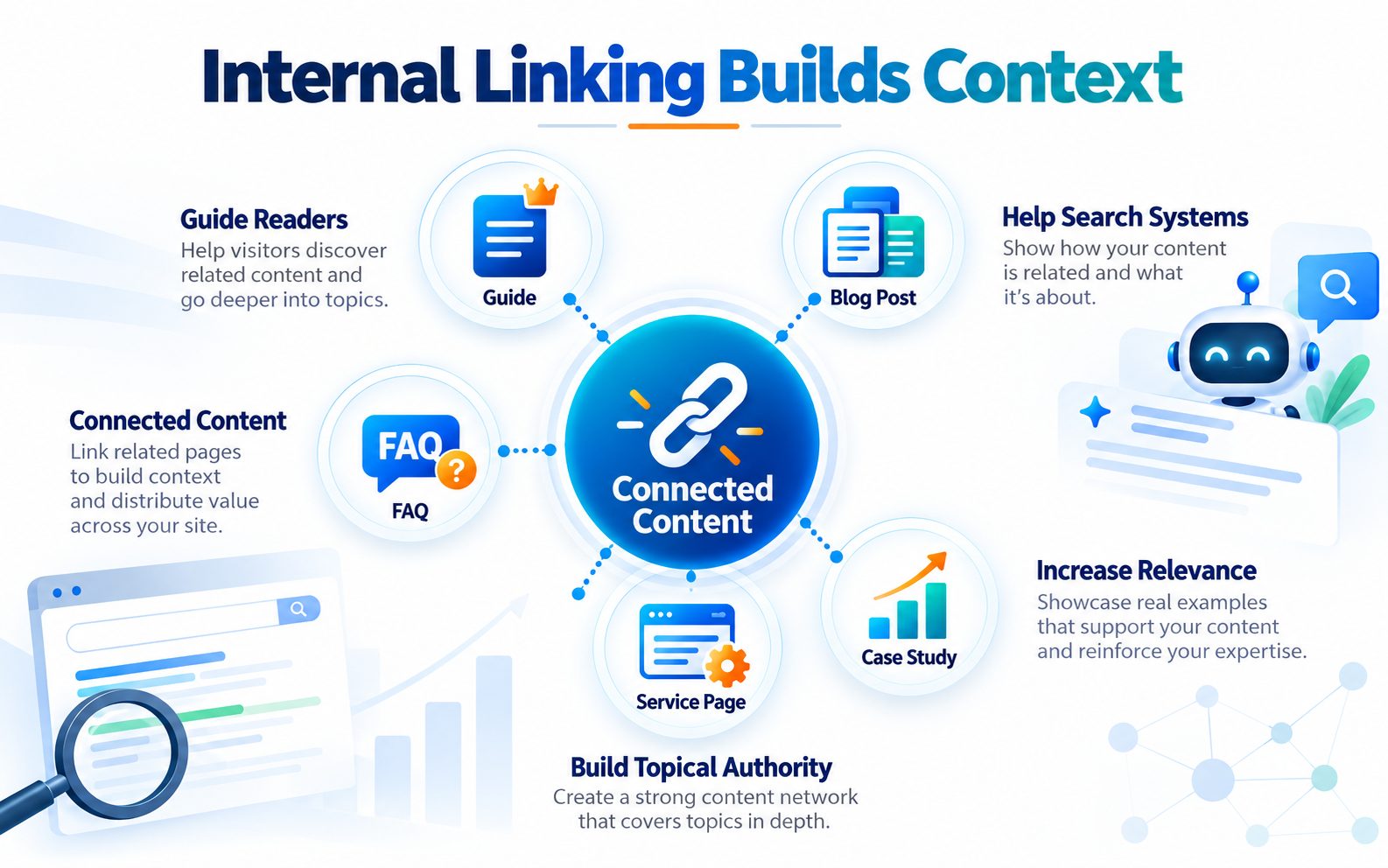
It should be treated as architecture. A good internal link helps a visitor, and potentially a machine, understand how two pieces of information relate.
For example, someone reading about topical authority may naturally want to know how AI systems eventually decide which sources deserve to be referenced.
That is where our guide to AI Search Citations: How Do AI Search Engines Decide Which Sources and Businesses to Cite? becomes relevant.
That link exists for a reason. It is not inserted merely because an SEO plugin says the page needs three internal links. Build linking into your content workflow so every new article links to relevant existing content and is linked from related pages already published.
Effective internal linking creates pathways between concepts. A strong topical cluster frequently follows a pattern such as:
Pillar → Supporting Topic → Related Supporting Topic → Pillar
This helps prevent valuable articles from becoming isolated islands buried somewhere in the blog archive.
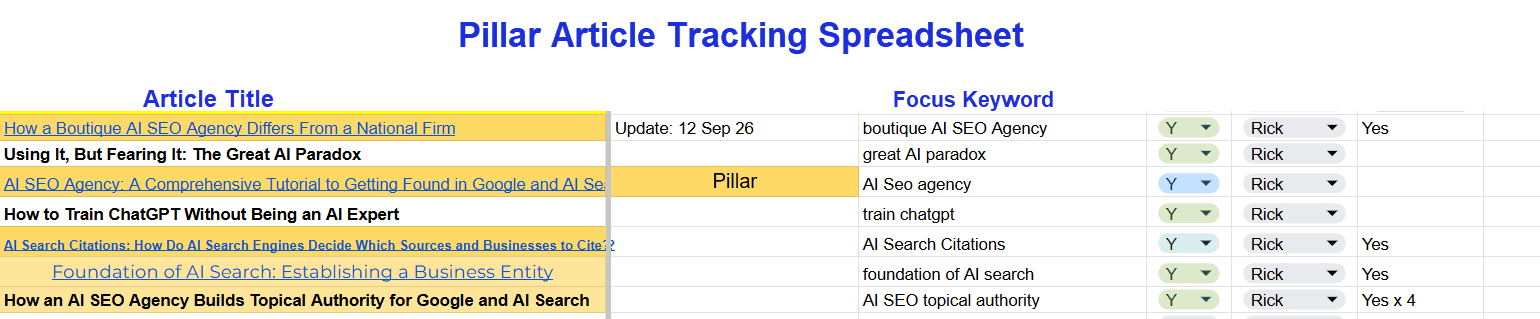
So, how do you track your pillar article and your supporting articles or cluster? Trust me, this can become very confusing if you don’t have a tracking system. I’ve provided a segment of a Google spreadsheet to show you how we do it. This is a rought example, but it serves a purpose. We color code our article cluster. In this case, we used orange. All orange articles are part of our cluster. The pillar article is identified in the second column. So we have our pillar article supported by four articles. Note that our focus keyword is included in article title. In the far right column, we use “Yes” once we have our internal linking finished.
Cover the Topic From Different Angles
AI SEO topical authority also benefits from different perspectives on the same broader subject. For instance, not every discussion about AI SEO needs to be technical. A business owner selecting an agency may care just as much about communication, accessibility, specialization, and who will actually perform the work. That is why How a Boutique AI SEO Agency Differs From a National Firm belongs within the same broader cluster.
It addresses a different part of the customer’s decision process. The underlying subject remains AI SEO, but the search intent has changed.
That is exactly what a useful cluster should do. It follows the customer’s questions rather than forcing every visitor into the same article.
Make the Content Easy for AI Systems to Extract
AI SEO topical authority alone does not guarantee visibility in AI-generated answers. Information also needs to be understandable. That means using content structures that make important ideas easy to locate.
For example:
Use descriptive headings
“How Internal Linking Supports Topical Authority” tells a reader far more than a heading such as “Another Important Factor.”
Answer important questions directly.
If the heading asks “What Is Topical Authority?” provide a concise answer immediately before expanding on it.
Define specialized terms
Do not assume that a small-business owner knows what entity optimization, GEO, schema markup, retrieval, or LLM citation means.
Use lists when lists make sense.
Steps, components, comparisons, and checklists become easier to scan.
Keep paragraphs focused
A paragraph that tries to explain five concepts at once is hard for humans to read and hard for machines to interpret cleanly. None of this requires writing robotic content. Quite the opposite. Good AI-readable content is usually good human-readable content. Imagine that.
AI SEO Topical Authority Is Not a Content-Volume Contest
One of the easiest mistakes in SEO is assuming that more content automatically means more authority. It does not. Twenty weak articles do not necessarily outperform five exceptional ones. A website can actually weaken its content architecture by producing large numbers of overlapping pages.
Before publishing another article, ask:
Does this page answer a question we have not answered well elsewhere?
If yes, it may strengthen the cluster. If the answer is no, improving an existing article might be the better move. An AI SEO agency should therefore look for coverage gaps, not merely publication opportunities.
Connect Topical Authority With Outside Evidence
Everything we have discussed so far happens primarily on the company’s own website. But there is another layer. A business saying something about itself is useful. Independent sources confirming it can be more meaningful for AI SEO topical authority.
This might include:
- reputable business directories,
- industry publications,
- professional profiles,
- interviews,
- podcasts,
- review platforms,
- association listings,
- local business information,
- author profiles,
- and legitimate editorial mentions.
These signals can help reinforce the entities and topics associated with a business. For AI search in particular, the objective eventually extends beyond ranking. A business wants systems to be able to determine:
- Who are you?
- What do you specialize in?
- What information have you published?
- Can those claims be corroborated elsewhere?
- Is your content useful for answering this particular question?
That is a considerably richer picture than keyword density.
How do You Build AI SEO Topical Authority?
A practical AI SEO topical authority strategy can be summarized in seven steps:
- Define the primary business topics. Determine what the business genuinely wants to become known for.
- Create a substantial pillar resource. Cover the broad subject clearly and comprehensively.
- Identify unanswered subtopics. Use actual customer questions, search intent, search data, and competitive research.
- Publish focused supporting content. Give each important question enough space to be answered properly.
- Connect related pages with meaningful internal links. Make the relationship between subjects obvious rather than random.
- Strengthen the entities behind the information. Connect authors, organizations, services, locations, and relevant third-party sources.
- Measure both traditional and AI visibility. Rankings remain useful, but businesses should increasingly watch whether their brand and content appear in AI-generated answers and citations.
The result is not simply a larger website. It is a more understandable one.
Can Topical Authority Help a Business Get Cited by AI?
Potentially, yes. But topical authority should not be presented as a magic switch that causes ChatGPT, Gemini, Perplexity, or another system to cite a website. AI citation decisions can depend on many factors, including the system being used, the question being asked, available source material, retrieval methods, authority signals, freshness, accessibility, and how clearly the information answers the query.
AI SEO Topical authority helps by giving these systems more useful context and more relevant material. It increases the strength of the information environment around the business. That is different from guaranteeing a citation.
Anyone guaranteeing an AI citation may also offer a bridge at a remarkably attractive price.
Topical Authority Is One Part of a Larger AI SEO Strategy
Businesses should not treat topical authority as an isolated SEO tactic. It works best when combined with strong entity signals, technically accessible pages, structured content, trustworthy authorship, internal linking, external corroboration, and ongoing measurement. That is why EIMS treats topical authority as part of a broader AI SEO framework rather than as a stand-alone trick.
Our complete guide, AI SEO Agency: A Comprehensive Tutorial to Getting Found in Google and AI Search, explains how these elements work together.
Search is evolving from simply matching keywords toward understanding topics, entities, relationships, and answers.
A website should evolve with it. The goal of AI SEO topical authority is not to convince a search engine that your business knows everything. It is to make the subjects you genuinely know clear, connected, useful, and difficult to misunderstand.
Frequently Asked Questions About AI SEO Topical Authority
What is AI SEO topical authority?
AI SEO topical authority is the process of developing interconnected, useful content around a defined subject so that search engines and AI systems have stronger evidence of a website’s relevance and expertise.
How many articles does a topical cluster need?
There is no required number. The right number depends on the subject’s complexity and the questions users need answered. A small, focused cluster of strong resources can be more valuable than dozens of repetitive articles.
Are internal links important for topical authority?
Yes. Internal links help users navigate related information and help establish relationships between pages and subjects across a website.
Does topical authority guarantee AI citations?
No. Topical authority may strengthen a website’s relevance and provide AI systems with useful source material. Still, no legitimate SEO strategy can guarantee that a particular AI system will cite a page.
Is topical authority the same as backlinks?
No. Backlinks involve links from other websites. Topical authority primarily concerns the depth, quality, organization, and relationships among information associated with a subject. External references can reinforce that authority, but they are not the same thing.
Does a small business need topical authority?
Yes, but it does not need to cover an enormous subject. A local business can build authority around a tightly defined combination of its services, expertise, customers, and geographic market.
About the Author
 Rick Samara is the founder of E-Internet Marketing Services (EIMS), a Southern Maryland digital marketing agency serving clients across the United States through video conferencing. He has worked in local search since the Google Places era, when EIMS helped a local attorney earn a top position in what was then the Google 7-Pack. Since then, he has watched local listing data break, propagate, and get corrected for close to two decades.
Rick is also the author of AI for Beginners Demystified. Before founding EIMS, he served as a U.S. Air Force Intelligence Analyst. That background still shapes how he approaches AI search: verify the source, reconcile contradictions, and never trust a record simply because it sounds confident.
Further Reading
For readers who want to go deeper into topical authority, content quality, credibility, and how modern search engines evaluate information, these resources are useful starting points:
Google. (n.d.). Creating helpful, reliable, people-first content. Google Search Central. https://developers.google.com/search/docs/fundamentals/creating-helpful-content
Google. (2022, December 15). Our latest update to the quality rater guidelines: E-A-T gets an extra E for Experience. Google Search Central Blog. https://developers.google.com/search/blog/2022/12/google-raters-guidelines-e-e-a-t
Google. (n.d.). Google Search appearance. Google Search Central. This resource includes guidance on structured data and other methods Google uses to understand better and present website content. https://developers.google.com/search/docs/appearance
Microsoft. (2025). How Bing delivers search results. Microsoft Support. This overview explains how Bing considers relevance, quality, credibility, authority, freshness, and other signals when returning search results. https://support.microsoft.com/en-us/bing/how-bing-delivers-search-results
Microsoft. (n.d.). Search and writing. Microsoft Style Guide. This guide discusses keyword use, descriptive link text, cross-referencing, and authoritative backlinks as part of creating useful searchable content. https://learn.microsoft.com/en-us/style-guide/search-writing