| SUMMARY: Traditional SEO is not dead — it got a promotion. AI-powered search engines like ChatGPT, Google AI Overviews, and Perplexity are now answering questions directly, which means small businesses need to do more than rank on a page. They need to be cited by AI. The good news: the same trusted content, consistent business information, and genuine expertise that won in traditional SEO are exactly what AI search rewards. |
You’ve probably heard the rumors. SEO is dead. Google is dying. AI is taking over and everything you’ve done to get your business found online is suddenly worthless.
Let’s pump the brakes.
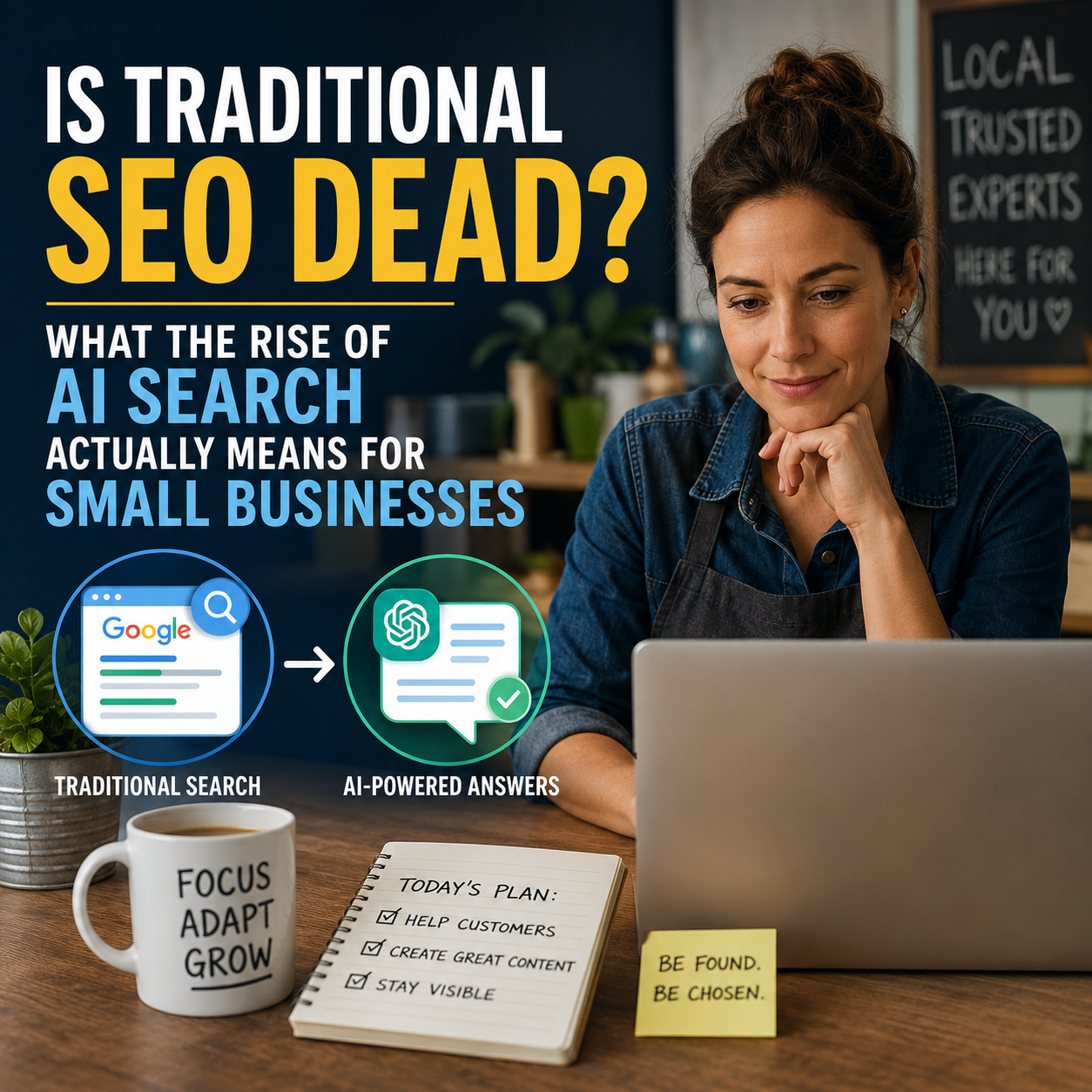
If you’re a small business owner who’s heard a lot about AI lately but aren’t sure what it actually means for your marketing, this article is for you. No jargon. No doom and gloom. Just a straight answer to the question everyone seems to be asking: Is traditional SEO dead?
Short answer: No. But it has changed — and knowing how it’s changed could be the difference between your business showing up when customers search and being completely invisible. Our clients who have allowed us to properly SEO their website are well-positioned for AI Seach.
What Is Traditional SEO, Anyway?
Before we declare anything dead, let’s make sure we’re talking about the same thing.
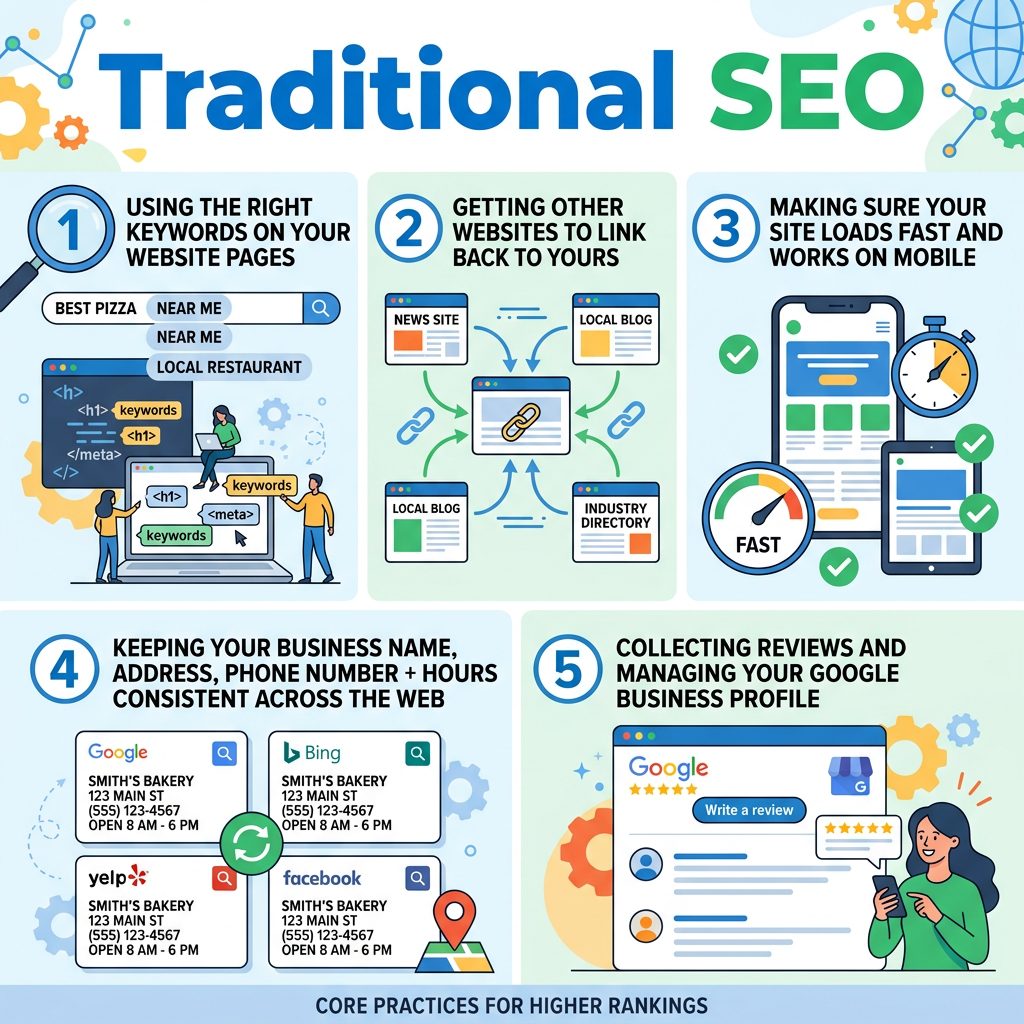 Traditional SEO (Search Engine Optimization) is the practice of making your website and online presence show up when people search on Google. It involves things like:
- Using the right keywords on your website pages
- Getting other websites to link back to yours
- Making sure your site loads fast and works on mobile
- Keeping your business name, address, and phone number consistent across the web
- Collecting reviews and managing your Google Business Profile
Some of our clients need a refresher on their Google Business Profile. Google has a feature that adds new services. These service descriptions need to be optimized. For our clients who have enrolled in our AI Google Business Profile Management service, nothing needs to be done. This AI service does this automatically. For those who have not, this process must be done manually. This is an ongoing process.
Think of traditional SEO like getting your business listed in the right section of the phone book — but instead of a phone book, it’s Google’s search results. The goal has always been simple: show up when someone nearby searches for what you sell.
For local businesses especially, this has meant fighting for a spot in what’s called the Google 3-Pack — those three business listings that appear at the very top of local search results with a map. That’s prime digital real estate.
What Is AI Search and Why Is Everyone Talking About It?
Here’s where things get interesting.
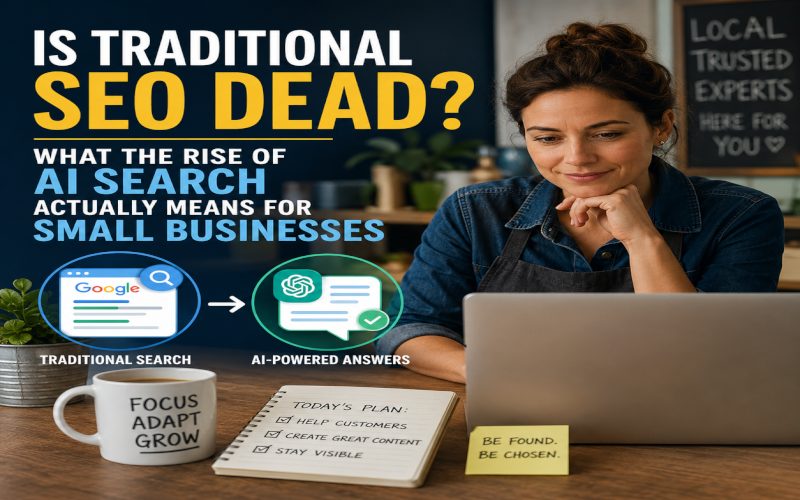
Over the past couple of years, a new kind of search has emerged. Instead of showing you a list of links and letting you click through them, AI-powered tools like ChatGPT, Google’s AI Overviews, and Perplexity AI answer your question directly — right there on the screen.
Imagine asking Google “What’s the best plumber near me?” and instead of ten blue links, you get a paragraph that says: “Based on reviews and online presence, here are three local plumbers worth calling.” And it names specific businesses.
That’s AI search in action. And it’s becoming more common every single day.
| Here’s the key shift: In traditional SEO, the goal was to get people to click on your website. In AI search, the goal is to get the AI to mention your business in its answer — even before anyone clicks anything. |
This is called being “cited” by an AI. And it’s the new frontier of online visibility for small businesses.
Is Traditional SEO Dead, or Just Evolving?
Let’s settle this once and for all: traditional SEO is not dead. But it has evolved into something bigger.
Think of it this way. Traditional SEO is like getting your business into the library. Good SEO means your “book” is on the shelf, organized, and findable. That still matters. It will always matter.
But AI search adds a new layer: now you also need the librarian to recommend your book every time someone walks in with a question. That’s what AI citation is — being the source the AI trusts enough to mention by name.
What Has Actually Changed?
- Zero-click searches are rising. More people are getting answers without ever visiting a website.
- AI tools are pulling from trusted, well-structured sources — not just whoever ranked #1 on Google.
- Voice search is growing. People ask questions out loud to Siri, Alexa, and Google Assistant — and those assistants pull from AI-curated answers.
- The businesses that get cited by AI are earning brand awareness even when no one clicks.
The fundamentals of SEO — quality content, consistent business information, genuine expertise, strong reviews — haven’t changed. They’ve become more important. The difference is that now those same fundamentals are being evaluated by AI engines, not just Google’s traditional algorithm.
What Does This Mean for Your Small Business?
Here’s the practical reality for a small business owner in 2026.
If you’ve been doing solid local SEO — keeping your Google Business Profile updated, collecting reviews, maintaining consistent business information across directories — you’re already doing a lot of what AI search engines reward.
But if you’ve been ignoring your online presence, or if your last “SEO update” was five years ago, you may already be invisible to AI search. And that gap is only going to widen.
Two Scenarios Playing Out Right Now
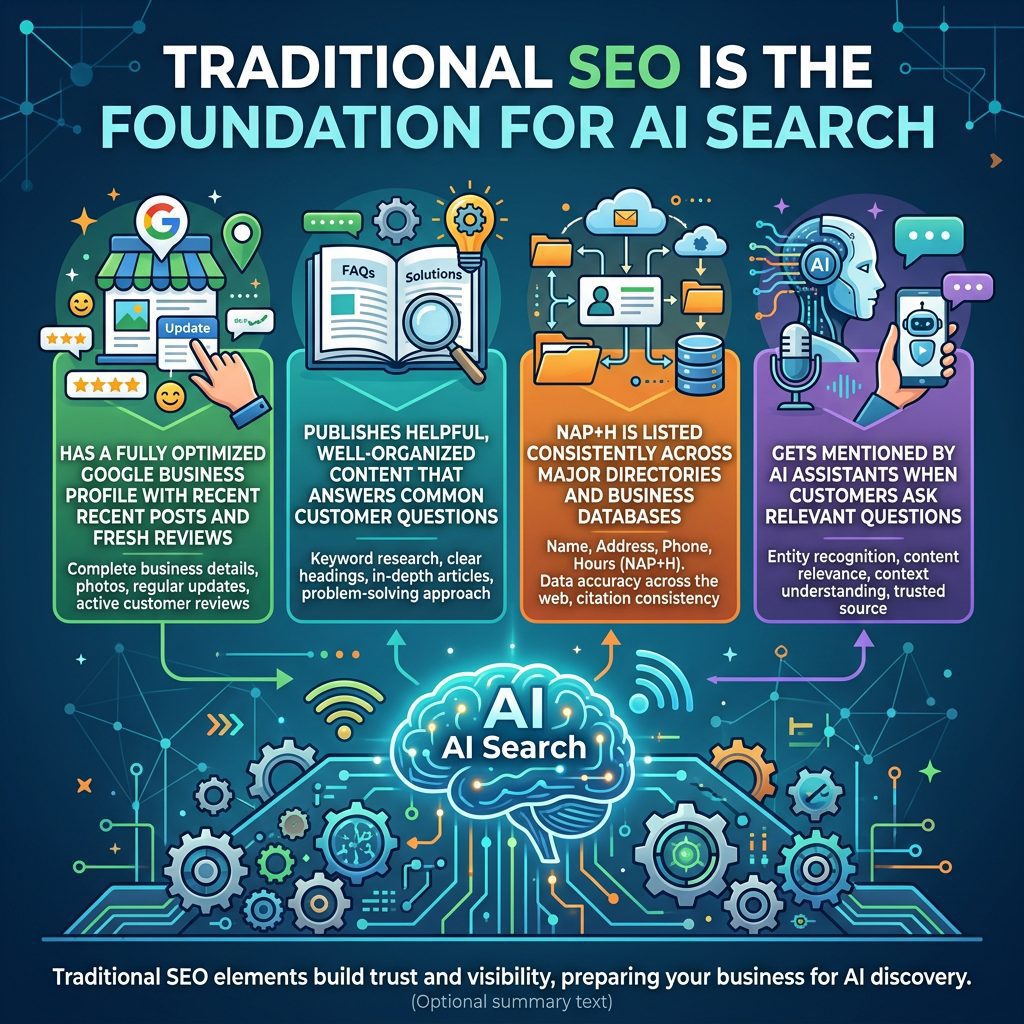 Scenario A — The Business That Adapts:
- Has a fully optimized Google Business Profile with recent posts and fresh reviews
- Publishes helpful, well-organized content that answers common customer questions
- Is listed consistently across major directories and business databases
- Shows up in Google’s local 3-Pack AND gets mentioned by AI assistants when customers ask relevant questions
Scenario B — The Business That Doesn’t:
- Has an outdated or unclaimed Google Business Profile
- Has a website that hasn’t been updated in years
- Has inconsistent or missing information across online directories
- Is invisible to both traditional Google search and AI-powered answers
Which scenario describes your business right now? No judgment — but it’s worth knowing.
How Do You Stay Visible in Both Traditional and AI Search?
The good news: you don’t need to start over. You need to build on what you already have — and add a few new habits.
Here’s a practical starting point:
- Audit your Google Business Profile. Is every detail accurate? Hours, address, phone number, photos, categories? This is ground zero for both local SEO and AI visibility.
- Check your consistency. Does your business name, address, and phone number match exactly across Yelp, Facebook, your website, and every other directory? Inconsistencies confuse both Google and AI engines.
- Start publishing helpful content. Write short articles or posts that answer the questions your customers actually ask. Not “Buy our service!” — but “How do I know when I need a plumber?” AI engines favor content that directly answers questions.
- Get more reviews — and respond to them. Reviews are a trust signal for Google AND for AI. A business with 200 genuine reviews looks authoritative. A business with 4 looks like it just opened.
- Don’t ignore structured data. This is a slightly more technical step — adding “schema markup” to your website helps AI engines understand exactly what your business does, where you are, and who you serve.
None of these steps require a computer science degree. They require consistency and intention — which, frankly, is what good marketing has always required.
What Is the LLM Citation Optimization Framework?
If you want to go deeper on the strategy behind getting cited by AI, there’s a name for it: the LLM Citation Optimization Framework.
LLM stands for Large Language Model — the technology behind ChatGPT, Google Gemini, and Perplexity. The LLM Citation Optimization Framework is a strategic approach to creating and distributing content so that these AI engines recognize your business as a credible, trustworthy source worth citing in their answers.
It has three core pillars:
- Entity-Based Authority Building. Making sure your business is clearly defined and well-documented online as an expert in your field.
- Structured, Question-Based Content. Writing content in a format that AI can easily parse and pull from when answering user queries.
- Off-Site Citation Building. Getting your business mentioned in trusted third-party sources — publications, directories, local news — so AI engines see you as broadly recognized, not just self-proclaimed.
For a full breakdown of the framework, read the pillar article: LLM Citation Optimization Framework: The Next Generation of SEO You Can’t Afford to Miss.
What Mistakes Are Small Businesses Making Right Now?
Let’s be honest about what’s happening out there.
- Assuming “my website is fine” without checking how it appears in AI search results
- Treating AI as a gimmick instead of a genuine shift in how customers find businesses
- Publishing thin, keyword-stuffed content that AI engines immediately distrust
- Ignoring Google Business Profile posts, which are a live ranking signal
- Waiting for competitors to figure this out first — then scrambling to catch up
The businesses that win the next five years of local search are the ones paying attention right now — not the ones who wait until being invisible becomes a crisis.
| The single biggest mistake small business owners make with AI search: assuming it doesn’t apply to them yet. It already does. |
Frequently Asked Questions
Is traditional SEO dead in 2026?
No. Traditional SEO is not dead — it has evolved. The core principles (quality content, consistent business information, authoritative backlinks, strong reviews) are more important than ever. What’s new is that these same principles now also determine whether AI search engines cite your business in their answers.
Does my small business need to worry about AI search?
Yes, and sooner than you might think. AI-powered answers are already appearing in Google, ChatGPT, and Perplexity for the kinds of questions your customers ask every day. If your business isn’t positioned to be cited in those answers, you’re losing visibility to competitors who are.
What is the difference between ranking on Google and being cited by AI?
Ranking on Google means your website appears in a list of search results. Being cited by AI means an AI assistant mentions your business by name when answering a relevant question — without the user needing to click through any results at all. Both matter. AI citation is the newer, faster-growing channel.
Do I need to rebuild my website to be visible in AI search?
Usually not. Most small businesses need to update and optimize what they already have — not start from scratch. The priorities are: accurate and complete Google Business Profile, consistent directory listings, helpful question-based content, and genuine reviews.
What is the LLM Citation Optimization Framework?
It’s a strategic methodology developed for structuring content and online presence so that large language models (AI engines) recognize a business as a credible source worth citing. It focuses on entity authority, structured content, and off-site citation building.
How do I know if AI is already mentioning my competitors?
Try it yourself. Open ChatGPT, Gemini, or Perplexity and ask: “What’s the best [your service] in [your city]?” See who comes up. If your competitors are appearing and you’re not, that’s a gap worth closing.
About the Author
Rick Samara | E-Internet Marketing Services | Southern Maryland
 Rick Samara is the founder of E-Internet Marketing Services, a digital marketing agency based in Southern Maryland serving local businesses nationwide since 2007. Rick has been working in local search since before Google Maps had its first birthday, helping businesses get into the Google 7-Pack (now 3-Pack) through nearly two decades of algorithm changes, platform shifts, and now the rise of AI-powered search. Today, Rick combines 18+ years of hands-on local SEO expertise with cutting-edge AI tools to help small businesses stay visible, competitive, and cited — by both Google and the AI engines reshaping how customers find businesses.
Book a Free Discovery Call: einternetmarketingservices.com/eims-discovery-calendar/
Phone: 301-923-4333
Further Reading
The following sources provide additional context on AI search, traditional SEO evolution, and local business visibility strategies.
Samara, R. (2026). LLM Citation Optimization Framework: The Next Generation of SEO You Can’t Afford to Miss. E-Internet Marketing Services.
Samara, R. (2026). How Do Google’s E-E-A-T Guidelines Impact LLM Citations?. E-Internet Marketing Services.
Samara, R. (2026). What Is Generative Engine Optimization?. E-Internet Marketing Services.
Google. (2024). How Google Search Works: AI Overviews and Generative Search. Google Search Central.
Moz. (2024). The Beginner’s Guide to SEO. Moz, Inc.
Search Engine Journal. (2024). AI and the Future of Search Engine Optimization. Search Engine Journal.
Semrush. (2024). State of Search: AI Overviews and Impact on Organic Traffic. Semrush Blog.
Anthropic. (2024). Claude Model Overview and Capabilities. Anthropic.
E-Internet Marketing Services | Southern Maryland | einternetmarketingservices.com | (301) 923-4333
Southern Maryland’s Local Search Authority Since 2007