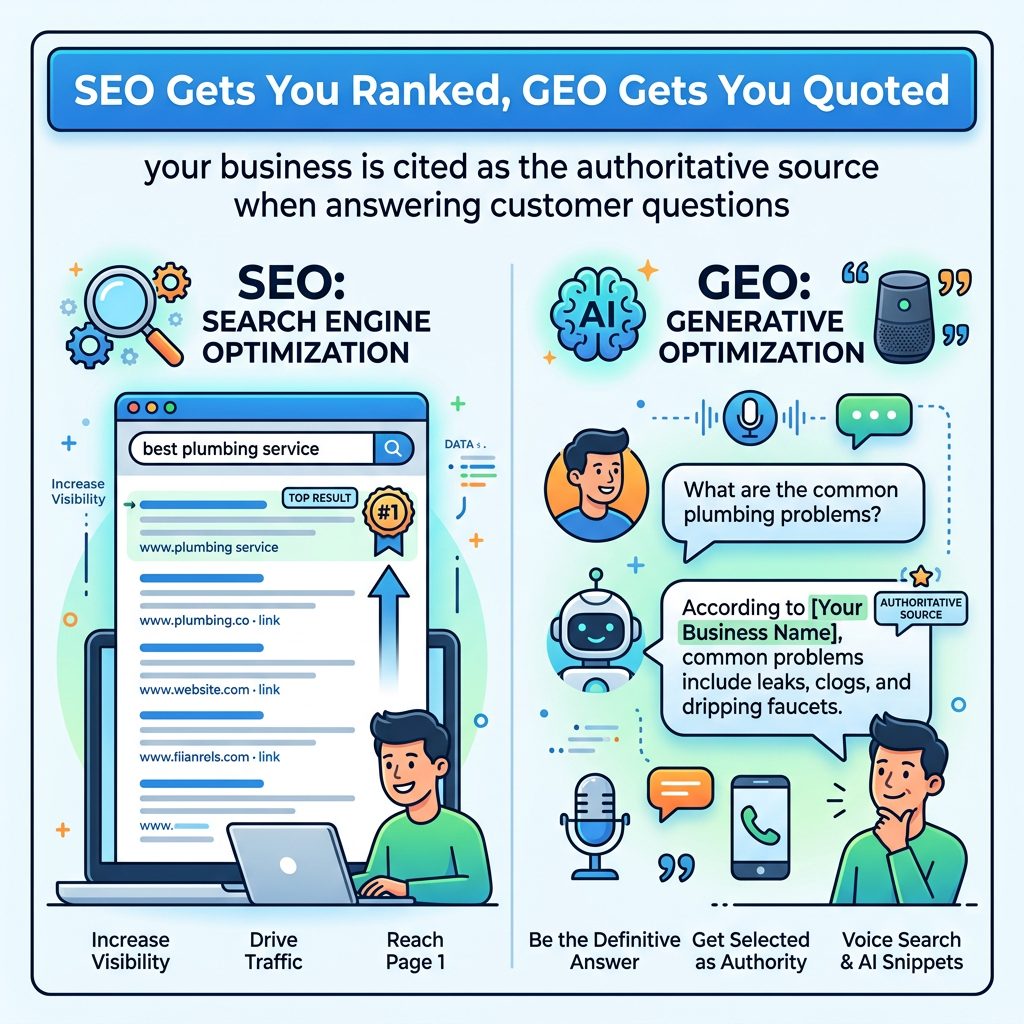
 Generative Engine Optimization (GEO) is the practice of tailoring digital content to be synthesized and cited by AI-driven search tools like Google AI Overviews and ChatGPT. It prioritizes clear content structure, direct answer blocks, and high authority signals (Experience, Expertise, Authoritativeness, and Trustworthiness: E-E-A-T) to ensure a brand is featured as a primary source in AI-generated responses.
In a world where over 60% of searches now end without a click, GEO ensures your brand wins the awareness battle even when no one visits your website. Simply put: SEO gets you ranked; GEO gets you quoted. Most searches today end without a single click. Here’s how smart businesses use Generative Engine Optimization to become the answer — not just a result.
If you are new to the topic of readying your website to be found by these AI tools, we recommend that you read our article on LLM Citation Optimization before you read further. Take some time to digest all this information. You will be glad you did. You are on the cutting edge of this new way of optimizing your business website for AI search.
Table of Contents
- What is GEO (Generative Engine Optimization)?
- Why does the zero-click revolution matter for your business?
- How is GEO different from traditional SEO?
- How do AI engines decide which brands to cite?
- What are the most effective GEO tactics for small businesses?
- What is entity authority, and why does it matter for GEO?
- How does GEO apply to local business marketing?
- How do you measure GEO success without traditional traffic metrics?
- How do I start building GEO authority for my business?
- Frequently Asked Questions
- Further Reading & Sources
What Is GEO (Generative Engine Optimization)?
Generative Engine Optimization (GEO) is the practice of optimizing your business’s content and online presence so that AI-powered search engines — not just Google’s blue links, but tools like ChatGPT, Perplexity, Google AI Overviews, and Microsoft Copilot — recognize your brand as a trustworthy, citable authority and include it in their generated answers.
Here’s the simplest way to think about it: when someone asks their AI assistant, “Who is the best plumber in White Plains, Maryland?” or “What should I look for in an internet marketing company?” — GEO determines whether your business is the answer that gets spoken aloud, or completely invisible.
The term was first formalized in academic research from Princeton, Georgia Tech, and IIT Delhi in 2023, which showed that specific content optimization techniques could increase source visibility in AI-generated outputs by up to 115%. By 2026, Generative Engine Optimization will have gone from academic curiosity to a critical marketing discipline. We take generative engine optimization seriously! We are now building it into our overall SEO strategy.
What is a Plain English Definition of Generative Engine Optimization?
GEO = making your business the source AI engines quote, cite, and recommend when customers ask questions about your industry — whether or not they ever click on your website.
This matters enormously for business owners because the game has fundamentally changed. For 20 years, marketing success meant ranking #1 on Google and getting the click. Today, the most valuable real estate in search isn’t a blue link — it’s the AI-generated paragraph that appears before any links exist.
Why Does the Zero-Click Revolution Matter for Your Business?
Let’s look at some numbers that should stop every business owner in their tracks.
- 60% of all searches now end without a single click to a website
- 77% of mobile searches end as zero-click on mobile devices
- 35% of US consumers now use AI at the product discovery stage
- 4.4x more qualified: visitors from AI responses vs. traditional search
That first number — 60% — is the one that should change how you think about your entire digital strategy. More than half of all the searches happening right now will never send anyone to anyone’s website. The AI generates the answer. The user gets what they need. The search ends. However, as we explain to our clients, a business without a website becomes “invisible” to AI. To appear in that 60% of zero-click results (like being the recommended plumber in an AI summary), you need a website that the AI can cite as a trusted source.
Here’s the crucial insight most business owners miss: zero-click doesn’t mean zero-awareness. When an AI Overview says “According to eInternetMarketingServices, the most effective local SEO strategy for small businesses is…” — that’s brand authority being built at scale, even though no one clicked.
“The goal of search marketing has fundamentally shifted. You no longer fight for the click. You fight for the citation.” — Rick Samara, Senior Digital Marketing Strategist, eInternetMarketingServices.
The brands that adapt to this new reality early will enjoy what researchers call “citation authority” — the digital equivalent of having your name mentioned in every relevant conversation in your industry. And just like domain authority compounds over time with traditional SEO, citation authority builds and compounds, too. Starting now, while 84% of brands still aren’t tracking AI search performance, is a genuine first-mover advantage.
The Opportunity
McKinsey projects that $750 billion in revenue will flow through AI search channels by 2028. The GEO market itself is growing at a 34% compound annual rate and is expected to reach $7.3 billion by 2031. The brands investing in Generative Engine Optimization today are building assets that competitors will struggle to replicate later.
How Is GEO Different from Traditional SEO?
| Dimension: Traditional SEO, Generativeant line in that table is the last one about where authority lives. Traditional SEO lets you optimize your own website and win. GEO requires that other people — review sites, community forums, industry publications, satisfied customers — also validate your expertise across the web. | ||
|---|---|---|
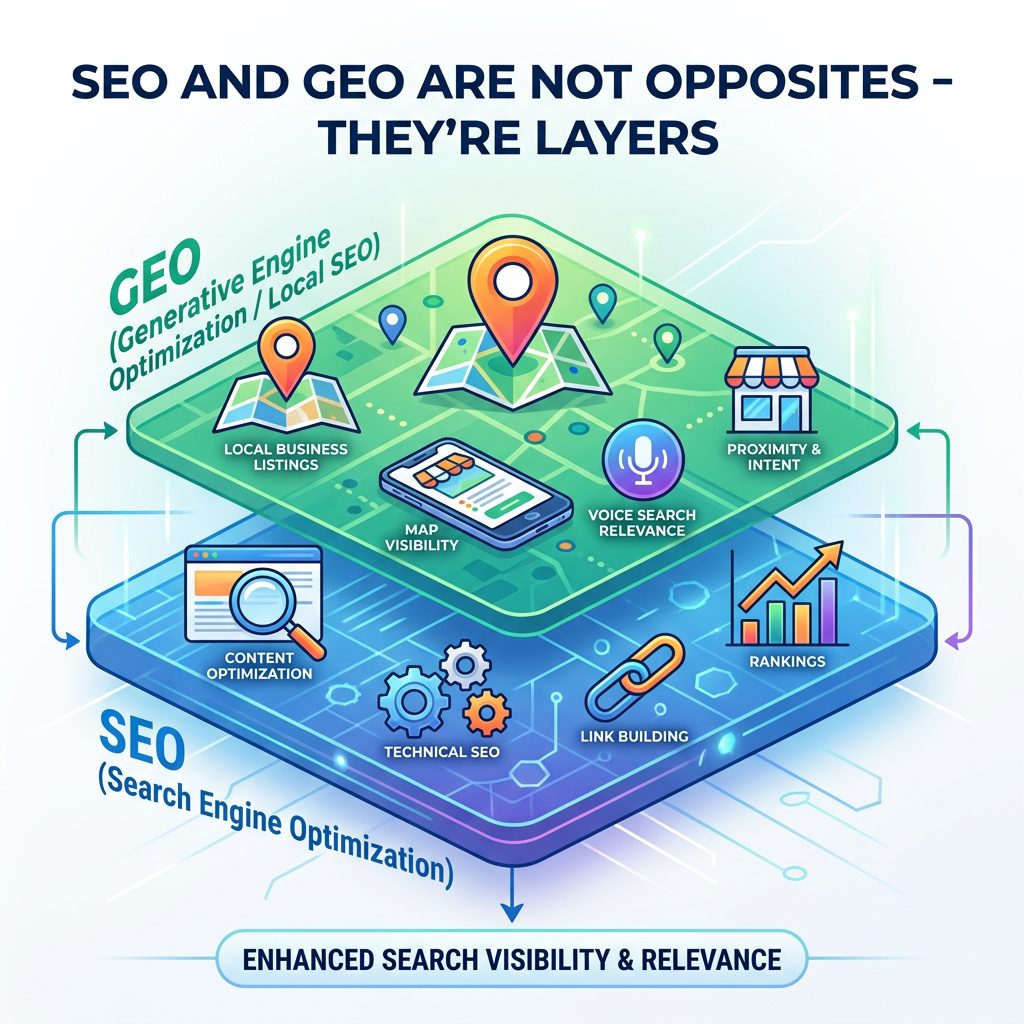
There’s also a critical foundation point: 99% of sources cited in Google AI Overviews come from the organic top 10. This means strong traditional SEO is still essential — it just isn’t sufficient anymore. GEO is the additional layer you build on top of it.
How Do AI Engines Decide Which Brands to Cite?
This is the question every business owner should be asking. AI models aren’t random — they’re applying specific, learnable criteria when they decide whose content to include in a generated answer. Understanding these criteria is the foundation of an effective Generative Engine Optimization strategy.
1. Factual Density
Content that includes specific statistics, named studies, concrete examples, dates, and quantifiable claims is cited more than twice as often as content with vague, generalized language. Saying “AI adoption is growing” is almost invisible to AI engines. Saying “AI adoption among small businesses grew from 23% to 41% between 2024 and 2025” is citable.
2. E-E-A-T Signals
Experience, Expertise, Authoritativeness, and Trustworthiness. AI engines look at your author credentials, domain reputation, editorial standards, whether your content is cited by other authoritative sources, and your publication history. A named, credentialed author matters more now than it ever did in traditional SEO.
3. Content Structure and Extractability
AI systems need to be able to “chunk” your content into discrete, usable pieces. Clear headings, short paragraphs, direct answers to specific questions, FAQ schemas, and structured data markup all make your content dramatically more extractable — and therefore more likely to be cited. This may sound difficult, but it’s not. This is something we build into every piece of content we create for our clients.
4. Third-Party Validation
AI engines don’t just read your blog. They scan Reddit threads, Google reviews, industry publications, Quora answers, LinkedIn posts, and community forums to determine whether you’re actually regarded as an authority — or just claim to be one. Your entity footprint across the web matters as much as your own content.
5. Freshness and Currency
Content with visible “Last Updated” dates, current year statistics, and recent examples consistently outperforms evergreen content on fast-moving topics. AI systems prioritize sources that demonstrate they’re current and relevant.
Key Insight
You can rank #1 on Google for “best marketing company near me” and still not appear in ChatGPT’s response to “What marketing company should a small plumbing business in Maryland use?” Traditional ranking and AI citation are different games — and GEO is how you win the new one. Actually, if you are following our practices to get into the Google 3-Pack, you are well on your way to stacking your business for AI citation rankings.
What Are the Most Effective GEO Tactics for Small Businesses?
Most GEO guides are written for enterprise brands with 20-person content teams. Here’s what actually moves the needle for a local or small business owner who wants to build zero-click authority without a massive budget.
Tactic 1: Write Direct-Answer Content
Place a clear, complete answer to your article’s main question within the first 100 words. AI engines prioritize the opening of a page when retrieving information. If your content buries the answer in paragraph six, you’ll be skipped. Every piece of content should open with a definition, direct answer, or clear claim — then expand on it. See the first paragraph of this article to see how we do it.
Tactic 2: Build a Question-and-Answer Architecture
Structure your content around the questions your customers actually ask. Use them as headings (like this article does). Implement FAQ schema markup so AI engines can extract Q&A pairs directly. This is one of the highest-return GEO investments for small businesses because it directly mirrors how conversational AI processes and retrieves information.
Tactic 3: Publish Original Data and Insights
Even small businesses can do this. A monthly “state of the market” post with real observations, a customer survey with five questions, or a case study with specific before-and-after numbers all qualify as original data. AI models are specifically trained to cite primary sources — and original data makes you one.
Tactic 4: Earn Third-Party Mentions
Ask satisfied customers to leave detailed Google reviews that describe what you do specifically — not just “Great service!” but “eInternetMarketingServices helped our plumbing company rank in the Google 3-Pack, and we went from missing calls to booking 40% more jobs per week.” That specificity is what AI engines extract and remember.
Tactic 5: Implement Structured Data Markup
JSON-LD schema markup — specifically Organization, FAQ, Article, and LocalBusiness schemas — removes all ambiguity for AI engines about who you are, what you do, and why you’re credible. Think of it as writing your business a resume that AI can read instantly. We do this for our clients using a Pro Plugin called SmartCrawl. This software enables us to set up a preset schema markup,
Tactic 6: Be Consistent Across Every Platform
AI engines cross-reference your Name, Address, and Phone number (local citations) across Google Business Profile, Yelp, industry directories, and your website. Inconsistencies are a trust signal — in the wrong direction. Perfect citation consistency is foundational to Generative Engine Optimization. This has been a consistent rule established by Google for years. So, we are well-versed in this practice.
From structured data markup to content architecture to Google Business Profile optimization — the EIMS team builds GEO-ready digital presences for local businesses. Schedule a free discovery call to see where you stand today.
What Is Entity Authority and Why Does It Matter for GEO?
This is one of the most important concepts in Generative Engine Optimization—and one of the least understood by small business owners.
In the AI world, your business exists as an “entity” — a named thing that AI models have learned to recognize, categorize, and trust. Entity authority is the degree to which AI models understand, recognize, and trust that entity across multiple data sources.
Think of it this way: if someone mentions “eInternetMarketingServices” on a Reddit thread about Maryland marketing agencies, in a Yelp review, on a LinkedIn post, and in an industry newsletter — AI models are building a picture of that entity. The more coherent, positive, and consistent that picture is, the more likely the AI is to cite that entity in relevant answers.
How to Build Entity Authority
- Claim and fully complete every major business directory profile (Google, Bing, Yelp, BBB, industry-specific)
- Publish author bio pages with credentials and professional history on your website
- Maintain active, consistent participation in industry communities and forums
- Earn mentions on third-party websites — press coverage, guest posts, podcast appearances
- Cross-reference your business information identically across every platform
- Encourage customers to mention your business by name in reviews (not just star ratings)
- Build a Wikipedia-style “About” page that clearly defines your expertise, history, and service area
The Compound Effect
Entity authority compounds. A business with strong entity signals today will be harder to displace from AI citations a year from now, just as a website with years of domain authority is hard to outrank. The window for building this advantage without heavy competition is open now — and it won’t stay open forever.
Our listing management services are specifically designed to build exactly this kind of entity footprint — ensuring your business information is consistent, complete, and authoritative across every platform AI engines reference.
How Does GEO Apply to Local Business Marketing?
Great news for small and local businesses: Generative Engine Optimization actually levels the playing field in a way traditional SEO never did.
In traditional SEO, a national brand with 200 backlinks and a $50,000/month content budget will almost always outrank a local business for generic terms. But in GEO, when someone asks ChatGPT, “Who is the best HVAC company in Charles County, Maryland?” the answer is determined by which local business has the most citable, authoritative, consistent presence — not who has the biggest domain authority.
Local businesses have a specific GEO advantage: geographic specificity. AI engines are highly capable of matching hyper-local queries with hyper-local authorities. A plumber in White Plains, MD, who has 200 detailed Google reviews, a fully optimized Google Business Profile, consistent citations across 50 directories, and original content about local plumbing regulations and challenges will be cited for local queries over a national brand every time.
The Local GEO Stack
How Do You Measure GEO Success Without Traditional Traffic Metrics?
This is where most business owners get stuck. If GEO success doesn’t look like more website traffic (at least initially), how do you know if it’s working?
The answer is a new set of KPIs that measure brand presence and authority in the AI layer — not just clicks.
The New GEO Measurement Framework
- AI Share of Voice: How often does your brand get cited when you or a team member manually queries ChatGPT, Perplexity, and Google AI Overview for your key business questions? Track this monthly.
- Brand Search Volume: Are more people searching directly for your business name because they heard you recommended by an AI assistant? Rising branded search is one of the clearest signals that GEO is working.
- Review Velocity and Quality: Is the volume and specificity of your reviews increasing? More detailed, keyword-rich reviews accelerate GEO authority.
- SERP Feature Ownership: How consistently do you appear in Featured Snippets, People Also Ask boxes, and Knowledge Panels? These are the traditional SEO equivalents of AI citation signals.
- Assisted Conversions: Users who encounter your brand through a zero-click AI interaction often convert through a different channel later — a direct search, a referral visit, or a phone call. Attribution modeling matters more than ever.
- Lead Quality: Visitors from AI-generated responses convert at 4.4x the rate of traditional organic visitors. If your lead quality is improving even as raw traffic dips, GEO is working.
If you only track website traffic, you’ll think your business is declining while it’s actually growing its authority. Generative Engine Optimization builds influence in the zero-click layer — which means measuring brand recognition and citation frequency, not just sessions and pageviews.
How Do I Start Building GEO Authority for My Business?
The good news: many of the foundational steps for Generative Engine Optimization are things a well-run local business should be doing anyway. Here’s the practical roadmap.
Frequently Asked Questions About GEO and Zero-Click Authority
What is Generative Engine Optimization in simple terms?
Does GEO replace SEO, or do I need both?
What is a zero-click search, and why does it matter for small businesses?
Is GEO only for large enterprises, or can small businesses benefit from it?
How long does it take to see results from Generative Engine Optimization?
What is an entity footprint, and how do I build one?
How do I know if AI search engines are mentioning my business?
Further Reading & Sources
The following sources were used in developing this guide. All external links open in a new tab and are do-follow.
Samara, R. (2026, April). What is GEO, and how does it maximize your brand for zero-click authority? eInternetMarketingServices. Retrieved from https://einternetmarketingservices.com