Google’s E-E-A-T guidelines (Experience, Expertise, Authoritativeness, and Trustworthiness) directly determine whether AI tools like ChatGPT, Google AI Overviews, and Perplexity cite your business when answering customer questions. Strong E-E-A-T signals make your content “citation-worthy” in the eyes of large language models (LLMs), while weak signals leave your business invisible in AI-generated answers. In the age of zero-click search, E-E-A-T is no longer just a ranking factor. It is your ticket to being the answer in search.
What Are Google’s E-E-A-T Guidelines, and Why Do They Matter Now?
If you are new to the topic of preparing your website to be found by these AI Chatbots, we recommend that you read our article on LLM Citation Optimization.
Let’s start with the basics. E-E-A-T stands for Experience, Expertise, Authoritativeness, and Trustworthiness. It’s the framework Google uses in its Search Quality Rater Guidelines to evaluate whether a piece of content — and the business or person behind it — is genuinely credible and helpful.
For years, E-E-A-T was primarily a tool for Google’s human quality raters and its ranking algorithms. Build it well, and your website will rank higher in traditional search results. Ignore it, and you slip down the page. The same quality signals Google uses to rank your website are now the signals AI tools use to decide whether to quote your business. Here’s what every business owner needs to know.
In 2026, the stakes are dramatically higher. E-E-A-T and LLM citations are now directly connected. Every major AI tool, Google AI Overviews, ChatGPT, Perplexity, Microsoft Copilot, uses the same credibility signals that E-E-A-T describes to decide which sources to include in their generated answers.
Google’s Search Quality Rater Guidelines explicitly state: “Trust is the most important member of the E-E-A-T family because untrustworthy pages have low E-E-A-T no matter how Experienced, Expert, or Authoritative they may seem.” Without trust, the other three pillars collapse — in both traditional rankings and LLM citations.
How Do LLMs Actually Use E-E-A-T to Choose What to Cite?
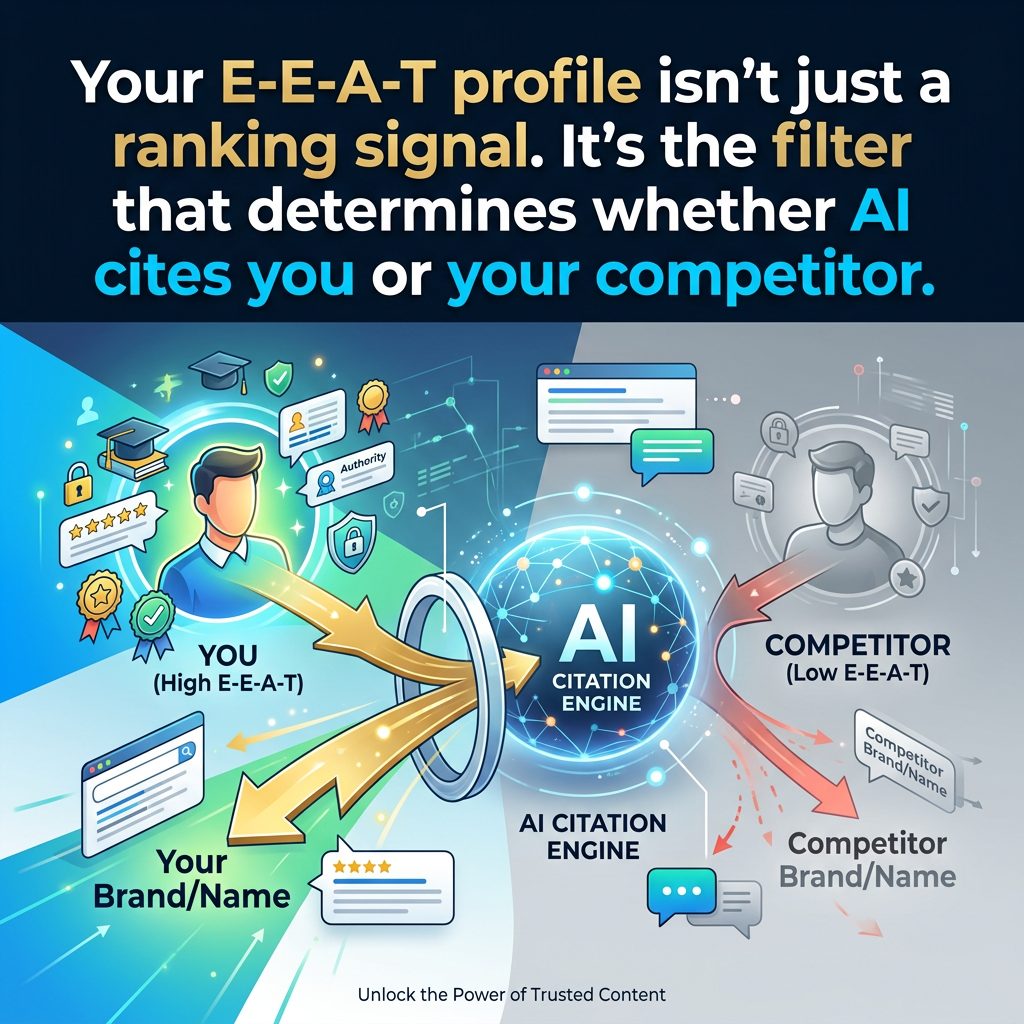 AI language models don’t have a visible “E-E-A-T score” to consult. But they are trained on vast datasets that reflect the same credibility signals E-E-A-T measures, and their citation behavior shows it clearly.
Here is the relationship in plain terms: E-E-A-T determines eligibility, while other optimization factors determine selection within the eligible pool. If your content fails E-E-A-T signals, it won’t enter the citation pool at all.
Research analyzing more than 15,000 AI Overview results confirms specific, measurable connections:
- Content with verifiable facts, recent citations, and cross-referenced data sources shows 73% higher selection rates in AI Overviews compared to unmarked, uncited content
- 44.2% of all LLM citations come from the first 30% of a page, making your opening E-E-A-T signals critical
- Traditional domain authority (DA) now shows only an r = 0.18 correlation with AI citations, down sharply from previous years, while trust signals have grown in importance
- Content distributed to third-party publications can increase AI citations by up to 325% compared to content published only on your own site
That last point is a direct reflection of the Authoritativeness pillar: AI engines weight external validation far more heavily than self-promotion. What other people say about you matters more than what you say about yourself.
“AI search runs on entity mass, not surface signals. E-E-A-T is not a checklist. It is the architecture of trust that AI engines are built to detect.” Rick Samara, Senior Digital Marketing Strategist, eInternetMarketingServices
How Does Each E-E-A-T Pillar Specifically Affect LLM Citation?
Let’s break down each pillar and what it means in practical terms for your business’s AI visibility.
Experience — The “I Was There” Signal
AI engines are increasingly sophisticated at detecting firsthand experience versus recycled information. A case study from your own business — “We ran this campaign for a plumbing client in Charles County and generated $53,000 in one month” — is vastly more citable than a generic industry summary that says “AI marketing can improve revenue.”
Personal case studies, original data, client outcomes with specific numbers, and first-person professional insights are your strongest E-E-A-T experience signals. AI cannot replicate the “I was there” factor, and it actively rewards content that has it.
We have been stressing this to our clients for years. We are glad we have. This now positions them to rank well and be cited by the LLMs.
Expertise — Named, Credentialed Authors
Author anonymity is an E-E-A-T and LLM citations liability. AI systems look for named authors with verifiable credentials, licenses, certifications, publication history, and professional affiliations. These should be listed clearly in bylines and author bios.
A content page written by “Admin” or attributed to no one will consistently lose citation priority to the same content written by “Rick Samara, Senior Digital Marketing Strategist with 15 years of local SEO experience.” The expertise signal has to be explicit and verifiable, not assumed.
Authoritativeness — Third-Party Validation
This is where most small businesses have the greatest untapped opportunity. Authoritativeness is built outside your own website — through reviews, press mentions, industry forum participation, guest articles, podcast appearances, and community engagement.
AI engines scan Reddit, Quora, Google Reviews, LinkedIn, and industry publications to cross-reference whether the web at large treats you as an authority — or whether you’re just claiming to be one on your own website. Our reputation management services are specifically built to grow this third-party validation footprint.
Trustworthiness — Consistency and Accuracy at Scale
Trust, Google’s own most important E-E-A-T pillar, is built through accuracy, consistency, and transparency. For AI citation purposes, this means:
- Your Name, Address, and Phone number are identical across every platform (Google, Yelp, directories, your website)
- Every factual claim in your content is sourced and verifiable
- Your content is updated regularly and reflects current information
- Schema markup (Organization, Author, FAQ) makes your identity machine-readable and unambiguous
- Your reviews are detailed, consistent, and responded to promptly
Our AI Google Business Profile Management and listing management services build exactly this kind of structural trust at scale.
What Steps Can a Business Owner Take Right Now to Improve E-E-A-T for AI Citations?
The good news: improving your E-E-A-T and LLM citation standing doesn’t require a massive budget. It requires intention and consistency. Here is the practical roadmap.
E-E-A-T signals compound over time — exactly like domain authority did in the early days of SEO. The businesses that invest in building genuine credibility signals now will be increasingly difficult to displace from AI citations in 2027 and beyond. The window for first-mover advantage is open today.
How Do E-E-A-T and GEO Work Together for Maximum AI Visibility?
If you’ve read our article on Generative Engine Optimization (GEO), you already know that GEO is the strategic practice of optimizing for AI citation. E-E-A-T is the credibility foundation that makes GEO possible.
Think of it this way:
- E-E-A-T determines whether your content is eligible to be cited by AI at all
- GEO tactics (content structure, schema, question-based headings, factual density) determine how frequently and prominently you get cited within the eligible pool
- Traditional SEO maintains the organic rankings that give AI systems access to your content in the first place
All three layers are required. A business with strong E-E-A-T but poor content structure will be overlooked. A business with excellent GEO tactics but weak trust signals will be filtered out before selection. A business that ignores traditional SEO entirely may not appear in the organic top 10 that AI engines primarily draw from.
AI Overviews now appear for 12–16% of all US search queries and link to an average of 13.3 sources per response. If your E-E-A-T and LLM citation profile is weak, your business won’t appear in those 13.3 sources — while credible competitors will. Every AI Overview that mentions a competitor without mentioning you is a lost opportunity to influence a buying decision, even without a click.
Is Your Business Citation-Worthy in AI Search?
 Rick Samara
Rick Samara is a Senior Digital Marketing Strategist at eInternetMarketingServices, a Maryland-based agency specializing in AI-enhanced marketing, E-E-A-T optimization, and Generative Engine Optimization for local and small businesses. Rick and the EIMS team help business owners build the credibility signals that make AI tools cite their brand, turning zero-click searches into real authority and qualified leads. He is an award-winning author of AI for Beginners Demystified, available on Amazon. Find more great articles on AI.
What does E-E-A-T stand for and why does it matter for AI?
Does E-E-A-T directly affect whether ChatGPT or Perplexity cites my business?
What is the single most important E-E-A-T signal for LLM citations?
Can a small business compete with large brands for AI citations using E-E-A-T?
How does E-E-A-T relate to Generative Engine Optimization (GEO)?
How long does it take to see AI citation improvements after improving E-E-A-T?
Further Reading & Sources
The following sources informed this article. All external links are do-follow and open in a new tab.
Samara, R. (2026, April). How do Google’s E-E-A-T guidelines impact LLM citations? eInternetMarketingServices. Retrieved from https://einternetmarketingservices.com