This article provides an overview of our Maryland AI SEO Agency. Roughly half of American adults now use AI chatbots, and the most common thing they do with them is look things up. That is not a projection about the future of search. It is a Pew Research Center survey of 5,119 U.S. adults, fielded in February 2026, that describes what your customers are doing today.
This creates a problem. So we adapted our SEO approach. You may have spent years earning a spot on page one of Google. None of it guarantees you a mention when a homeowner in Tulsa opens ChatGPT and types “who should I call to fix a heat pump that keeps freezing up?” Different system, different retrieval logic, different winners.
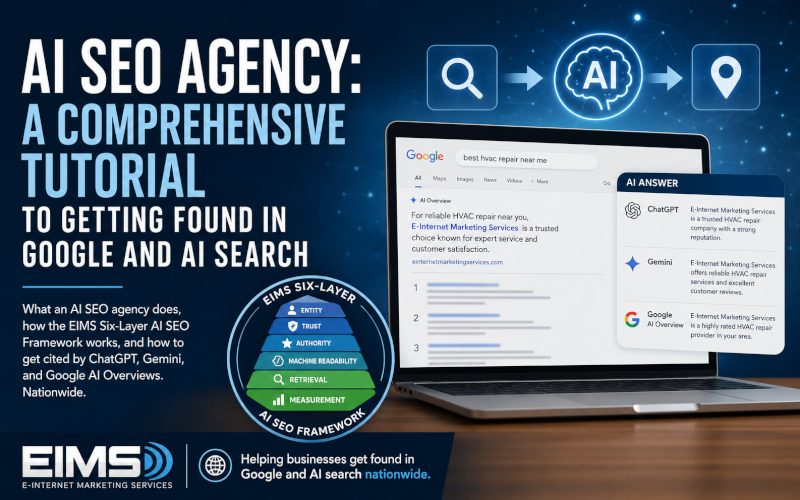
Hiring an Maryland AI SEO agency is how most businesses close that gap. This tutorial explains what an AI SEO agency does in plain English: the work involved, the order in which it happens, what it costs, and how to tell our Maryland AI SEO agency from a rebranded link-building shop. Everything here follows the EIMS Six-Layer AI SEO Framework, the sequence we run with clients across the country.
Yes, our Six-Layer AI SEO Framework may appear a bit complicated. Rather than viewing it that way, we ask that you consider our framework to be very comprehensive. Look at it this way. Imagine someone gave you a 500-piece puzzle to solve. They also gave you 750 pieces. The extra 250 pieces will work to complete the puzzle as well, but the overall solution may look different. Every business has different needs. Our job is to help you solve the puzzle using the proper pieces.
Our Maryland AI SEO Agency, and How Is It Different From a Traditional SEO Agency?
Our Maryland AI SEO agency optimizes your business for both classic search rankings and AI-generated answers. Traditional SEO aims for a position on a search results page. An AI SEO agency chases inclusion in a sentence, the one a language model writes when someone asks a question your business could answer.
The two overlap more than the hype suggests. Google’s documentation says there are no special requirements to appear in AI Overviews or AI Mode beyond the fundamentals that always applied: meet the technical requirements, follow Search policies, publish helpful content written for people. A good AI SEO agency starts there rather than selling you a secret.
Where they diverge is in what counts as a win.
| Dimension | Traditional SEO | What an AI SEO Agency Adds |
| Goal | Rank on page one | Get retrieved, quoted, and recommended inside AI answers |
| Unit of visibility | The blue link | The citation, the brand mention, the recommendation |
| Query style | Short keywords: “roof repair Tulsa” | Full questions: “my shingles are curling, repair or replace?” |
| Content shape | Pages optimized for a keyword | Pages built so a specific passage answers a specific question |
| Entity data | Nice to have | Load-bearing — schema, NAP consistency, knowledge graph alignment |
| Measurement | Rankings, sessions, conversions | All that, plus how often AI platforms name you and what they say |
That last row is where most businesses find they have been flying blind. Your analytics say nothing about a conversation inside Gemini. A competent AI SEO agency builds a monitoring layer so you can see what the models say about you when nobody is watching.
| The short version: traditional SEO gets you listed. Our Maryland AI SEO agency gets you cited. You need both because the same customer will use Google, ChatGPT, and a map app in a single buying decision. |
Why Does Your Business Need an AI SEO Agency in 2026?
Because the audience moved, and it moved fast enough that a two-year-old marketing plan now describes a search landscape that no longer exists.
Pew’s 2026 research puts adult chatbot use at 49%, up from 33% two years earlier, with about a quarter using these tools daily. And 42% specifically use them to search for information, the number one use case, ahead of work tasks and everything else.
Passive exposure is larger still. Six in ten U.S. adults say they read the AI summary at the top of a search results page. Your prospects do not have to adopt a new app to be influenced by AI. Google puts the AI in front of them.
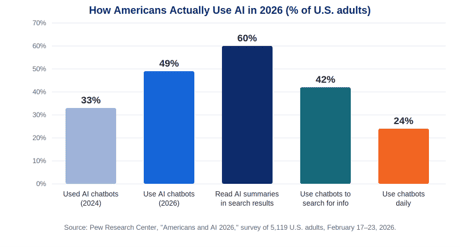
Chatbot adoption jumped 16 points in two years, and AI summaries reach a larger share of adults than the chatbots do. An AI SEO agency optimizes for both behaviors.
Half the country still does not touch a chatbot, which is exactly why abandoning traditional SEO would be a mistake. The businesses winning right now show up in both channels. The practical case for an AI SEO agency over an AI-only consultant or a legacy vendor that hasn’t changed a deliverable since 2021.
What Changed in Search That Made a AI SEO Agency Necessary?
Clicks got scarcer. That is the blunt version.
Pew tracked 68,879 real Google searches from 900 U.S. adults across March 2025. When an AI summary appeared, users clicked a traditional result 8% of the time. Without one, they clicked 15% of the time, nearly twice as often. And the links inside the AI summary itself? Clicked on in 1% of visits.
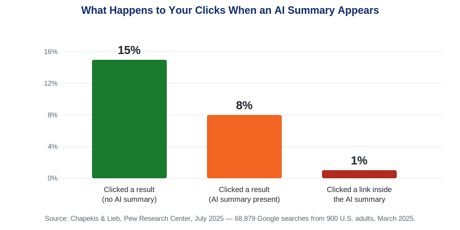 This click penalty is real, and the citation link inside the summary does not offset it. This is why an AI SEO agency measures mentions, not just sessions.
Read that 1% carefully, because it reframes the job. An AI citation is worth having as brand exposure and as a nudge toward a direct visit, not as a traffic source. If an AI SEO agency pitches you on “traffic from ChatGPT,” ask what share of AI answer views become sessions. The honest answer is: a small one.
The mechanics matter too. Google’s documentation describes a “query fan-out” technique, where AI Overviews and AI Mode issue multiple related searches across subtopics before assembling an answer. Your page no longer competes for one query. It competes across a spray of sub-questions the user never typed, which rewards depth and clear organization over keyword repetition.
Pew found something else useful. Question-shaped searches trigger AI summaries far more often. Six in ten queries beginning with who, what, when, or why produced one, against 8% of one- or two-word searches. If your customers ask questions, AI already sits in the middle of your funnel.
| Example — one customer, three touchpoints. A restaurant owner in Sacramento needs a walk-in cooler repaired. She asks ChatGPT the difference between a compressor failure and a refrigerant leak, Googles “walk-in cooler repair Sacramento,” skims the AI Overview, then opens Maps and calls whoever has recent reviews and clear hours: three systems, one decision, nine minutes. An AI SEO agency’s job is appearing in all three moments. |
What Framework Does our Maryland AI SEO Agency Use to Build Visibility?
At EIMS, every engagement runs through a six-layer sequence. The order is not decorative. Each layer carries the one above it, and skipping ahead is the most common way businesses waste money on AI SEO.
Publishing forty expert articles while your name and address disagree across the web is like printing beautiful business cards with the wrong phone number. The content is fine. The entity underneath it is broken, so machines cannot connect what you wrote to who you are.
Layers 1 through 3 make you legible and believable. Layers 4 and 5 make you retrievable. Layer 6 tells you whether it worked.
The next six sections walk through each layer in order, with the deliverables an AI SEO agency should produce at every stage.
How Does an AI SEO Agency Establish Your Business Entity?
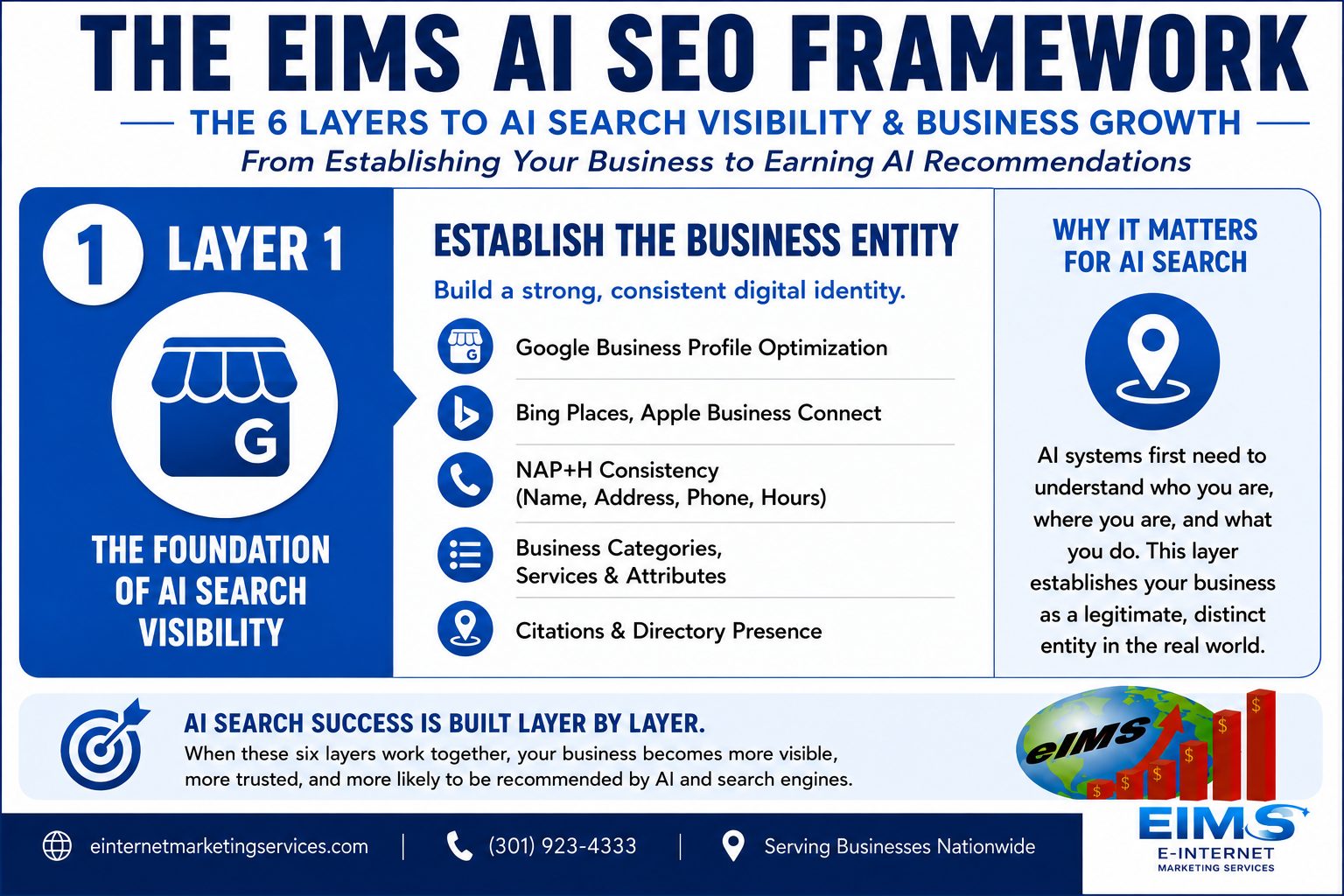 Layer one is where an AI SEO agency answers the machine’s first question: who are you, where are you, and what do you do?
An AI system cannot recommend a business it cannot identify. Before anything else, an AI SEO agency makes you a distinct, verifiable entity — one consistent name, address, phone number, and set of hours everywhere you appear.
- Google Business Profile optimization. Correct primary and secondary categories, services with real descriptions, service areas, attributes, and photos of actual work.
- Bing Places and Apple Business Connect. Bing feeds Copilot. Apple Business Connect feeds Apple Maps and Siri. Most businesses have claimed neither.
- NAP+H consistency. Name, address, phone, hours. These must be identical on your website, your profiles, and every directory listing.
- Citations and directory presence. Not 300 junk listings — the industry and geography listings a human would check. An AI SEO agency should show you that list before building it.
Consistency sounds boring until you see why it matters. When a model encounters “Miller & Sons Plumbing, Suite 4” in one place and “Miller and Sons Plumbing LLC, Ste. 400” in another, it has to decide whether those are one business or two — and sometimes it splits you into two weak entities instead of one strong one. Abbreviations, tracking numbers, and an address from a move three years ago do more damage than anything on your website.
| Example. A two-location dental practice in Ohio lists its downtown phone number on both location pages because that is where the front desk is located. Reasonable — but now both locations share a number, the citation records contradict the profiles, and the suburban entity is muddy. An AI SEO agency would give each location its own line, profile, page, and LocalBusiness schema, then reconcile any directory entries that disagree. |
How Does our Maryland AI SEO Agency Build Trust and Credibility Signals?
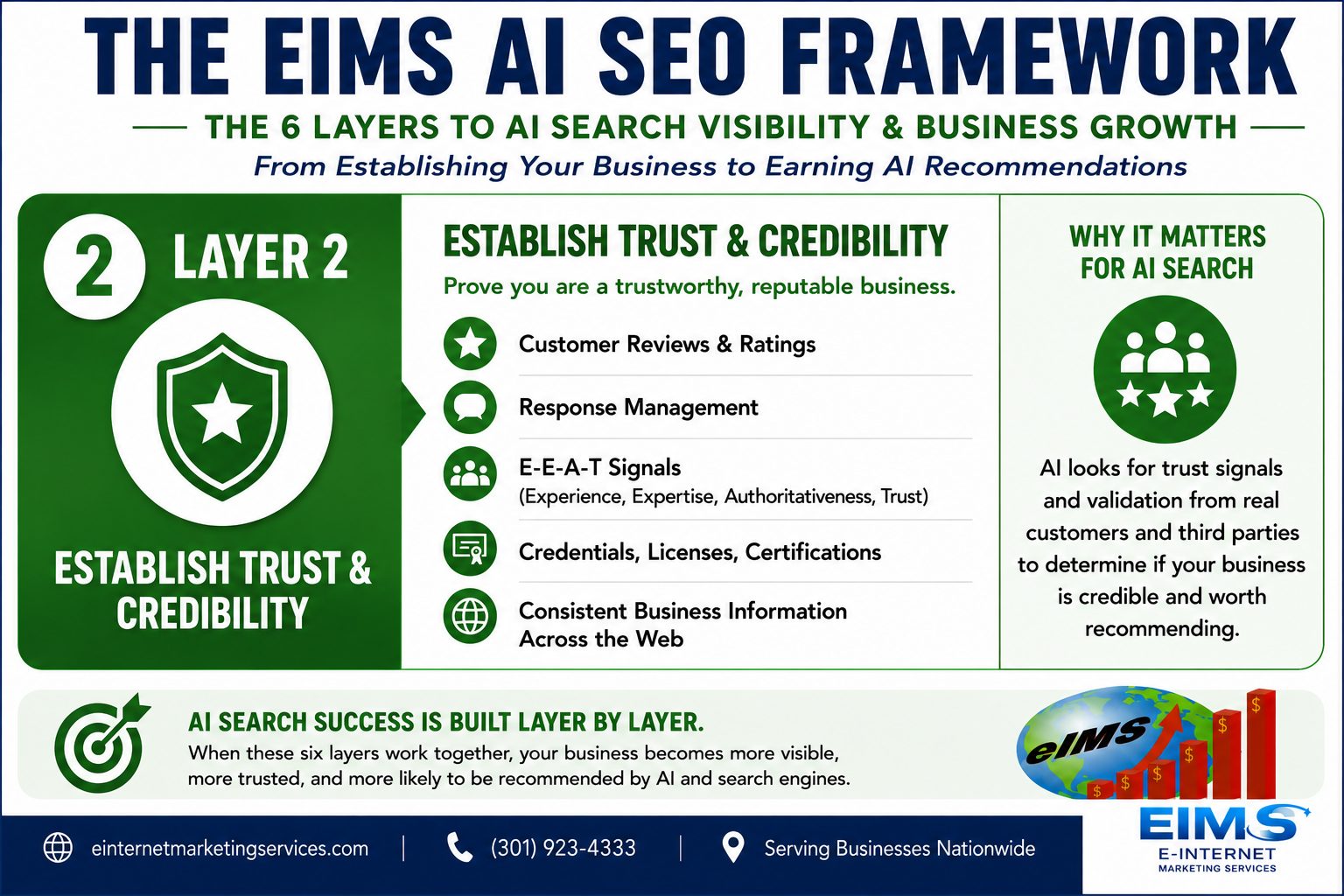 Layer two is where an AI SEO agency answers the second question: are you any good, and can anyone other than you confirm it?
Every claim on your website is self-reported. Models weigh third-party corroboration far more heavily, which is why an AI SEO agency treats review volume, recency, and wording as core deliverables rather than nice-to-haves.
- Review generation systems. A repeatable ask built into your job-completion or invoicing workflow, not an occasional plea.
- Response management. Owner replies to every review, positive and negative, written in specifics. Responses are indexed text, and they show a business that is paying attention.
- E-E-A-T signals. Named authors with real credentials, an about page describing actual humans, and content showing firsthand experience rather than summarized research.
- Credentials and licenses. State license numbers, manufacturer certifications, bar admissions, insurance carriers on the site and mirrored in your profiles, where applicable.
Review wording deserves specific attention, because it shapes what a model can say about you. Fifty reviews saying “great job, highly recommend” prove you are not a scam and nothing else. A handful saying “they found a slab leak two other plumbers missed” give a model something to work with when someone asks who is good at hard diagnostics. When an AI SEO agency helps you request reviews, the ask should invite that kind of detail.
| Do not buy reviews. Beyond platform violations and the FTC’s rules on fake endorsements, purchased reviews are, by nature, generic — they add volume while giving a model nothing quotable. You pay for risk and get no retrieval benefit. |
How Does our Maryland AI SEO Agency Build Topical Authority?
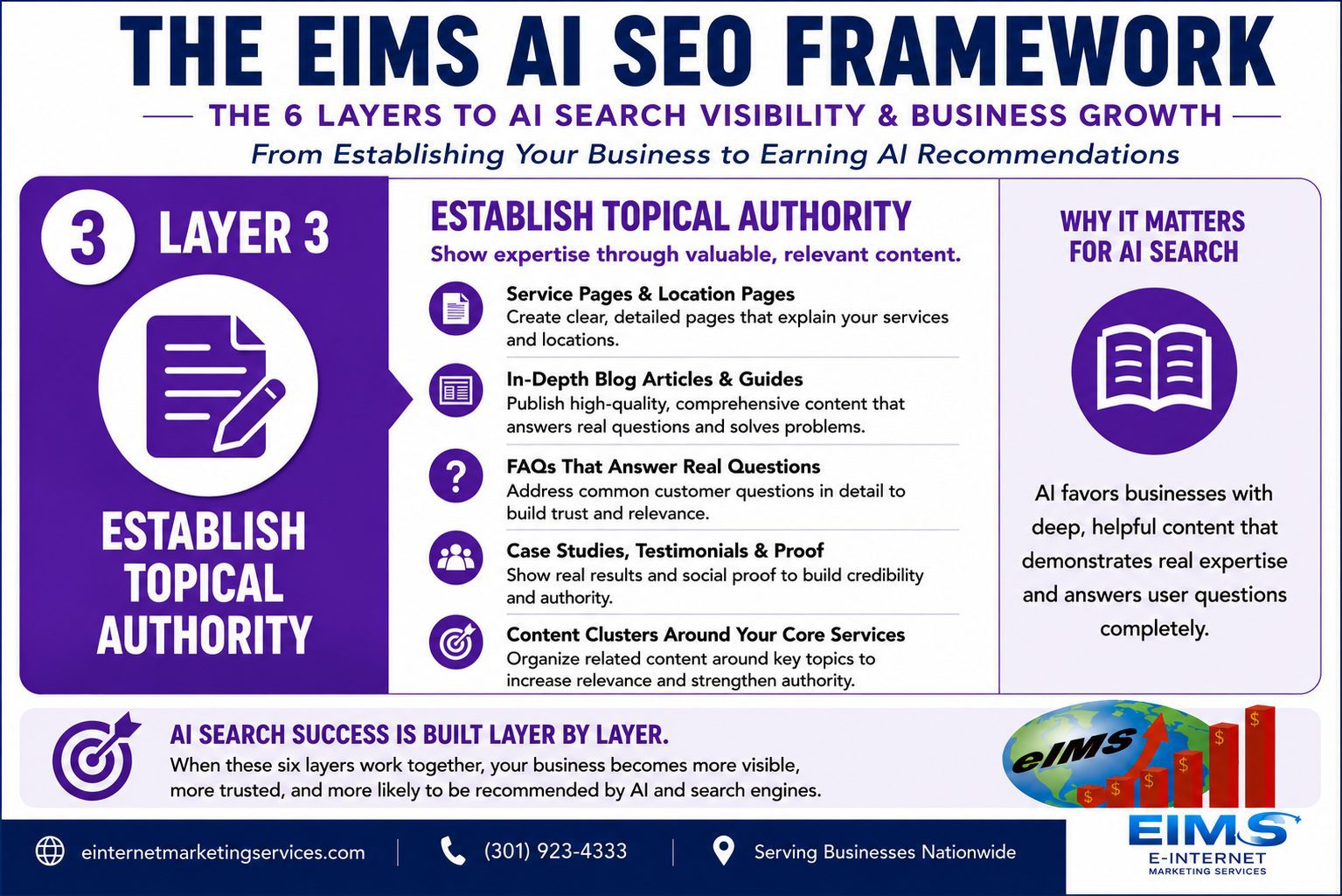 Layer three is where an AI SEO agency proves you know the subject well enough to be worth quoting.
Topical authority is not a score you can look up. It is the cumulative effect of covering a subject thoroughly enough that retrieval systems keep finding you relevant no matter which corner gets asked about. Query fan-out makes this concrete: if AI Mode splits one question into eight sub-questions, the site with something useful on six of them beats the site with a single broad page.
- Service pages that explain the service. Process, timeline, cost drivers, what goes wrong, who it is wrong for. Most service pages are 300 words of adjectives and a contact form.
- In-depth guides that answer a question completely enough that the reader stops searching.
- FAQs from real customer questions — pulled from your inbox, phone logs, and sales calls, not from a keyword tool’s export.
- Case studies and proof. Specific situations, specific constraints, specific outcomes.
- Content clusters. A pillar page on the core service, supported by pieces on each sub-topic, internally linked so the relationships are obvious.
Here is the discipline most businesses skip, and the first thing a good AI SEO agency asks for. Before writing anything, list the twenty questions customers ask before they buy and the ten they ask after. That list is your content plan, and it beats a keyword report because it is grounded in what people actually want to know.
| Example — cluster architecture for a commercial roofing contractor. Pillar: a complete guide to TPO roof replacement. Supporting pieces: TPO versus EPDM in a Midwest climate; repair or replace a flat roof; what a roof inspection covers; how warranties actually work; what causes ponding water. One cluster, and now a model asking about any sub-topic keeps landing on the same domain. |
One warning about volume. Publishing thin AI-generated filler at scale is the fastest way to undo this layer. Google’s guidance has not moved: content built primarily to game search has never held up. An AI SEO agency measuring its own work in articles per month rather than questions answered is selling you word count.
How Does our Maryland AI SEO Agency Make Your Site Machine Understandable?
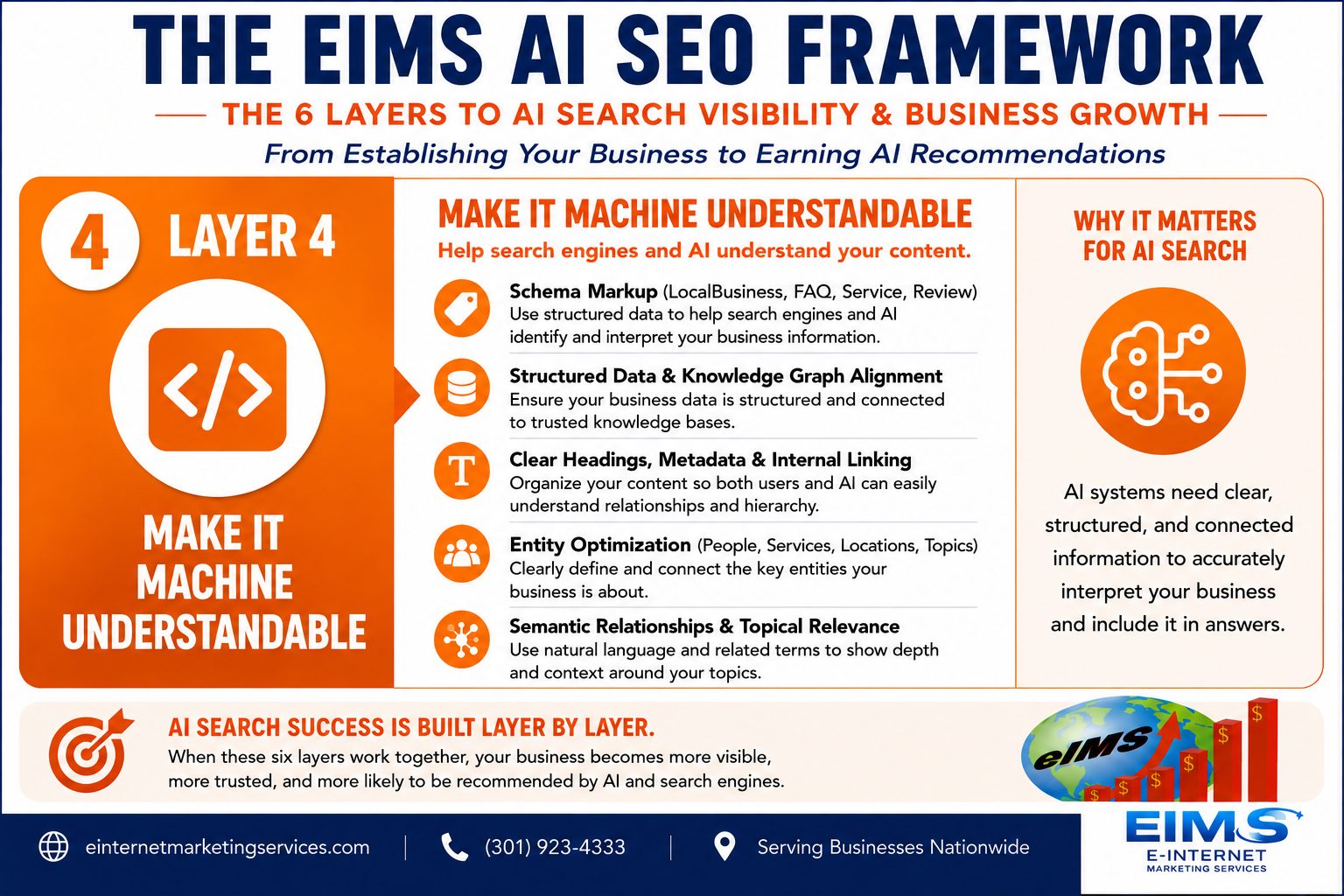 Layer four is where an AI SEO agency translates your business into a format machines read without guessing.
Everything above this layer is written for people. Here, an AI SEO agency adds a parallel track written for parsers, structured data stating your facts explicitly instead of hoping an algorithm infers them from prose.
What an AI SEO agency implements here:
- Schema markup in JSON-LD. LocalBusiness (or the most specific subtype available — Plumber, Attorney, Dentist, MedicalClinic), Service, FAQPage, Article with real author markup, and Review or AggregateRating where you legitimately have them.
- Knowledge graph alignment. Connecting your entity to the places that define entities — profiles, associations, licensing bodies — through consistent naming and same-as references.
- Heading structure. One H1, H2s stating what each section answers, a hierarchy a parser can follow. We build many H2s as questions. H2 are subheadings. Forming them as questions is an on-page SEO strategy designed to match how people search and consume content.
- Internal linking with descriptive anchors. “Commercial roof inspection checklist” tells a machine something. “Click here” does not.
- Entity optimization. Naming the people, services, locations, and topics your business is about consistently and connecting them.
Google’s structured data guidelines carry one rule that trips up more sites than any technical error: markup must match what is visible on the page. Marking up a 4.9-star rating that appears nowhere is a violation, not a shortcut. Any AI SEO agency worth hiring validates its claims with Rich Results. We validate all Rich Results and Schema with our SmartCrawl SEO plugin for businesses we manage and host. For those businesses that do not, several SEO plugins do this very well, such as Yoast SEO Premium and RankMath Pro. We should also make you aware that we don’t charge our clients for SmartCrawl Pro.
You can test your own Rich Results by using Google’s Rich Results Test.
| Reality check on schema. Structured data is not a ranking factor, and no AI SEO agency should tell you it is. What it does is remove ambiguity — hours, service area, price range, who wrote this, and what they know. When a model chooses between a business whose facts are explicit and one whose facts must be inferred, the explicit one is safer to cite. Safer gets cited more. |
How Does our Maryland AI SEO Agency Optimize for AI Retrieval and Citation?
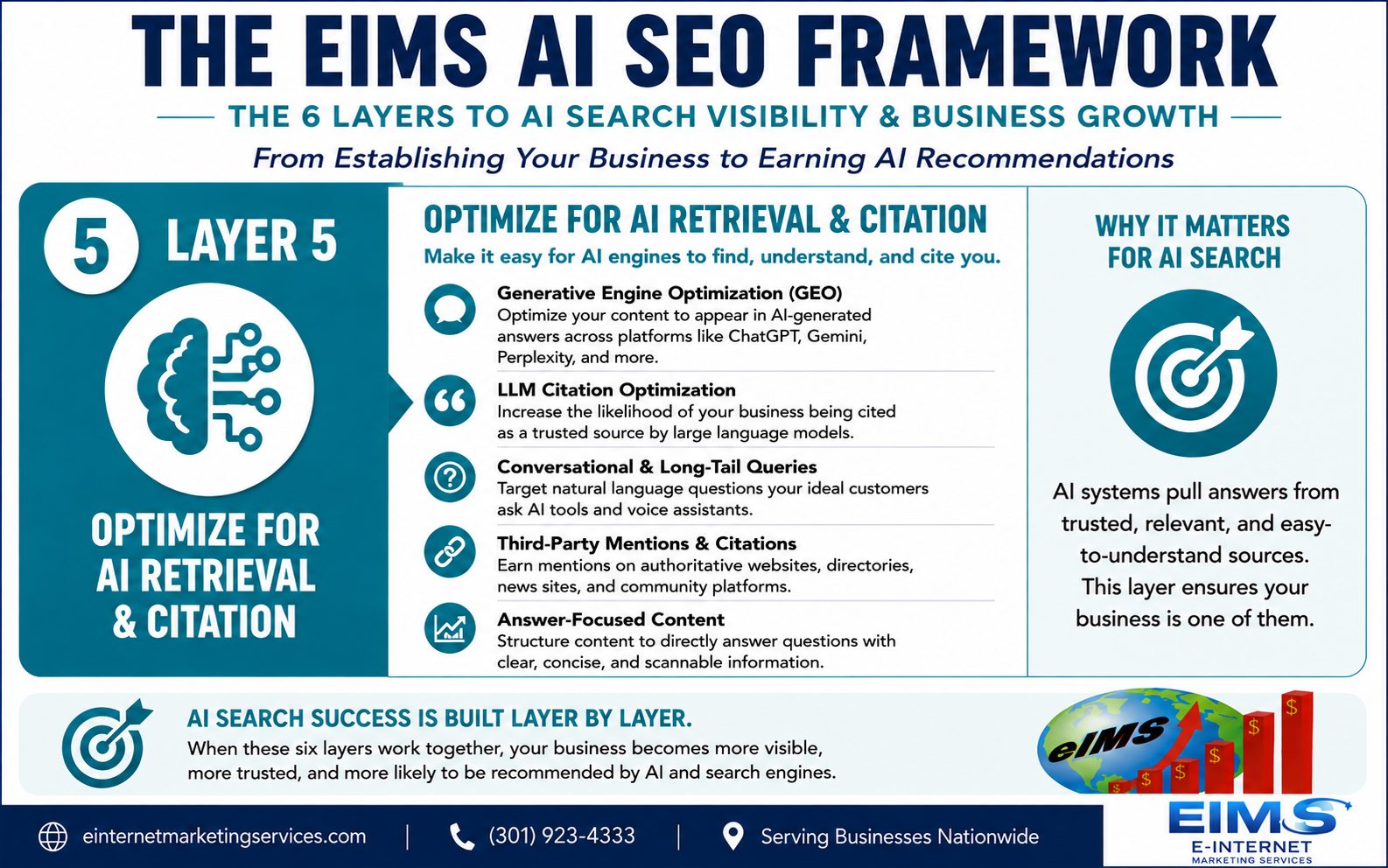 Layer five is what people mean by “AI SEO,” and it only works because layers one through four came first.
Retrieval optimization means structuring content so that a model can extract a clean, self-contained answer from your page. A paragraph that needs three paragraphs of setup will not be quoted. A paragraph answering the question in its first sentence will.
The practices an AI SEO agency applies here:
- Answer-first structure. State the answer in the first 40 to 60 words under the heading, then explain and qualify. Journalists have called this the inverted pyramid for a century, and it is exactly what retrieval systems want.
- Conversational targeting. Build sections around the full questions people ask out loud, since longer natural-language queries are far more likely to produce AI summaries.
- Self-contained passages. Each section should survive extraction alone. Restate the subject instead of leaning on “it” and “this” from three paragraphs earlier.
- Third-party mentions. Industry publications, local news, association directories, supplier listings, podcast appearances. Models synthesize across sources, so an accurate description elsewhere matters enormously.
- Multi-platform distribution. The same expertise on YouTube, LinkedIn and industry forums, since retrieval pulls from more than one index.
Formatting does quite a lot of work here. Clear headings, short paragraphs, definition sentences, comparison tables, and numbered steps give a model clean units to extract. Dense unbroken prose is harder to quote, and hard-to-quote content loses to easy-to-quote content that is only slightly less good.
| Example — same information, two structures. Version A opens with “Many homeowners wonder about the differences between various water heater options available today.” Version B opens with “A tankless water heater heats water on demand and usually outlasts a tank model, but it costs more up front and often requires a gas line or electrical upgrade.” Version B ends up inside the answer because it is the only one that says anything. |
How Does our Maryland AI SEO Agency Measure AI Visibility and Performance?
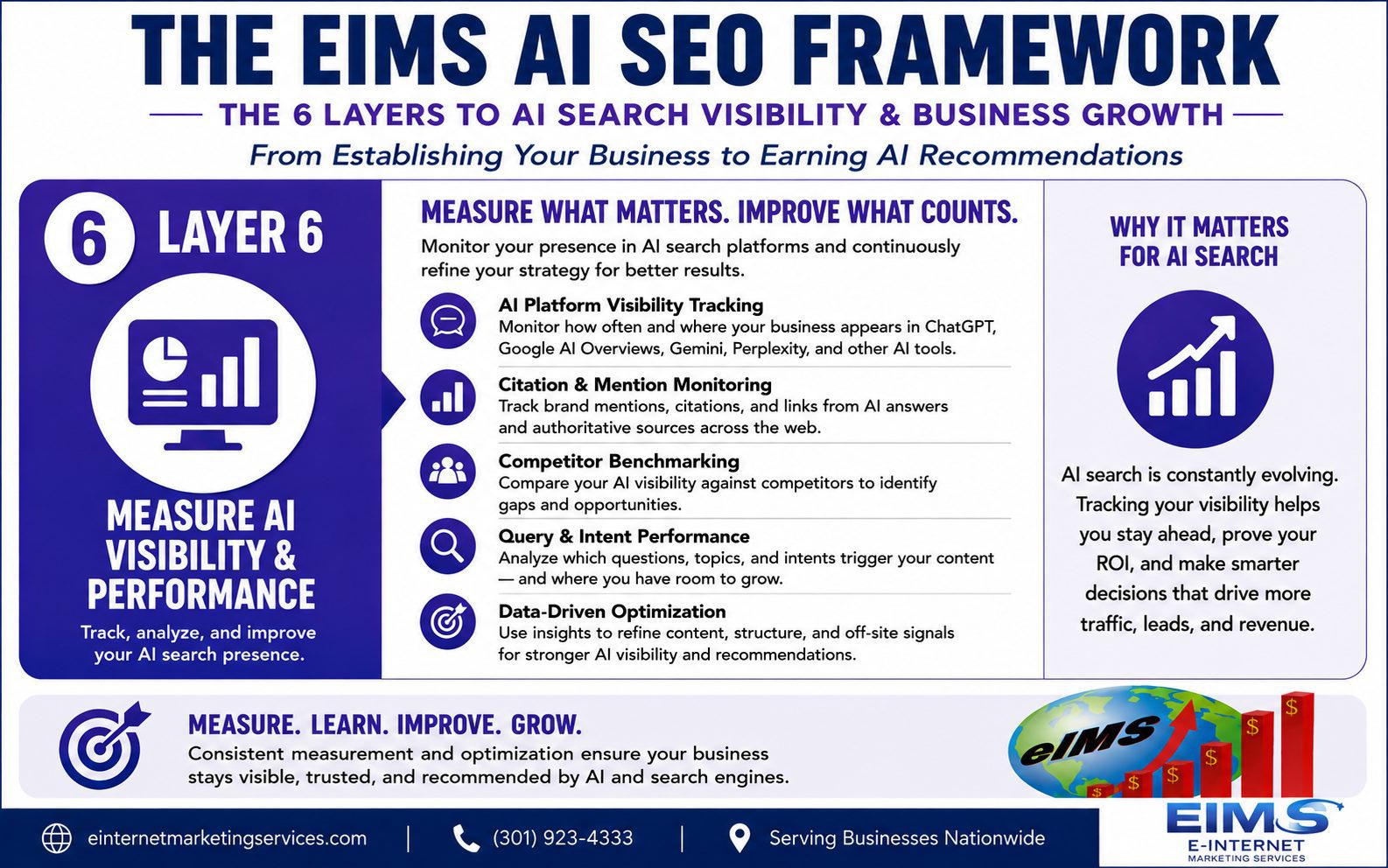 Layer six separates a real AI SEO agency from a vendor selling activity reports.
Traditional analytics cannot see AI answers. Nothing in Google Analytics tells you Perplexity recommended a competitor when someone asked for the best commercial electrician in Phoenix. Untracked means unoptimized.
What an AI SEO agency measures at this layer:
- AI platform visibility. Run a standing set of buyer questions across ChatGPT, Gemini, Copilot, Perplexity, and Google AI Overviews on a fixed schedule. Log whether you appear, where, and how you are described.
- Citation and competitor monitoring. Track which sources AI answers pull from, then run the same question set against your top three competitors. The gaps are your roadmap.
- Traditional search and profile performance. Rankings and clicks in Search Console, plus calls, direction requests, and the queries surfacing your Google Business Profile.
- Revenue outcomes. Leads, booked jobs, closed deals. Everything above is a proxy for these.
One caution: model outputs vary, and the same question asked twice can surface different sources. An AI SEO agency reporting a crisp “AI visibility score” without explaining sampling, query set, and variance is dressing up noise as precision. Track trend lines over months, not a number from Tuesday.
What Does Working With our Maryland AI SEO Agency Look Like Month to Month?
The six layers do not run one at a time in tidy succession. Some finish and become maintenance. Others never stop.
A typical engagement front-loads the foundation. Entity work and the measurement baseline start in week one because you cannot prove improvement without a baseline. Content production begins once the entity is clean, then continues indefinitely. Retrieval optimization ramps up as there is content worth optimizing.
Expect first movement (calls, direction requests, profile views, website visits) within two to three months, because entity and trust work hits systems that update quickly, like your Google Business Profile. Authority and citation behavior move slower; six to nine months is realistic. Any AI SEO agency promising AI citations in thirty days is describing luck, not a process.
How Do You Choose the Right AI SEO Agency?
The category is new enough that the label means whatever the person using it wants it to. Some firms doing excellent work call themselves an AI SEO agency. So do firms that added the words to a stale service page last spring. Ask these questions, and listen for whether the answers are specific:
- How do you measure AI visibility, and what will I see? A real answer names the platforms, describes a fixed set of questions, and shows a sample report.
- What happens in the first 30 days? Entity audit, citation cleanup, profile work, measurement baseline. If month one is “strategy,” you are buying a document.
- Who writes the content, and what do they know about my industry? A model can spot generic content. So can your customers. Ask for a client whose situation resembles yours, not a logo wall, but the problem, the work, and what moved.
- What do I own if we part ways? Your site, profiles, content, and data. Anything the agency keeps is leverage against you.
- How do you handle schema, and how do you validate it? The answer should name a validator and mention matching visible content. If you have a WordPress website, ask them what SEO plugin they use.
Walk away from any AI SEO agency offering guaranteed citations or rankings, a proprietary score with no methodology, a content plan measured only in articles per month, or purchased reviews. Walk away just as fast from an AI SEO agency that cannot explain why entity consistency comes before content.
| One more filter. Ask what they would do if your Google Business Profile got suspended tomorrow. It happens; it is an emergency, and the answer reveals instantly whether that AI SEO agency has handled real accounts or only read about them. |
What Should an AI SEO Agency Cost, and How Do You Judge the Return?
Pricing varies more here than in almost any other marketing service, because “AI SEO” covers everything from a cheap profile-posting service to a full content, technical, and measurement program. Comparing quotes without comparing scope is how businesses end up disappointed.
Normalize every AI SEO agency proposal against the same questions: how many substantive content pieces per month, whether technical implementation is included or billed separately, whether review management is hands-on or a software license, and how many hours of human attention your account gets.
For return, work backward from your own numbers rather than an agency’s projections. You know two things no AI SEO agency does: what a closed customer is worth, and what share of leads you close.
| Input | Where it comes from | Why it matters |
| Average customer value | Your books — revenue per closed job or client | Sets the value of one additional customer |
| Lead-to-customer close rate | Your CRM, or your own count | Converts leads into customers |
| Customer lifetime | Repeat purchase or retention history | A recurring client is worth multiples of a one-time job |
| Monthly investment | The proposal in front of you | The number everything above has to beat |
Run it as a test. If your average customer is worth X and you close one lead in four, then N additional leads a month cover the retainer. Once you know N, you can judge whether an AI SEO agency proposal is plausible. Usually N is smaller than owners expect. Occasionally it is absurd, which is very useful to learn before signing.
Judge an AI SEO agency at 90 days on leading indicators and at 9 to 12 months on revenue. Leading indicators: profile actions, ranking movement on target questions, content shipped against plan, and whether you now appear in AI answers you previously missed.
Can You Do This Yourself Instead of Hiring our Maryland AI SEO Agency?
Some of it, yes, and those parts are worth doing whether or not you hire anyone.
Claim and complete your Google Business Profile, Bing Places, and Apple Business Connect. Make your name, address, phone, and hours identical everywhere. Ask every satisfied customer for a review and respond to all of them. Write down the twenty questions customers ask before they buy. That costs nothing but attention, and it is the entire foundation of Layers 1 and 2.
Owners usually stall in the middle of the framework, which is where an AI SEO agency earns its retainer. Content is the bottleneck; not because owners cannot write, but because publishing substantive pieces consistently for a year while running a company is a hard commitment. Schema stops anyone without development support.
A sensible hybrid: you own reviews and customer questions; an AI SEO agency owns content, technical implementation, and measurement. You are closer to the customer than any agency will ever be, and that raw material is the part nobody can outsource.
Can our Maryland AI SEO Agency Serve Your Business If You Are Not Local to Them?
Yes. In this discipline, geography is nearly irrelevant.
Consider what the work consists of. Writing and publishing content. Implementing schema. Running query sets across AI platforms and reading the results. None of it requires anyone standing in your lobby. It requires access, information, and regular conversation.
What matters is whether the AI SEO agency understands your market. A firm in your city that has never worked in your industry is less useful than a firm across the country that has. Local knowledge you can hand over in an hour. Domain expertise takes years.
EIMS works with clients across the entire United States by video conference. Onboarding, strategy, monthly reporting, and quarterly planning all happen on screen, which, in practice, buys more face time with the people doing the work than a local retainer usually does. No travel, no scheduling around drive times, and a recording of every session for anyone who could not attend.
| Ready to find out where you stand in AI search?
Most businesses have never seen what ChatGPT, Gemini, or Google’s AI Overviews say about them — or whether they come up at all—a five-minute question, a very useful answer. Book a discovery call with E-Internet Marketing Services, and we will walk your business through the Six-Layer AI SEO Framework, show you which layers are solid and which have gaps, and lay out what it would take to close them. We serve clients nationwide by video conference — so whether you are in Portland, Maine, or Portland, Oregon, you get the same AI SEO agency working the same way.
Schedule Your Free Discovery Call E-Internet Marketing Services · (301) 923-4333 · Serving businesses nationwide. |

Frequently Asked Questions About Hiring an AI SEO Agency
What exactly does an AI SEO agency do?
An AI SEO agency makes your business findable and quotable in both traditional search results and AI-generated answers: a clean business entity across Google, Bing, and Apple, verifiable trust signals, content that answers real customer questions, structured data so machines read your facts correctly, passages built to be extracted, and monitoring of what the platforms say about you.
Is an AI SEO agency just a traditional SEO agency with new branding?
The foundations are shared, and any AI SEO agency claiming otherwise is overselling. Google’s documentation says the fundamentals driving Search also govern AI Overviews and AI Mode. What is new is the emphasis: entity clarity and structured data carry more weight, content has to survive extraction out of context, and success gets measured in citations rather than clicks alone.
How long before an AI SEO agency produces results?
Profile and entity work often moves calls and direction requests within two to three months, because those systems update quickly. Authority and citation behavior compound more slowly, six to nine months before the pattern is clear. Any AI SEO agency guaranteeing citations in weeks is describing a coin flip.
Can an AI SEO agency guarantee that my business will appear in ChatGPT or Google AI Overviews?
No, and a guarantee is a reason to end the conversation. Nobody controls what a language model generates, and the same question asked twice can surface different sources. A competent AI SEO agency improves the conditions that make citation likely — entity clarity, third-party corroboration, extractable content, structured data — then measures whether it worked.
Do I still need traditional SEO if I hire an AI SEO agency?
Yes. About half of U.S. adults do not use chatbots at all, and Google remains the dominant starting point even for those who do. The channels feed into each other, since AI systems draw on indexed content. Dropping traditional SEO to chase AI visibility trades a known channel for an unproven one.
How does an AI SEO agency track visibility inside AI platforms?
By running a fixed set of buyer-intent questions across ChatGPT, Gemini, Copilot, Perplexity, and Google AI Overviews on a repeating schedule — logging whether you appear, how you are described, which sources get cited, and how competitors fare on identical questions. The value is the trend line across months, not a single snapshot.
What size and type of business is a good fit for an AI SEO agency?
Any business where customers research before buying and one customer is worth enough to justify a monthly investment. Professional services, home services, healthcare practices, B2B firms, and specialty retailers all qualify. A storefront is not required — service-area businesses lean on profile and location work, national brands on topical authority and third-party mentions.
Will publishing AI-written content help or hurt the work an AI SEO agency does?
It depends entirely on whether the content is worth reading. Google’s guidance targets content produced primarily to manipulate rankings, regardless of how it was made. Using AI to draft, research, or edit is fine. Publishing volume nobody has fact-checked or improved with real expertise is how sites lose trust — and generic content gives models nothing distinctive to quote.
| About the Author
Connect with Rick at ricksamara.com or book a discovery call with EIMS. |
 Rick Samara is the founder and principal owner of E-Internet Marketing Services LLC, an authority local search agency headquartered in Southern Maryland. A former US Air Force Intelligence Officer and analyst, Rick brings nearly two decades of methodical data analysis, precision, and strategic execution to the local SEO industry. Since founding
Further Reading
Chapekis, A., & Lieb, A. (2025, July 22). Google users are less likely to click on links when an AI summary appears in the results. Pew Research Center. https://www.pewresearch.org/short-reads/2025/07/22/google-users-are-less-likely-to-click-on-links-when-an-ai-summary-appears-in-the-results/
Goodwin, D. (2025, July 22). Google’s AI Overviews are hurting clicks: Pew study. Search Engine Land. https://searchengineland.com/google-ai-overviews-hurting-clicks-study-459434
Google Search Central. (n.d.). AI features and your website. Google for Developers. https://developers.google.com/search/docs/appearance/ai-features
Google Search Central. (n.d.). Local business (LocalBusiness) structured data. Google for Developers. https://developers.google.com/search/docs/appearance/structured-data/local-business
Google Search Central. (2025, May 21). Top ways to ensure your content performs well in Google’s AI experiences on Search. Google for Developers. https://developers.google.com/search/blog/2025/05/succeeding-in-ai-search
Gottfried, J., Bishop, W., Anderson, M., Faverio, M., Park, E., & McClain, C. (2026, June 17). Americans and AI 2026: Chatbots, smart devices and views on impact. Pew Research Center. https://www.pewresearch.org/internet/2026/06/17/americans-and-ai-2026-chatbots-smart-devices-and-views-on-impact/
Search Engine Journal. (2025, October 28). Google AI Overviews impact on publishers & how to adapt in 2026. https://www.searchenginejournal.com/impact-of-ai-overviews-how-publishers-need-to-adapt/556843/