Getting an AI to reference your work isn’t luck — it’s architecture. Here’s the blueprint.
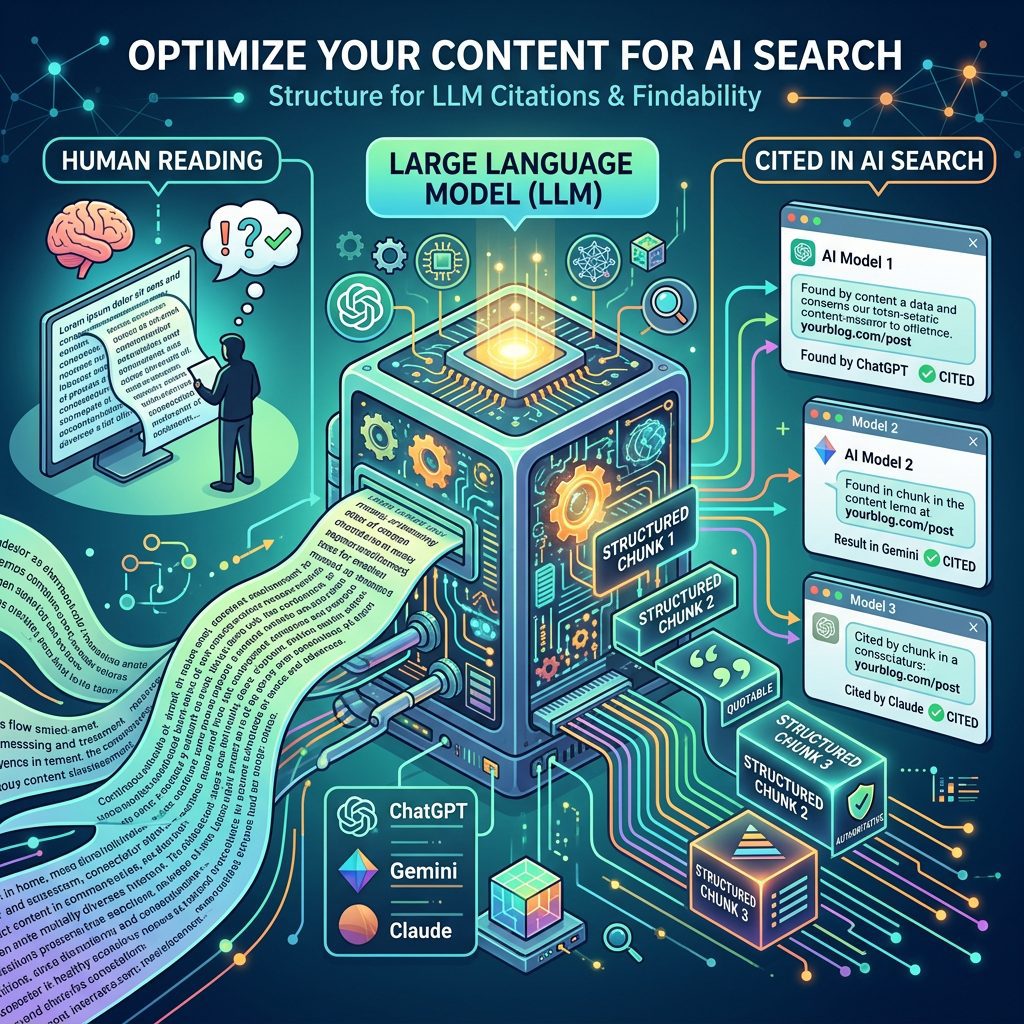
Picture your blog post or article as a neatly labeled filing cabinet. When a human reader arrives, they can rifle through every drawer, skim the fonts, and decide what matters. When an AI arrives, it reads the labels. If those labels are clear and confident, your content gets pulled into AI-generated answers. If they’re vague? The cabinet stays shut. That’s the premise behind AI blog citation — and mastering it is quickly becoming the most valuable SEO skill of 2026. See this article: LLM Citation Optimization Framework: The Next Generation of SEO
Large language models like ChatGPT, Gemini, and Claude don’t “read” the way you do. They extract structured, quotable, authoritative chunks of text. If your blog post is organized to surface those chunks cleanly, you dramatically increase your chances of being cited. Below is a field-tested template — plus real examples — that makes your content AI-citation-ready from the first heading to the last paragraph.
“If you write for humans AND structure for machines, the machines will introduce you to humans you’ve never met.”
Step 1 — Open with a Definitional Hook
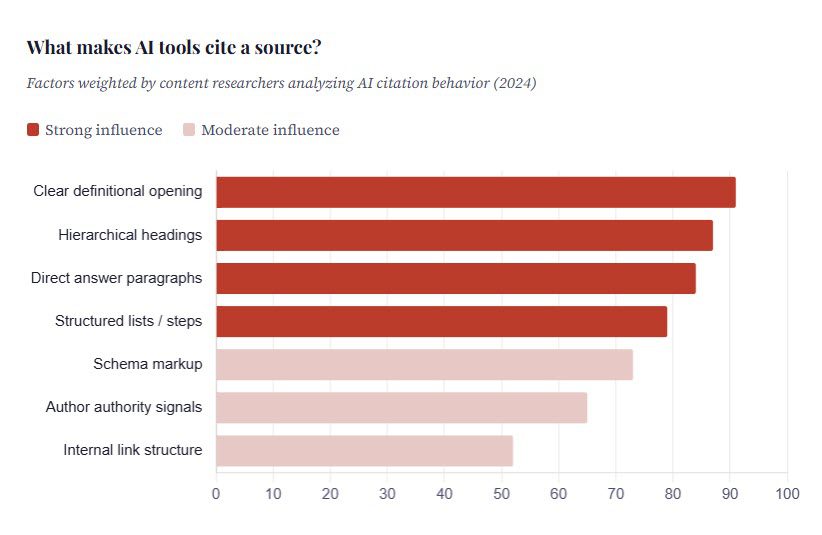
AI models are trained to recognize authority. The fastest signal of authority? Defining your core concept in the first 100 words. Think of it as planting a flag: this post owns this term.
Template: Opening Block
Paragraph 1 — Define + Context
State what the post is about. Define the primary keyword. Give one sentence of real-world stakes.
[Primary keyword] is [clear definition]. This matters because [concrete consequence].
Here is an example: AI blog citation. In the evolving world of Generative Engine Optimization (GEO), an AI blog citation acts as a powerful “trust signal.” While humans see a citation as a courtesy, a Large Language Model (LLM) sees it as a mathematical anchor that makes your content more “citable” and authoritative. This matter because mastering it is quickly becoming the most valuable SEO skill of 2026.
Paragraph 2 — Preview of Value
Promise the structured answer. AI scans for “this post will cover / explain / show you.”
In this guide, you'll find [X], [Y], and [Z] — a complete framework for [outcome].
Step 2 — Use Scannable, Hierarchical Headings
 AI doesn’t prefer your prose — it prefers your outline. Headings are the skeleton an AI X-rays first. Use H2s for major sections, H3s for sub-points, and keep every heading answerable as a standalone question. If your H2 could stand alone as a search query, you’re on the right track.
Heading Formula Convert every section into a “how/what/why” question your reader (and AI) would actually ask.
❌ "Background Information"
✅ “What Is AI Blog Citation and Why Does It Matter?”
❌ “More Details”
✅ “How Do AI Tools Decide Which Blog Posts to Reference?”
Step 3 — Include a “Direct Answer” Paragraph
Every well-optimized post for AI blog citation should include at least one paragraph that answers the central question in 2–3 punchy sentences. Think of it as your post’s “highlight reel” — the snippet an AI would pull verbatim if it could. Keep it clean, factual, and free of hedging language.
Step 4 — Structure with Lists and Numbered Steps
Lists are AI catnip. Numbered steps, bulleted criteria, and comparison tables give AI systems pre-packaged, quotable units of information. Wherever your content includes a process, a set of rules, or a comparison, convert it to structured format. Prose is for humans; lists are for everyone.
Template: The Step-by-Step Block**Step 1:** [Action verb] + [specific task]
**Step 2:** [Action verb] + [specific task]
**Step 3:** [Action verb] + [specific task]
…Each step should be completable as a standalone instruction. Avoid vague language like “consider” or “think about.”
Step 5 — Add Schema Markup and Article Metadata
Behind the scenes of every citable post is a layer of structured data that tells AI crawlers exactly what they’re looking at. At minimum, implement Article or BlogPosting schema markup. Include author, date published, headline, and description fields. It’s the difference between shouting into a crowd and handing someone a business card.
Step 6 — Close with a Citable Conclusion
Your final paragraph is prime real estate for AI blog citation. Restate the core answer, echo the primary keyword naturally, and include one memorable, quotable sentence. AI systems heavily weight conclusions — they’re the last thing processed and often the first thing cited.
Conclusion
Structuring a blog post for AI blog citation is less about writing better and more about writing smarter. When every section is clearly labeled, every key point is directly stated, and every page carries proper metadata, you stop writing for the algorithm and start writing with it — which is exactly where the future of content lives.
Ready to Make Your Content AI-Citation Ready?
We help businesses across the U.S. — from Miami to Seattle — build content strategies built for the AI era. No matter where you are, we bring our expertise to you via video conference.

Further Reading
Fishkin, R. (2024). The future of SEO in an AI-first search world. SparkToro. https://sparktoro.com/blog/seo-ai-future
Google Search Central. (2024). Creating helpful, reliable, people-first content. Google. https://developers.google.com/search/docs/fundamentals/creating-helpful-content
Schema.org. (2024). BlogPosting schema type documentation. Schema.org. https://schema.org/BlogPosting
Patel, N. (2024). How to optimize content for AI overviews and generative search. NP Digital. https://neilpatel.com/blog/ai-overviews-optimization
Search Engine Journal. (2024). Structured data and its role in AI-powered search results. Search Engine Journal. https://www.searchenginejournal.com/structured-data-ai-search/500124/