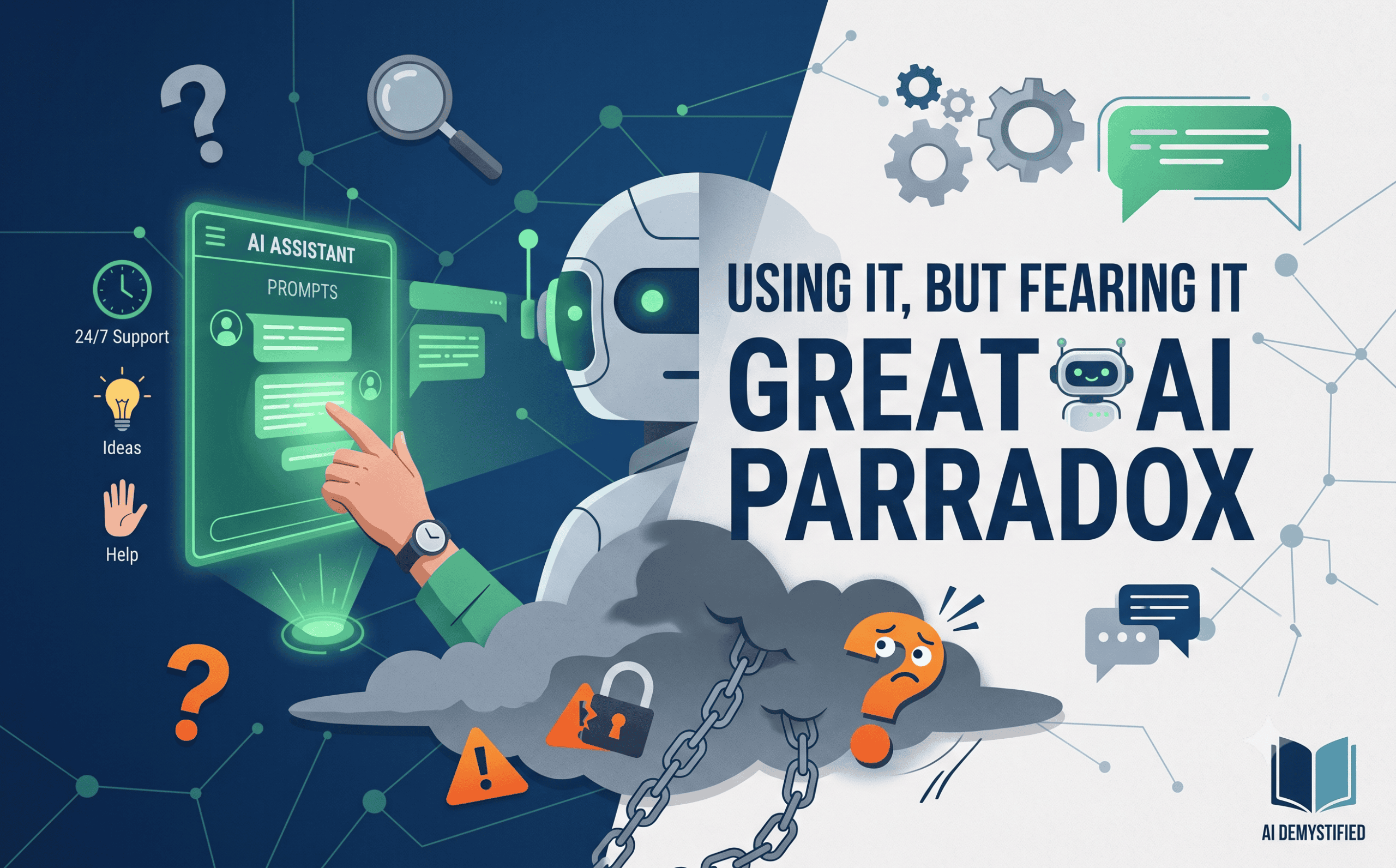
The great AI paradox is the documented tension in which public adoption of AI chatbots grows rapidly while fear, skepticism, and distrust remain high. More than 70% of adults have used generative AI tools, yet roughly half report feeling more concerned than excited about the technology. The paradox is driven by three root causes: AI “hallucinations” that produce false information, fear of job displacement, and concerns about data privacy and algorithmic bias. Overcoming the great AI paradox requires shifting from keyword-based searching to structured, conversational prompting. This is a skill anyone can learn without technical experience.
TABLE OF CONTENTS
- What Is the Great AI Paradox?
- What Are the Three Root Causes of the Great AI Paradox?
- How Are Everyday Users Overcoming AI Hesitancy?
- What Is the CROFTC Framework and How Does It Reduce AI Errors?
- How Do Small Businesses Apply AI Without Technical Experience?
- Frequently Asked Questions
- Further Reading
What Is the Great AI Paradox?
The great AI paradox is the simultaneous growth of AI adoption and public skepticism toward the same technology. Artificial intelligence has moved from science fiction into everyday life, powering web searches, customer service, content creation, and workplace productivity tools. Yet broad usage has not translated into broad trust.
According to research from the Pew Research Center, more than 70% of adults have experimented with generative AI tools such as ChatGPT, Google Gemini, or Microsoft Copilot. These same users actively rely on AI to draft emails, answer questions, and streamline tasks at work. Yet roughly half of that same group reports feeling significantly more concerned than excited about the rise of artificial intelligence.
A Facebook friend of mine told me that she and her husband refer to ChatGPT as Chatty Cathy. I find that hilarious. If you’re familiar with the Mattel doll of the same name that came out in the early 1960’s, you just pulled a string and it talked. I’m afraid that a lot or people actually use ChatGPT the same way. Obviously, technology has exploded exponentially over these 50+ years. I just have to wonder how much this example parallels how people feel about the chatbots today.

According to Dictionarty.com The phrase “chatty cathy” means an overly talkative person who engages in a lot of idle or nonstop chatter. It is an informal, often slightly critical expression used to describe someone who talks incessantly, sometimes without sharing information of real importance. Hey, that’s why we are here. We want to dispel all these common myths about AI, the LLMs, and help people get over their distrust for the chatbots like ChatGPT, Google Gemini, etc..
| The great AI paradox describes a documented social tension: widespread daily use of AI chatbots coexists with deep skepticism about their accuracy, safety, and societal impact. It is not a contradiction — it is a rational response to technology that is genuinely useful and genuinely unpredictable at the same time. |
What Are the Three Root Causes of the Great AI Paradox?
The great AI paradox persists because personal utility and societal anxiety pull in opposite directions. Three specific drivers account for most of the skepticism:
1. AI Hallucinations and Accuracy Concerns
AI large language models frequently generate false information and present it as facts. This behavior is called “hallucinating.” A user who asks a chatbot for a legal citation, a medical dosage, or a historical date and receives a confident but incorrect answer quickly learns to distrust the tool for any high-stakes task. This single experience is often enough to color all subsequent interactions with skepticism, even when the AI performs well.
2. Fear of Job Displacement
Between 60% and 70% of workers report concern that widespread AI automation will result in significant net job losses across administrative, creative, and technical sectors. This fear does not require a worker to have personally lost a job to AI. News coverage, industry reports, and peer conversations are sufficient to sustain it.
3. Loss of Human Connection and Data Privacy
As AI systems take over customer interactions and content generation, concerns accumulate around three related issues: algorithmic bias (AI systems that reflect or amplify human prejudices), data privacy (uncertainty about how personal information is collected and used), and erosion of human engagement (the sense that genuine human interaction is being replaced by scripted machine responses).
| Key Insight
These three drivers do not disappear when someone begins using AI — they persist alongside usage. The great AI paradox is not a phase users pass through on the way to full acceptance. It is an ongoing, rational negotiation between what AI can do and what it might cost. |
How Are Everyday Users Overcoming AI Hesitancy?
Despite persistent anxiety, most users are not abandoning AI tools — they are adapting their approach to them. Three behavioral shifts are helping everyday users navigate the great AI paradox:
- Shifting from keyword searching to conversational prompting — Users are learning that AI responds better to full, contextual sentences than to the short keywords they once typed into Google.
- Breaking through technical jargon — When concepts like Machine Learning or Neural Networks are explained through plain-language analogies, user confidence rises significantly.
- Starting with practical, low-stakes applications — Tools like AI appointment schedulers, automated phone assistants, and email drafters let users build confidence before tackling more complex use cases.
As I write in AI for Beginners Demystified, the primary barrier for most people is not the technology itself. It is the intimidating vocabulary that surrounds it. When you strip away the jargon and replace it with clear analogies, and beginner confidence rises quickly.
What Is the CROFTC Framework and How Does It Reduce AI Errors?
One of the most effective tools for overcoming the great AI paradox at the practical level is structured prompt engineering. Rather than typing vague questions and hoping for useful output, structured prompting gives the AI every piece of context it needs to produce accurate, usable results.
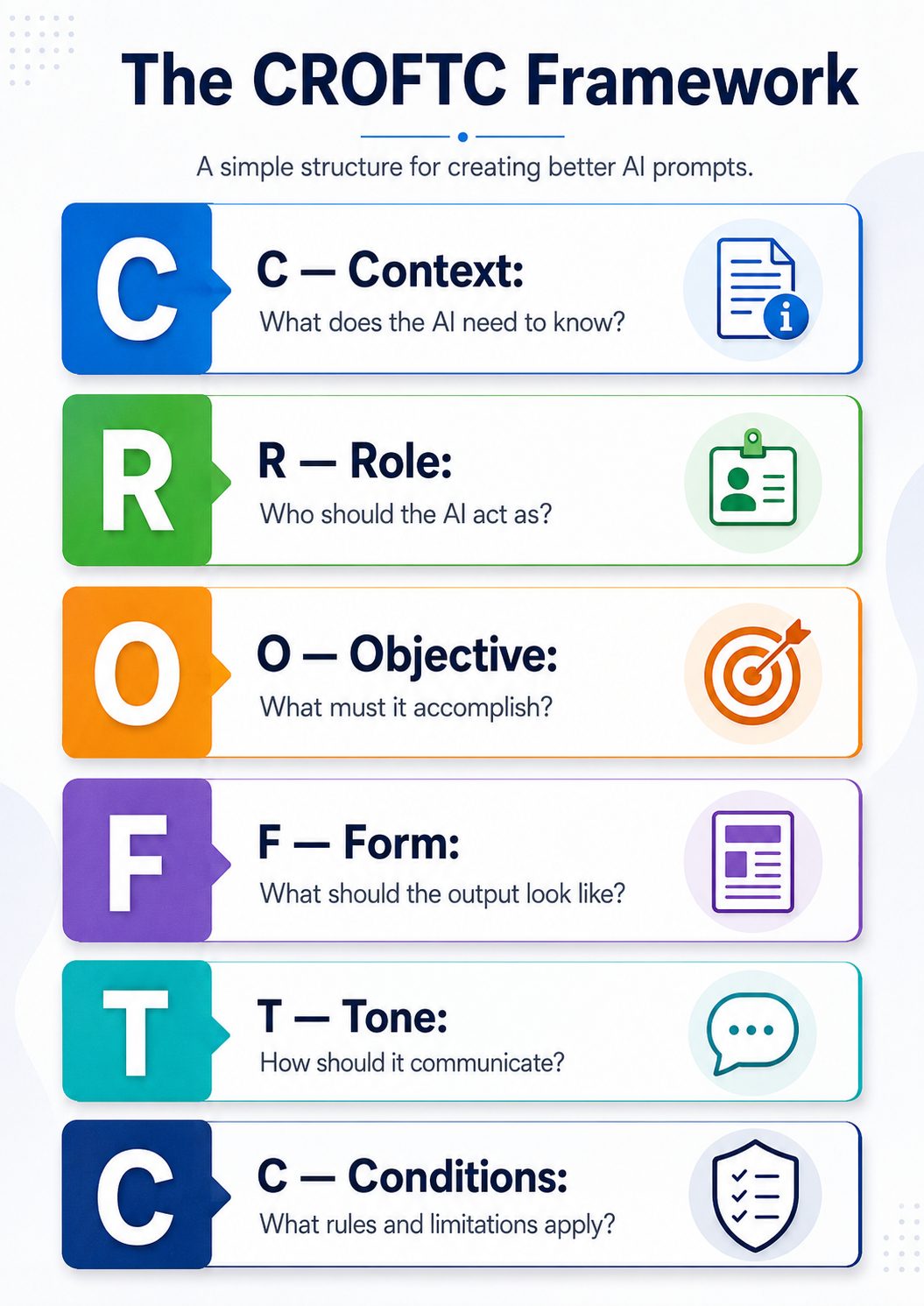
The CROFTC Framework — developed as part of AI for Beginners Demystified (Vale, A., 2025) — provides a six-element structure that reduces hallucinations, narrows the AI’s scope, and dramatically improves output quality:
[C] Context
Describe the situation in one or two sentences. Who is involved, what has happened so far, and what environment are you working in?
[R] Role
Tell the AI what persona to adopt. “Act as an experienced legal editor” or “You are a licensed nutritionist” narrows the AI’s frame of reference.
[O] Objective
State the specific task clearly. “Draft a client welcome email” is better than “write something for my new clients.”
[F] Format
Specify the structure of the output: bullet points, numbered steps, a table, or prose with bold headers.
[T] Tone
Indicate the desired voice: formal, conversational, encouraging, technical, or any combination.
[C] Conditions
Set explicit constraints: word count limits, things to include or avoid, required disclaimers, or deadline references.
| CROFTC in Action — Bowling League Example
[Context] I am organizing a 10-week, 8-team recreational bowling league for local parents starting next month. [Role] Act as an experienced, highly organized community sports league coordinator. [Objective] Draft a welcome email for team captains that outlines the schedule format, rules, and fee details. [Format] Format the output with clear bullet points, bold headers, and a simple placeholder schedule table. [Tone] Friendly, encouraging, and structured, with a lighthearted, welcoming vibe. [Conditions] Keep the email under 300 words, explicitly state that all skill levels are welcome, and highlight that fees are due by next Friday. Result: A complete, ready-to-send email with no follow-up revisions required. |
How Do Small Businesses Apply AI Without Technical Experience?
Small businesses and independent professionals are resolving the great AI paradox not by waiting for the technology to feel safe, but by starting with a narrow, practical application and expanding from there. The most common friction-free entry points are:
- 24/7 AI voice phone assistants — Answer inbound calls, qualify leads, and schedule appointments automatically, without a human receptionist on staff around the clock.
- Automated appointment schedulers — Eliminate the back-and-forth of calendar coordination with a tool that books directly from a client-facing link.
- Customer service chatbots — Handle frequently asked questions, order status inquiries, and basic support without requiring a full-time support agent.
- AI-assisted email drafting — Produce first drafts of client communications, proposals, and newsletters in minutes using structured CROFTC prompts.
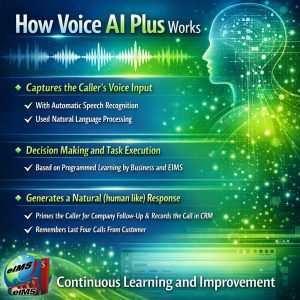
None of these tools require coding, a dedicated IT team, or deep technical knowledge. They are designed to reduce operational friction and free human staff for high-judgment tasks that AI cannot replicate. For a deeper look at how AI voice tools specifically support small business operations, see the related article: Voice AI Plus for Business →
CONCLUSION
The great AI paradox — the coexistence of enthusiastic adoption and persistent distrust — is not a problem to be solved. It is a condition to be understood. The users and organizations that are navigating it most successfully share a common approach: they start with practical, low-stakes applications, they use structured prompting frameworks to minimize errors, and they treat AI as a skilled collaborator rather than an infallible oracle.
In my own practice, I estimate that structured AI usage saves me 20 to 25 hours of work each week. That productivity gain is not the result of trusting AI blindly. It is the result of knowing exactly how to frame a request so the output is immediately useful. The CROFTC Framework is the fastest path I know to that level of fluency for any user, at any skill level, in any industry.
| The great AI paradox resolves not when the technology becomes perfect, but when the user becomes practiced. Structured prompting, plain-language learning, and friction-free entry points are the three tools that move any individual or business from anxious observer to confident practitioner. |
| 📹 Serving Clients Nationwide via Video Conferencing
Ready to put AI to work for your business? E-Internet Marketing Services helps small businesses, real estate professionals, and independent practitioners implement AI tools that actually work — without requiring a tech background. We work with clients across the entire United States via video conferencing. No travel. No friction. einternetmarketingservices.com • (301) 923-4333 |
Frequently Asked Questions
Q1: What is the great AI paradox?
The great AI paradox is the documented coexistence of high AI adoption rates and persistent public skepticism. More than 70% of adults have used generative AI tools, yet roughly half report feeling more concerned than excited about the technology. The paradox arises because personal utility and broader societal anxiety operate simultaneously — they do not cancel each other out.
Q2: Why do people distrust AI if they use it every day?
Daily use does not eliminate distrust because the concerns driving skepticism — hallucinations, job displacement, and privacy risk — are structural features of the technology, not beginner misunderstandings. A user can find AI genuinely useful for drafting emails while still reasonably worrying about the accuracy of AI-generated medical or legal information.
Q3: What is a hallucination in AI?
An AI hallucination occurs when a language model generates a statement that is factually incorrect but presented with full confidence. Examples include fabricated citations, invented statistics, and incorrect dates. Hallucinations are reduced — though not eliminated — by providing more context and specificity in your prompt, which is the core principle behind structured frameworks like CROFTC.
Q4: Do I need technical experience to use AI effectively?
No. Effective AI use relies on clear, structured natural language — not programming knowledge. The CROFTC Framework (Context, Role, Objective, Format, Tone, Conditions) is a prompting approach that anyone can apply using ordinary writing skills. No coding, no technical background, no prior AI experience required.
Q5: Are AI chatbots safe for small business use?
Yes, when used as supportive tools rather than autonomous decision-makers. Small businesses routinely use AI for customer service routing, phone handling, email drafting, and appointment scheduling — all tasks where AI reduces friction without replacing human judgment on high-stakes decisions.
Q6: How does the CROFTC Framework reduce AI errors?
CROFTC reduces AI errors by eliminating ambiguity. Each element of the framework — Context, Role, Objective, Format, Tone, Conditions — narrows the AI’s search space and reduces the probability that it will fill in missing information with an incorrect assumption. A well-structured prompt gives the model fewer gaps to hallucinate into.
ABOUT THE AUTHOR
 Rick Samara
Former USAF Intelligence Officer | Award-Winning Author | AI Marketing Strategist
Rick Samara is a former Air Force Intelligence Officer and award-winning author of AI for Beginners Demystified. Drawing on his background in translating complex intelligence data into simple, actionable insights, Rick specializes in helping small business owners, professionals, and everyday learners embrace artificial intelligence without getting lost in technical jargon. He is the founder of E-Internet Marketing Services LLC and publishes AI literacy content at ricksamara.com. Rick works with clients nationally via video conferencing.
FURTHER READING
Pew Research Center. (2025, September 17). How Americans view AI and its impact on people and society. Pew Research Center. https://www.pewresearch.org/science/2025/09/17/how-americans-view-ai-and-its-impact-on-people-and-society/
Pew Research Center. (2026, March 12). Key findings about how Americans view artificial intelligence. Pew Research Center. https://www.pewresearch.org/short-reads/2026/03/12/key-findings-about-how-americans-view-artificial-intelligence/
Vale, A. (2025). The prompt recipe: A practical guide to prompt engineering and AI interaction. Independent. https://www.amazon.com
Samara, R. (2025). AI for beginners demystified: Build confidence without the techie jargon. E-Internet Marketing Services LLC. https://einternetmarketingservices.com
E-Internet Marketing Services. (2025). Voice AI Plus: Your personal virtual AI assistant for your business. https://einternetmarketingservices.com/voice-ai-plus-your-personal-virtual-ai-assistant-for-your-business/