Summary
AI Search Citations are becoming an important part of online visibility as Google, ChatGPT, Copilot, Perplexity, and other AI platforms answer questions with information drawn from multiple sources. This article explains how AI systems retrieve information, why relevance, authority, clarity, freshness, and corroboration matter, and how businesses can make their websites easier to understand and cite. It also examines reviews, social media, structured data, and third-party mentions, with practical examples for companies serving customers across the United States. Finally, it shows how to measure AI visibility and strengthen your presence without abandoning proven SEO fundamentals or chasing shortcuts and gimmicks.
For years, search engine optimization had a relatively straightforward objective: get your website as high as possible in Google search results. Please read our baseline article on this topic: A Comprehensive Tutorial to Getting Found in Google and AI Search.
That goal still matters. But something important has changed. And AI Search Citations are part of that change.
Your prospective customer may now ask ChatGPT for recommendations, read a Google AI Overview, conduct a detailed search in Google AI Mode, consult Microsoft Copilot, or use an answer engine such as Perplexity before ever visiting a traditional search results page.
Those AI-generated answers frequently contain references to websites, publications, businesses, government agencies, and other sources. These references, AI Search Citations, are creating another form of online visibility businesses need to understand.
The critical question is no longer simply:
“Does my website rank?”
Businesses increasingly need to ask:
“When AI answers a question about my industry, does it know who we are, understand what we do, and consider our information useful enough to include?”
No magic switch makes that happen. Google specifically says that sites do not need a separate set of technical requirements to appear in AI Overviews or AI Mode. The same fundamentals of helpful content, technical accessibility, and people-first SEO remain important. Google also says its AI search experiences can conduct multiple related searches through a process it calls “query fan-out” before assembling an answer. (Google for Developers)
Understanding that process helps explain what businesses can realistically do to improve their chances of earning AI Search Citations.
What Are AI Search Citations and Why Do They Matter?
AI Search Citations are references, links, or source attributions associated with information presented in an AI-generated response.
Suppose someone asks:
“What should I look for when choosing a commercial roofing company?”
An AI system might produce an explanation and reference several supporting sources. One may be a roofing manufacturer. Another may be a trade association. A third may be an experienced roofing contractor that published a particularly useful guide.
Being included in that answer is different from ranking as a conventional blue link.
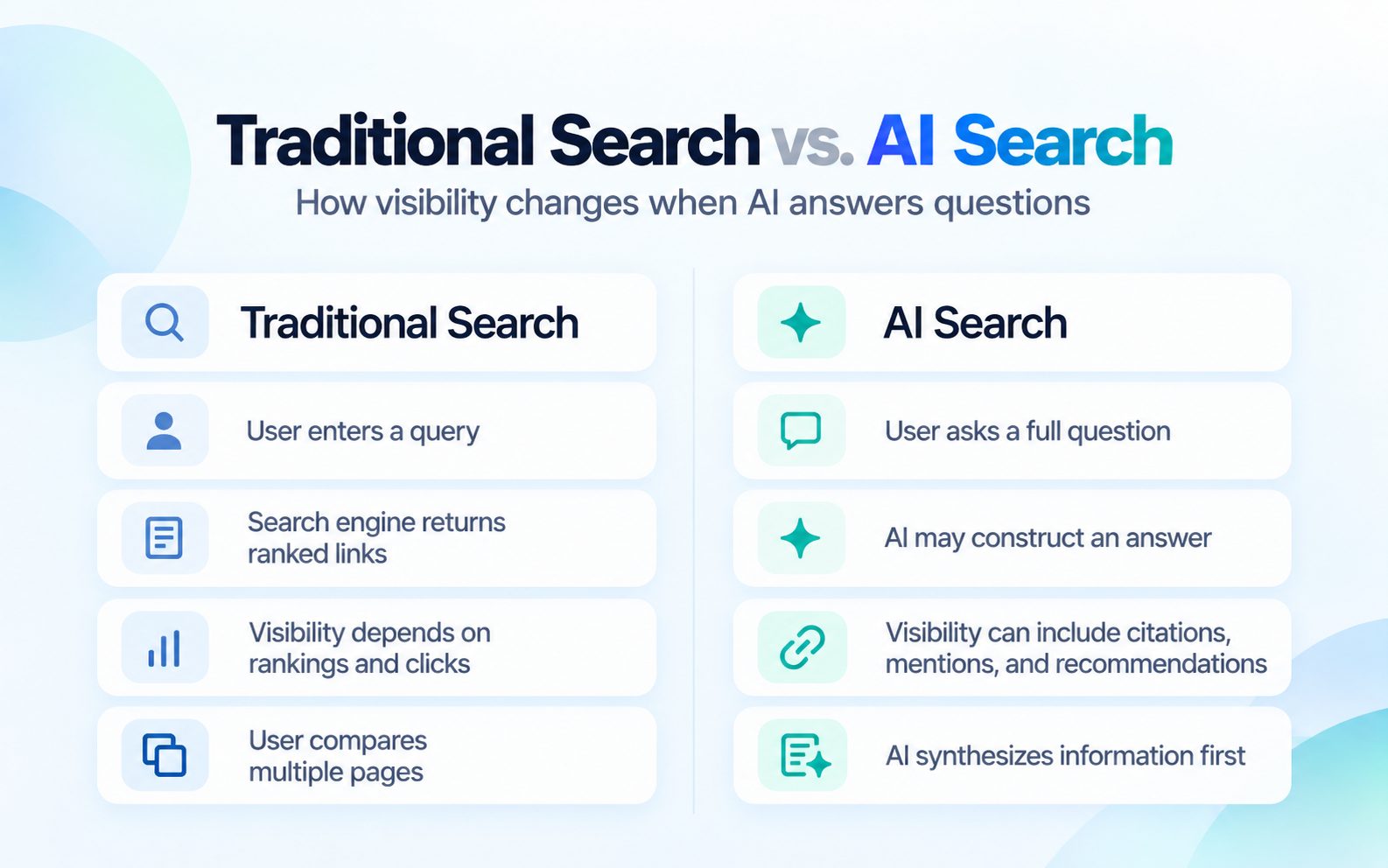
Traditional Search vs. AI Search
| Traditional Search | AI-Powered Search |
|---|---|
| User enters a query | User often asks a complete question |
| Search engine returns ranked links | AI may construct an answer |
| Website competes for a ranking position | Website may compete to become supporting information |
| Visibility centers on rankings and clicks | Visibility can include citations, mentions, and recommendations |
| User interprets multiple pages | AI may synthesize information before presenting it |
The distinction matters because a customer can encounter your company or expertise without immediately clicking your website.
Pew Research Center analyzed 68,879 Google searches from U.S. adults in March 2025. When an AI summary appeared, users clicked a traditional search result in 8% of visits, compared with 15% when no AI summary appeared. Users clicked links within the AI summaries themselves in only about 1% of visits. (Pew Research Center)
That means AI Search Citations should not be evaluated purely as referral traffic. They may also contribute to visibility, familiarity, and authority before a customer ever reaches your website.
How Do AI Search Citations Begin With Retrieval?
One of the easiest ways to understand modern AI search is to think of an open-book exam.
A language model contains an enormous amount of information learned during training. But some AI systems can also retrieve outside information when responding to a question.
ChatGPT Search, for example, can search the web and provide links to relevant sources. Microsoft describes a similar concept as “grounding,” where Copilot can use web information and other available sources to anchor a response. (OpenAI)
A simplified process looks like this:
| Stage | What Happens |
|---|---|
| 1. Question | Someone asks an AI system a question |
| ↓ | |
| 2. Retrieval | The system searches for potentially relevant information |
| ↓ | |
| 3. Selection | Useful passages or sources are identified. |
| ↓ | |
| 4. Synthesis | The AI combines relevant information. |
| ↓ | |
| 5. Answer | A response is generated. |
| ↓ | |
| 6. Citation | Supporting sources may be displayed. |
This retrieval component is closely related to a concept called Retrieval Augmented Generation, commonly known as RAG.
RAG combines language generation with information retrieved from an external knowledge source. The original academic work describing RAG demonstrated how a language model could combine information stored in the model with information retrieved from an external collection. (arXiv)
For business owners, the technical definition matters less than the practical idea:
Instead of relying only on what an AI model already knows, the system can look up information before answering.
That creates the opportunity for your content to become part of the material an AI system uses. That’s why AI Search Citations matter.
Where Can AI Search Citations Get Their Information?
AI systems are not limited to one type of website.
Depending on the platform, query, and available data, potential sources can include:
- Business websites
- Government websites
- Educational institutions
- News organizations
- Industry associations
- Manufacturers
- Professional organizations
- Online directories
- Research studies
- Customer review platforms
- Forums and community websites
- Social content
- Videos
- Product information
- Knowledge bases
This is one reason AI Search Citations should be viewed as an ecosystem rather than something controlled exclusively through your company website.
Pew’s analysis of Google AI summaries found that Wikipedia, YouTube, and Reddit collectively accounted for 15% of the sources it examined. Government websites were also more prevalent among AI Overview sources than among traditional search results in that particular study. (Pew Research Center)
That does not mean every business needs a Wikipedia page or a Reddit campaign. It’s nice. It’s another source for AI search citations. While having those outposts is a nice little bonus for feeding the AI search citation machine, treating them like mandatory marketing checkboxes is a great way to waste time. Let’s be real. The algorithm might love a Wikipedia footnote, but your customers usually just want a business that answers the phone and doesn’t accidentally launch a viral Reddit roast.
It means AI visibility can depend on what the broader web says about a subject or business, not simply what the business says about itself.
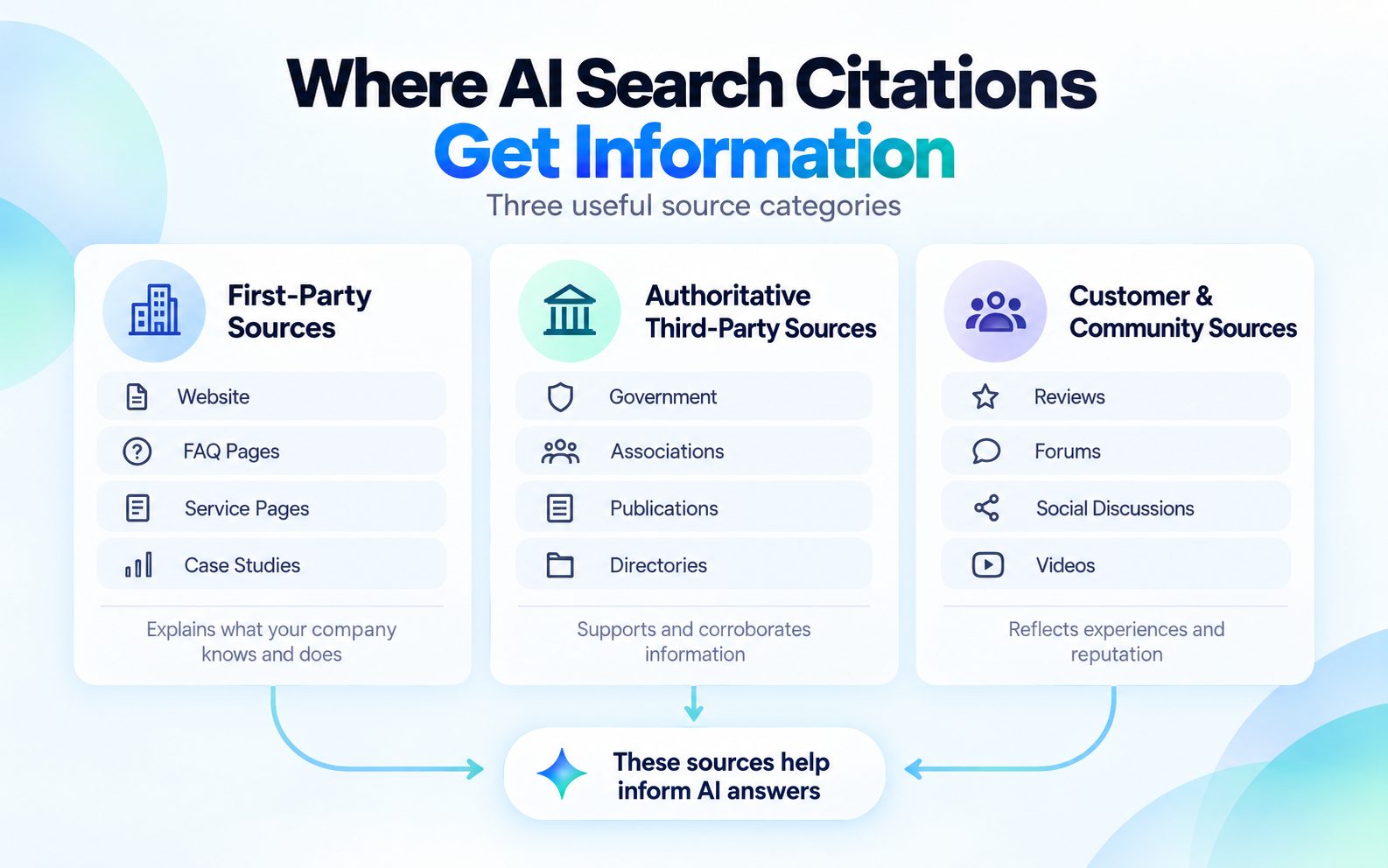
Three Useful Source Categories
| Source Category | Examples | Primary Role |
|---|---|---|
| First-party sources | Website, FAQ, case studies, service pages | Explain what your company knows and does |
| Authoritative third-party sources | Government agencies, associations, publications | Support and corroborate information |
| Customer/community sources | Reviews, forums, social discussions | Reflect experiences, sentiment, and reputation |
A strong digital presence can contain signals from all three categories.
How Do AI Search Citations Evaluate Relevance?
The first requirement is deceptively simple. Your information needs to answer the question. Imagine a homeowner asks:
“How do I know whether my HVAC compressor has failed?”
Company A has a service page saying:
We provide excellent HVAC repairs at competitive prices. Contact our experienced team today.
Company B has an article explaining:
- common compressor failure symptoms,
- why breakers sometimes trip,
- how technicians test compressors,
- when replacement makes sense,
- what other problems can resemble compressor failure.
Company B has created material that more directly addresses the information need.
That does not guarantee AI Search Citations, but it gives a retrieval system much more useful material to work with.
Google’s documentation reinforces this principle. Its guidance for generative AI search emphasizes useful, satisfying, and original content that addresses people’s needs rather than producing large amounts of material designed primarily to manipulate search visibility. (Google for Developers)
Think in Questions, Not Just Keywords for AI Search Citations to Work.
Traditional keyword:
commercial roof repair
Natural-language question:
“Should I repair or replace a 20-year-old commercial flat roof that has started leaking?”
The second query contains multiple concepts:
- roof age
- flat roofing
- leaks
- repair
- replacement
- decision criteria
An AI system may need information about several of those subjects before answering.
That is why comprehensive topical coverage can improve the environment in which AI Search Citations become possible.
How Do AI Search Citations Determine Whether a Source Is Trustworthy?
No public checklist tells businesses exactly how each AI platform evaluates sources.
Different systems use different models, indexes, retrieval methods, and ranking technologies.
However, businesses can strengthen characteristics that make information easier to evaluate and verify.
These include:
Relevance. Does the information answer the question?
Specificity. Does the source contain useful facts rather than generic marketing language?
Authority. Is the source demonstrably knowledgeable about the subject?
Experience. Does it contain evidence of firsthand knowledge?
Corroboration. Can important claims be confirmed elsewhere?
Freshness. Is time-sensitive information current?
Clarity. Can a machine, and a human quickly understand the answer?
Accessibility. Can search systems crawl and index the material?
Think of these attributes as pieces of evidence rather than a formula.
The Trust Equation Is Not One Signal
A useful conceptual model is:
| Weak Digital Evidence | Stronger Digital Evidence |
|---|---|
| “We are the best.” | Detailed evidence of expertise |
| One company claim | Independent corroboration |
| Anonymous article | Identified knowledgeable author |
| Generic service copy | Specific explanations and examples |
| Inconsistent business details | Consistent entity information |
| Old information | Regularly reviewed information |
| Thin content | Complete answers to real questions |
For AI Search Citations, verifiability matters.
A company saying it has 25 years of experience is one statement.
A company website, state licensing record, trade association profile, credible news article, and other established sources consistently connecting the same company to that history create a much richer information environment.
Why Does Entity Clarity Matter for AI Search Citations?
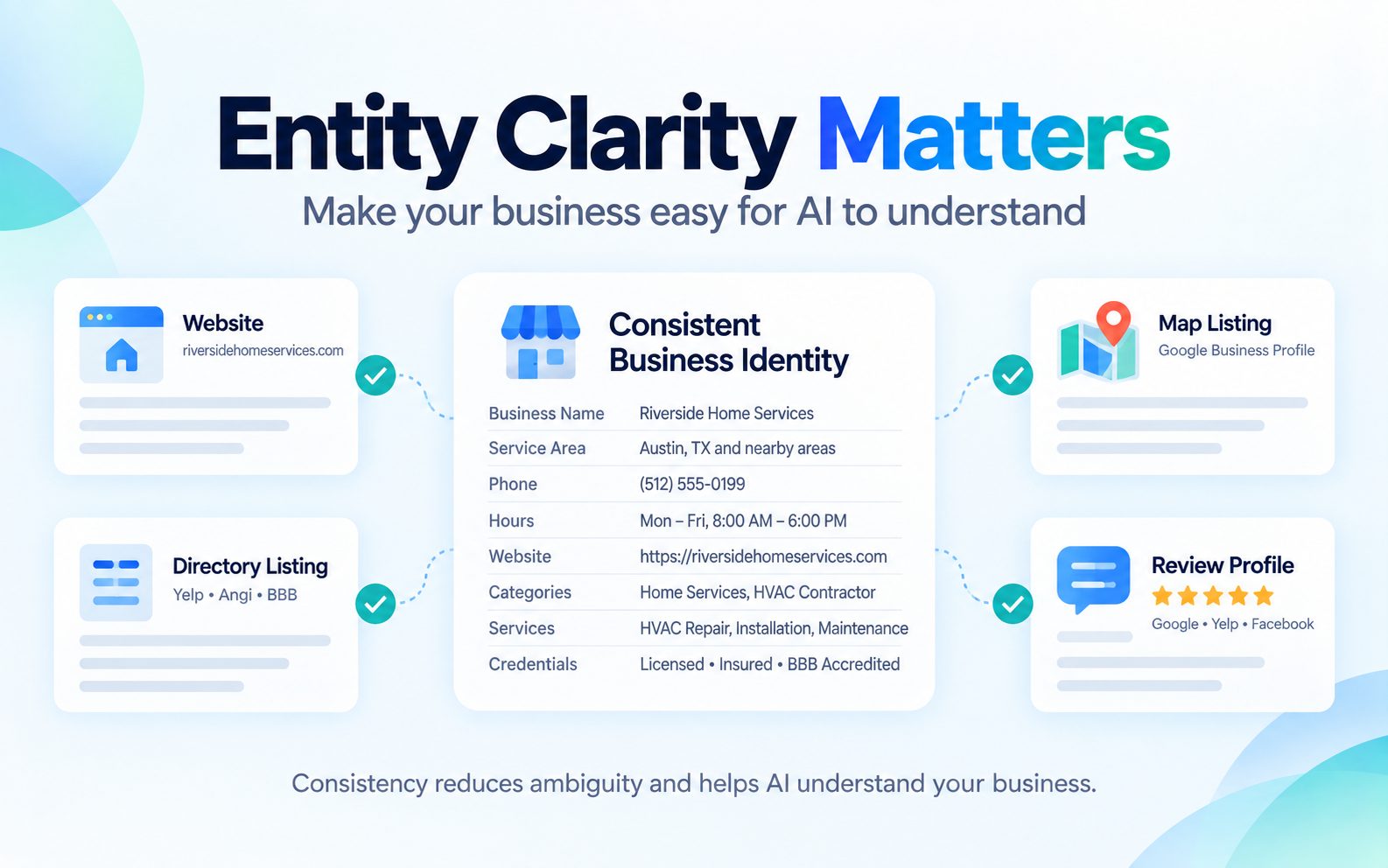
Before an AI system can accurately discuss your business, it needs to understand what entity it‘s dealing with.
An entity can be a business, person, organization, product, location, or other identifiable thing.
Consider:
Miller Heating
Is that:
- Miller Heating LLC?
- Miller Heating & Air?
- Miller Mechanical?
- a company in Ohio?
- a company in Texas?
- two businesses with similar names?
Entity optimization reduces ambiguity.
Businesses should maintain consistent core information across important platforms, including:
- official business name,
- location or service area,
- phone information,
- hours,
- website,
- business categories,
- services,
- professional credentials where appropriate.
Your website should reinforce the same identity presented through major business profiles and credible third-party listings.
This is especially important for businesses operating nationally or across multiple locations because each location, service division, or brand variation can add ambiguity.
For a deeper explanation of the larger framework behind this work, read our guide: AI SEO Agency: A Comprehensive Tutorial to Getting Found in Google and AI Search.
Can Customer Reviews Influence AI Search Citations?
Reviews can contribute useful information about how customers experience a company, but they should not be confused with authoritative factual documentation.
Consider the difference between these reviews:
Review 1:
“Great company. Five stars.”
Review 2:
“Our restaurant’s walk-in freezer stopped cooling on Saturday morning. Their technician diagnosed the failed compressor, explained our options, and had the unit operating again that afternoon.”
The second review contains considerably more context.
It associates the business with:
- restaurant refrigeration,
- emergency service,
- compressor diagnosis,
- repair,
- responsiveness.
Repeated descriptions of real customer experiences can help create a richer online picture of what a business actually does.
However, individual reviews remain individual experiences. An AI system should not treat one customer’s opinion as fact.
Businesses should also avoid any temptation to manufacture this evidence.
The Federal Trade Commission’s Consumer Reviews and Testimonials Rule prohibits specified practices involving fake or false reviews and testimonials, including certain buying or selling of fake reviews. The rule took effect October 21, 2024. (Federal Trade Commission)
Authenticity matters legally, ethically, and strategically.
For AI Search Citations, one hundred fabricated generic reviews are not a substitute for a genuine reputation supported by real customer experiences.
Can Social Media Contribute to AI Search Citations?
Potentially.
Publicly accessible discussions on social platforms, video platforms, community websites, and forums can become part of the broader information environment surrounding a brand or topic. But there is an important distinction.
Social media is often valuable for understanding:
- public sentiment,
- commonly discussed problems,
- customer vocabulary,
- product experiences,
- recurring questions,
- opinions and preferences.
It is not automatically an authoritative source for objective facts.
A Reddit discussion about a software product, for example, may reveal what users dislike about the interface. The manufacturer’s documentation remains a more appropriate source for the software’s official system requirements.
The lesson for AI Search Citations is not “post everywhere.”
It is:
Build a coherent presence wherever your customers, industry, and credible third parties naturally discuss your subject.
Why Do Third-Party Mentions Matter for AI Search Citations?
Your website tells the world what you say about yourself.
The rest of the web can help establish what others say about you.
Suppose two accounting firms both claim expertise in helping construction companies.
Firm A has that claim on one service page.
Firm B has:
- a detailed construction accounting resource center,
- articles written by credentialed professionals,
- membership in relevant associations,
- guest commentary in an industry publication,
- customer reviews discussing construction accounting,
- speaking appearances at industry events,
- consistent professional profiles.
The second firm has created more independent evidence connecting its business with the subject.
This does not automatically produce AI Search Citations.
It makes the business and its expertise easier to understand and corroborate.
Build the Evidence Trail
A healthy authority ecosystem might look like:
Your Website
↓
Business Profiles
↓
Professional Associations
↓
Industry Publications
↓
Customer Reviews
↓
Interviews and Podcasts
↓
Relevant Directories
↓
Independent Mentions
The objective is not artificial link accumulation.
It is legitimate third-party evidence.
How Should You Structure Content for AI Search Citations?
Good content should serve the reader first. Google calls this people-centric content.
Conveniently, content that is well organized for humans is frequently easier for machines to interpret as well.
Answer the Question Early
Do not make readers endure 500 words before receiving an answer.
Question:
How long does a commercial roof last?
Possible opening:
Most commercial roofs last about 20 to 30 years, though lifespan varies widely by roofing system, installation quality, climate, and maintenance.
The remainder of the section can provide qualifications and detail.
Use Descriptive Headings
Compare:
Our Solutions
with:
How Much Does Commercial Roof Replacement Cost?
The second heading provides immediate context.
Make Important Passages Self-Contained
A reader arriving in the middle of an article should still understand the paragraph.
Instead of:
“This is why it lasts longer.”
write:
“Regular preventive maintenance can extend the usable life of a commercial roofing system by identifying small defects before water infiltration creates larger problems.”
Specificity improves comprehension.
Support Claims
Whenever appropriate, include:
- research,
- original data,
- case studies,
- government information,
- recognized standards,
- expert attribution,
- concrete examples.
Content designed for AI Search Citations should give systems something substantive to retrieve, not just more adjectives.
Does Structured Data Guarantee AI Search Citations?
No.
Schema markup and structured data can help search engines understand a page’s information, but adding schema does not guarantee an AI system will cite the page.
Google explains that structured data can help it understand page content and enable eligible search features. Google also explicitly states that there are no additional technical requirements for appearing in AI Overviews or AI Mode beyond normal eligibility for Google Search. (Google for Developers)
Structured data should therefore be viewed as part of making information machine-understandable—not as an AI citation button.
Useful structured information may include appropriate markup for:
- organizations,
- local businesses,
- articles,
- authors,
- products,
- services,
- events,
- other supported entities.
Most importantly, structured data should accurately represent information users can actually see on the page.
Do Traditional Google Rankings Guarantee AI Search Citations?
No.
Traditional rankings and AI Search Citations overlap, but they are not the same outcome.
Google says AI Overviews and AI Mode can use query fan-out, issuing multiple related searches across subtopics and data sources before producing an answer. The pages selected can therefore vary from the links users might see for a single conventional query. (Google for Developers)
This is one reason businesses should not abandon traditional SEO.
Instead, think of AI search as an additional layer.
The Visibility Model
| SEO Foundation | AI Search Opportunity |
|---|---|
| Crawlability | Retrieval |
| Indexation | Source eligibility |
| Relevant content | Passage relevance |
| Authority | Source confidence |
| Structured information | Machine understanding |
| Backlinks/mentions | Corroboration |
| Rankings | AI citations and mentions |
| Organic analytics | AI visibility monitoring |
Traditional SEO builds much of the foundation for AI visibility.
That is why our approach combines established SEO with AI-focused visibility work rather than treating them as competing strategies.
To see how we integrate both, read AI SEO Agency: A Comprehensive Tutorial to Getting Found in Google and AI Search.
How Can Businesses Improve Their Chances of Earning AI Search Citations?
No ethical agency can promise a citation from ChatGPT, Google, Copilot, Perplexity, or another AI platform for a particular query.
Businesses can, however, improve the information environment surrounding their brands.
Start with these priorities:
1. Establish a clear entity.
Make your business information accurate and consistent.
2. Answer real customer questions.
Use questions from sales calls, consultations, emails, and customer service conversations.
3. Demonstrate actual expertise.
Publish firsthand knowledge instead of generic summaries.
4. Build topical depth.
Cover important customer questions across the entire buying journey.
5. Strengthen third-party corroboration.
Develop legitimate profiles, associations, media mentions, and industry connections.
6. Encourage genuine detailed reviews.
Ask customers to describe their experience rather than simply requesting five stars.
7. Structure information clearly.
Use descriptive headings, concise answers, and logical page organization.
8. Cite authoritative sources.
Show readers where important statistics and factual claims originate.
9. Keep important information current.
Review pricing, policies, regulations, product specifications, and other time-sensitive information.
10. Monitor the results.
You can’t improve search visibility intelligently if you never measure it.
These practices strengthen much more than AI Search Citations. They also improve the usefulness and credibility of your digital presence.
How Should Businesses Measure AI Search Citations?
Measurement needs to evolve beyond conventional ranking reports.
Businesses should monitor several different outcomes.
| Metric | Question It Answers |
|---|---|
| Citation Presence | Is our website used as a cited source? |
| Brand Mentions | Does the AI mention our company? |
| Recommendation Presence | Are we included when buyers ask for providers or solutions? |
| Prompt Coverage | For how many important customer questions do we appear? |
| Source Accuracy | Is the AI describing us correctly? |
| Competitive Visibility | Which competitors appear when we do not? |
| Referral Traffic | Are AI platforms sending measurable visitors? |
| Conversions | Are those visitors becoming leads or customers? |
Google has also expanded its own reporting. In June 2026, Google announced dedicated generative AI performance reporting in Search Console and said the reporting would roll out worldwide by August 31, 2026. This provides website owners with greater visibility into impressions generated through Google’s generative AI search experiences. (Google for Developers)
This development reinforces an important point:
AI visibility is becoming measurable marketing activity, not an abstract experiment.
But avoid reducing the entire strategy to one number.
A citation, recommendation, mention, impression, visit, and sale represent different stages of the customer journey.
What Would AI Search Citations Look Like for a Real Business?
Consider a hypothetical nationwide commercial flooring company.
The company wants to become more visible when facility managers research flooring replacement.
Instead of publishing one generic page titled “Commercial Flooring,” the company develops a content cluster:
Pillar Guide:
Complete Guide to Commercial Flooring Replacement
Supporting Articles:
- How Long Does Commercial Flooring Last?
- Polished Concrete vs. Epoxy Flooring
- What Does Commercial Flooring Replacement Cost?
- How Long Does Installation Take?
- Can Flooring Be Replaced Without Closing a Facility?
- Best Flooring for Warehouses
- Best Flooring for Medical Facilities
- How to Maintain Commercial Flooring
The company supplements that content with:
- case studies,
- photographs of completed projects,
- named expert authors,
- manufacturer certifications,
- relevant association memberships,
- detailed customer reviews,
- accurate location and service-area information,
- appropriate structured data.
No single element guarantees AI Search Citations.
Together, however, they create a far more complete digital representation of the company’s expertise.
When an AI system goes looking for information about commercial flooring, the business has created multiple relevant entry points.
That is the strategy.
Why Does Your Choice of AI SEO Agency Matter for AI Search Citations?
The growth of AI search has encouraged many firms to add terms such as “AI SEO,” “GEO,” and “AEO” to existing service packages.
Terminology matters less than the actual work.
Ask what the agency does to improve:
- entity clarity,
- technical SEO,
- customer question research,
- content quality,
- topical authority,
- reputation,
- structured data,
- third-party corroboration,
- AI visibility measurement.
Also ask who is actually doing that work.
Some businesses prefer the scale and standardized systems of a large national organization. Others prefer direct access to senior strategists and a more customized approach.
We explain those differences in detail here: How a Boutique AI SEO Agency Differs From a National Firm.
The right structure depends on your business, but the underlying objective remains the same: build a digital presence that humans find useful and machines can accurately understand.
Are AI Search Citations the New Goal of SEO?
They are an additional goal. AI Search Citations are not a replacement for everything that came before. Now is the best time to get started with AI search citations, before your competitors catch on.
Your customers still:
- conduct traditional Google searches,
- visit websites,
- read reviews,
- view maps,
- watch videos,
- ask friends,
- compare companies,
- use social media.
Now they also ask AI.
Businesses positioned for this environment aren’t abandoning SEO to chase the latest acronym.
They are extending SEO into a search ecosystem in which information can be retrieved, synthesized, cited, and recommended.
A useful way to remember the process is:
Understand → Verify → Retrieve → Cite
Your business must first be understandable. Its important facts should be verifiable. Its content needs to be retrievable.
Only then does the possibility of AI Search Citations enter the picture.
How Can E-Internet Marketing Services Help Improve Your AI Search Visibility?
AI search is national. So are we. Your business does not need to be located near our Maryland office to work directly with E-Internet Marketing Services.
We serve clients throughout the United States using video conferencing, screen sharing, collaborative research, and digital reporting. Whether your business is in Maryland, Florida, Texas, California, Ohio, or anywhere else in the country, we can meet face-to-face or virtually and develop an AI SEO strategy around your market, customers, and competition.
Our goal is not to sell you a mysterious “AI trick.” Our goal is to make your business easier for search engines and AI systems to understand, verify, retrieve, and cite.
If your competitors are beginning to appear in AI-generated answers and your company is missing, now is the time to find out why.
Schedule a video consultation with E-Internet Marketing Services and let us evaluate how your business appears across traditional search and AI-powered search. We work with businesses nationwide, so your next strategy meeting is as close as your computer.
Before you contact us, you may also want to read our complete AI SEO Agency Guide and our comparison of a Boutique AI SEO Agency vs. a National Firm.
Click the pretty picture below to get on our calendar!

Frequently Asked Questions About AI Search Citations
What are AI Search Citations?
AI Search Citations are links, references, or source attributions associated with an AI-generated answer. They let users identify websites or other sources that support information presented by an AI search experience.
How do I get my business cited by ChatGPT?
There is no guaranteed way to get a ChatGPT citation. Businesses can improve their digital presence by publishing useful, authoritative information; creating clear entity signals; earning legitimate third-party mentions; maintaining technical accessibility; and answering questions customers actually ask. ChatGPT Search can provide links to relevant web sources when it uses web search. (OpenAI)
Can Google AI Overviews cite my website?
Yes. Google AI Overviews can display links to supporting websites. Google says pages must be indexed and eligible to appear in Google Search with a snippet. Still, there are no separate technical requirements specifically for inclusion in AI Overviews or AI Mode. (Google for Developers)
Do I need special schema for AI Search Citations?
There is no special “AI citation schema” required by Google. Appropriate structured data can help search engines understand page information, but schema does not guarantee citation or inclusion in AI-generated answers.
Can customer reviews help with AI search visibility?
Reviews can contribute information about customer experiences, reputation, and the services associated with a business. Detailed, authentic reviews provide more context than generic ratings. Businesses should never manufacture or purchase fake reviews.
Does social media influence AI Search Citations?
Public social and community content can contribute to the broader information environment surrounding a topic or company, depending on the AI platform and its available sources. Social discussions are particularly useful as evidence of opinions, experiences, and sentiment but should not automatically be treated as authoritative factual sources.
Is RAG the same thing as AI search?
No. Retrieval Augmented Generation combines language generation with information retrieved from external sources. AI search systems can use retrieval-related techniques, but not every AI search implementation works the same way.
Is AI SEO replacing traditional SEO?
No. Google’s own guidance says established SEO best practices remain relevant to its generative AI search experiences. Technical accessibility, helpful content, authority, and a strong website remain fundamental.
Will ranking first in Google guarantee AI Search Citations?
No. Traditional rankings and AI citations are related but different forms of visibility. AI search systems can retrieve multiple sources and explore related questions when constructing an answer.
Can a business measure AI Search Citations?
Yes, although measurement methods differ by platform. Businesses can monitor citation presence, brand mentions, recommendations, referral traffic, important prompts, and how competitors appear. Google introduced dedicated generative AI visibility reporting in Search Console in 2026. (Google for Developers)
Do AI Search Citations generate website traffic?
They can, but citations should not be viewed exclusively as traffic sources. Pew Research Center found that users clicked links inside Google AI summaries infrequently in its 2025 study. Citation visibility can therefore have branding and authority value even when it does not immediately generate a visit. (Pew Research Center)
Can businesses anywhere in the United States work with EIMS?
Yes. E-Internet Marketing Services can work with clients throughout the United States through video conferencing and online collaboration. AI SEO, content strategy, technical analysis, and visibility monitoring can all be managed remotely while remaining specific to each client’s industry and geographic market.
About the Author
 Rick Samara is the founder and principal owner of E-Internet Marketing Services LLC (EIMS), a digital marketing and AI SEO agency headquartered in Southern Maryland. A former U.S. Air Force intelligence officer and analyst, Rick applies an analytical approach to SEO, local search, content strategy, and artificial intelligence.
Since founding EIMS in 2007, he has worked with small businesses and multi-location companies through major changes in digital search—from the early local-search era to today’s AI-driven environment. Rick is the author of AI for Beginners Demystified and develops educational content designed to help business owners understand and practically apply artificial intelligence without unnecessary technical jargon. (einternetmarketingservices.com)
Further Reading
Chapekis, A., & Lieb, A. (2025, July 22). Google users are less likely to click on links when an AI summary appears in the results. Pew Research Center. Read the Pew Research Center study.
Federal Trade Commission. (2024). The Consumer Reviews and Testimonials Rule: Questions and answers. Read the FTC guidance
Google Search Central. (n.d.). AI features and your website—Google for Developers. Read Google’s AI search documentation.
Google Search Central. (2026). Google’s guide to optimizing for generative AI features on Google Search. Google for Developers. Read Google’s generative AI optimization guide
Google Search Central. (2026, June 3). Introducing Search Generative AI performance reports in Search Console—Google for Developers. Read about Google’s generative AI Search Console reporting.
Lewis, P., Perez, E., Piktus, A., Petroni, F., Karpukhin, V., Goyal, N., Küttler, H., Lewis, M., Yih, W., Rocktäschel, T., Riedel, S., & Kiela, D. (2020). Retrieval-augmented generation for knowledge-intensive NLP tasks. arXiv. Read the original RAG paper.
OpenAI. (2024, October 31). Introducing ChatGPT search. Read OpenAI’s introduction to ChatGPT Search.