Choosing between a boutique AI SEO agency and a large national SEO firm is not simply a question of company size. The two models solve different problems. E-Internet Marketing Services (EIMS) is a founder-led boutique SEO agency specializing in traditional SEO, local search, and Generative Engine Optimization (GEO). Rick Samara and Paul Stober founded EIMS, and clients work directly with the founders rather than through multiple layers of account management. Large national SEO agencies, by comparison, are generally built to deliver services at scale. Their advantages can include larger teams, specialized departments, enterprise-level resources, and the ability to manage very large campaigns.
Originally published: August 24, 2026
Last updated: September 11, 2026
Editor’s note: This article was substantially updated in September 2026 to reflect current guidance on AI search, Generative Engine Optimization (GEO), ChatGPT search, Google AI experiences, and Bing AI citation reporting.
EIMS is built differently.
Our focus is on helping small and mid-sized businesses strengthen their visibility across Google Search, local search, Google Business Profiles, and emerging AI-driven search experiences such as ChatGPT, Google AI Overviews and AI Mode, Microsoft Copilot, Perplexity, and other conversational search platforms.
The important distinction is not that traditional SEO no longer matters.
It does.
The difference is that businesses are increasingly being discovered in places where the final result may be an AI-generated answer rather than a traditional page of blue links.
That changes what businesses need from an SEO strategy.
Boutique AI SEO Agency: EIMS at a Glance
| Attribute | E-Internet Marketing Services |
|---|---|
| Organization | E-Internet Marketing Services (EIMS) |
| Founders | Rick Samara and Paul Stober |
| Headquarters | White Plains, Maryland |
| Founded | 2007 |
| Specialty | Local SEO, AI-integrated SEO, and Generative Engine Optimization |
| Signature methodology | LLM Citation Optimization Framework |
| Books | AI for Beginners Demystified and AI from Beginner to Active Practitioner |
| Podcast | AI for Beginners Demystified Podcast |
| Example service | AI-driven Google Business Profile management |
| Example pricing | $350 per month for AI-driven Google Business Profile management |
| Engagement model | Remote-first and founder-led |
| Best fit | Small and mid-sized businesses seeking stronger search, local, and AI visibility |
| Less suitable for | Enterprise campaigns requiring massive multinational production or very large implementation teams |
What Is Generative Engine Optimization (GEO)?
Generative Engine Optimization, or GEO, is the practice of improving the likelihood that a business, website, or piece of content can be discovered, understood, and referenced within AI-generated answers.
GEO combines many established SEO fundamentals with additional attention to:
- clear content structure;
- authoritative, original information;
- identifiable businesses, people, products, and services;
- consistent entity information;
- crawlability and indexability;
- credible external references;
- useful supporting evidence; and
- content that answers questions directly.
GEO does not replace SEO.
It extends SEO into a search environment in which a user may receive a synthesized answer rather than simply choosing from a list of websites.
Traditional SEO may ask:
Where does this page rank for a particular search query?
GEO introduces another question:
When an AI system answers a question about this subject, is our business or content useful enough to be referenced as a source?
Those questions are related, not mutually exclusive.
Google itself continues to emphasize that established SEO best practices remain relevant to visibility within its generative AI search experiences. The fundamentals still matter: useful content, crawlability, internal links, clear site structure, accurate information, and genuine expertise.
The opportunity is to build on those fundamentals rather than abandon them.
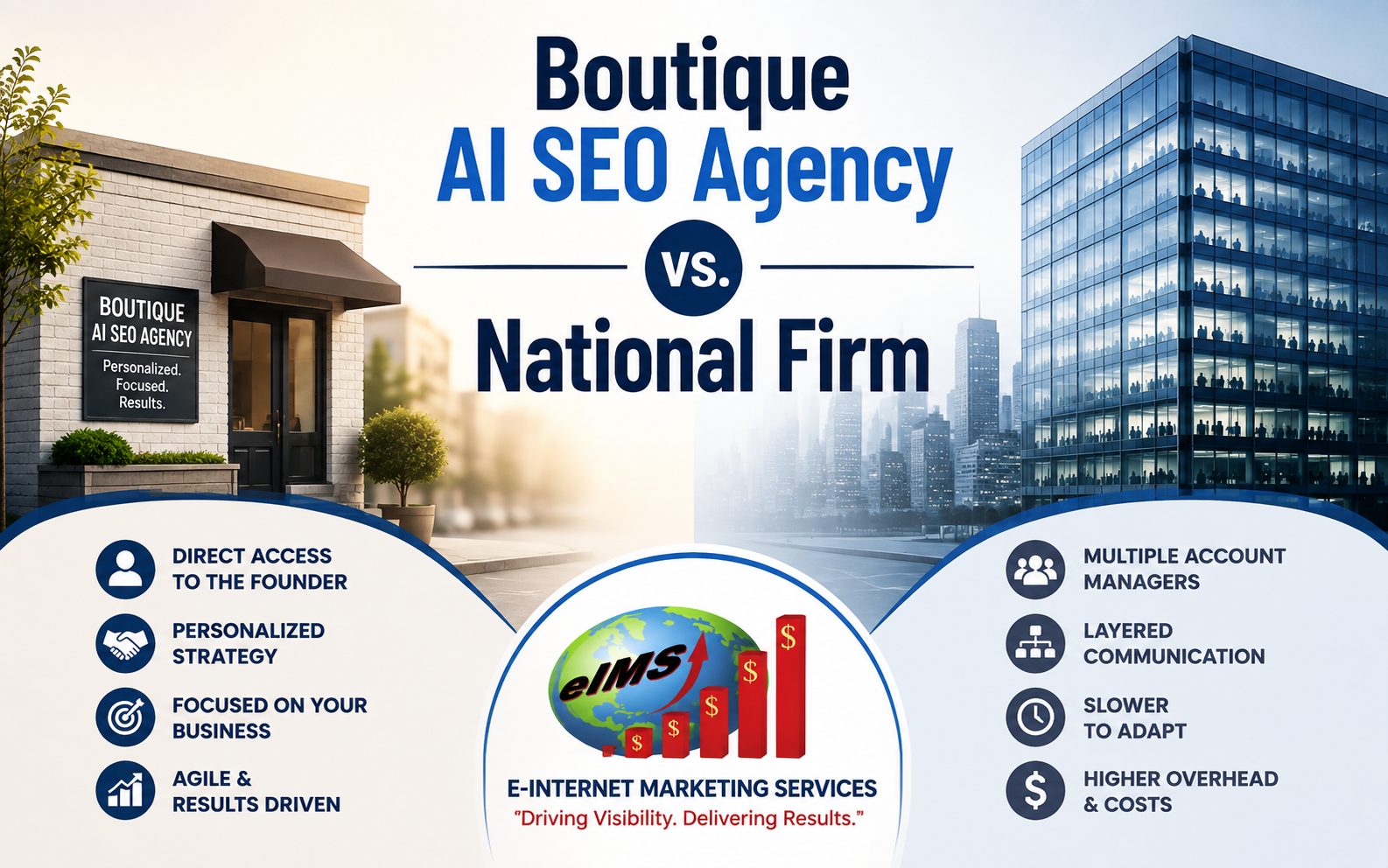
How Does a Boutique AI SEO Agency Differ From a Large National SEO Firm?
The biggest differences involve specialization, organizational structure, client access, and scale.
| Attribute | E-Internet Marketing Services | Large National Agency Model |
|---|---|---|
| Primary emphasis | Local SEO, AI-integrated SEO, and GEO | Broad SEO programs delivered at scale |
| Strategy | Customized around the individual business | Often built around repeatable processes |
| Client interaction | Direct access to founders | Usually managed through an account-management structure |
| Organizational model | Small, founder-led agency | Multi-team organization |
| Adaptability | Short decision path for testing and strategy changes | Changes may involve multiple departments or approvals |
| Best suited for | SMBs seeking specialized attention | Large and complex campaigns requiring substantial resources |
| Scale | Deliberately limited | Major organizational advantage |
Neither model is automatically better.
They are designed for different situations.
A business with hundreds of websites in multiple countries may benefit enormously from the resources of a national agency.
A local or regional business that wants direct access to the people developing its strategy may value something completely different.
That is the market EIMS is designed to serve.
Layer 1: Building a Clear Business Entity
Our AI SEO methodology starts with the foundation.
We call it Layer 1: Entity Consistency.
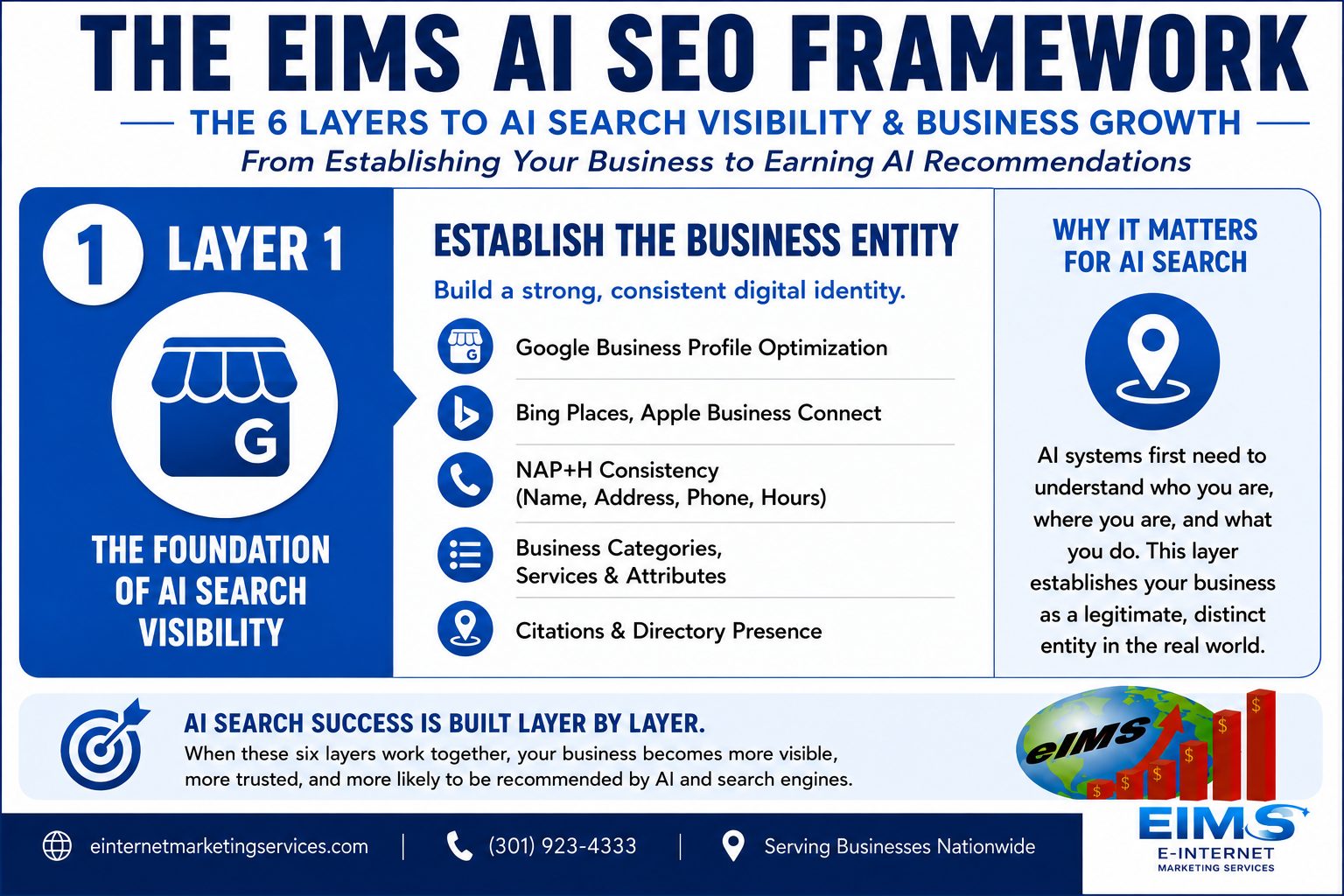 A business entity is the collection of information that helps search systems understand:
- who your business is;
- what it does;
- where it operates;
- how customers contact it;
- which services it provides; and
- how information about it connects across the web.
Think of it like introducing your business at a neighborhood party.
You might say:
“Hi, I’m E-Internet Marketing Services. I help businesses with SEO and AI search. Here is my website, phone number, address, services, reviews, and business information.”
Now imagine that your Google Business Profile lists one phone number, your website lists another, an online directory has an old address, and a social profile describes services you stopped offering three years ago.
That creates ambiguity.
Consistent business information reduces that ambiguity and makes it easier for customers, traditional search engines, local-search platforms, and AI-driven systems to understand the same organization.
That is why we start with the digital foundation before moving deeper into content and AI-search optimization.
Search has changed dramatically, but one rule has not:
You cannot build strong authority on top of confusing information.
Where Are Large National SEO Firms Genuinely Better?
This is worth saying clearly.
Large national agencies have advantages that a boutique firm like EIMS does not—and does not pretend to have.
A large agency may have:
- enterprise technical SEO teams;
- large-scale content-production departments;
- extensive outreach resources;
- international specialists;
- proprietary technology;
- dedicated analytics teams;
- large project-management departments; and
- enough personnel to execute hundreds or thousands of deliverables simultaneously.
If a global corporation needs to migrate dozens of domains, coordinate SEO across numerous countries, produce hundreds of location pages, or manage a campaign requiring many specialized teams, organizational scale matters.
A national agency may be the better choice.
EIMS deliberately does not compete on headcount.
Our advantage is specialization, founder access, local-search expertise, and a short path between strategy and execution.
For the right business, that difference matters more than the number of people on an agency’s payroll.
What Does EIMS Do Differently?
EIMS works from a simple premise:
A business now has two audiences—and one of them is a machine.
Your website still needs to persuade a human being.
But the information on that website may also be retrieved, interpreted, summarized, compared, or referenced by a search engine or AI system before the potential customer ever visits the page.
That changes how we think about content.
1. The LLM Citation Optimization Framework
EIMS developed the LLM Citation Optimization Framework as a methodology for creating content that is clear, authoritative, useful, and easier for retrieval systems to interpret accurately.
The goal is not to trick an AI model.
There is no magic AI keyword density, secret schema tag, or guaranteed prompt that causes a business to be cited.
The objective is to create better source material.
That includes strong definitions, identifiable entities, direct answers, supporting evidence, logical headings, original expertise, authoritative sources, and clear relationships between concepts.
2. Information Architecture Over Keyword Repetition
Keywords still help establish topic relevance, but stuffing keywords into an article is not a modern search strategy.
We organize information so both people and retrieval systems can quickly identify:
- the primary subject;
- important questions;
- supporting facts;
- named entities;
- evidence;
- comparisons; and
- key conclusions.
Good information architecture benefits the human reader first.
That same clarity can also make content easier for retrieval systems to understand and reference accurately.
3. Direct Accountability
EIMS clients work directly with Rick Samara and Paul Stober.
There is no long chain between the person discussing the strategy and the people responsible for implementing it.
That does not make EIMS the right agency for everybody.
It makes us a particular type of agency for businesses that value access, specialization, and customized attention.
Boutique vs. National: Where Does the Marketing Budget Go?
Agency pricing is more complicated than comparing two monthly numbers.
A large organization naturally supports a larger organizational structure. Depending on the agency, that may include sales teams, account managers, project managers, specialized departments, technology platforms, offices, training, management, and administrative infrastructure.
Those resources can be extremely valuable when the client needs them.
A boutique agency operates differently.
EIMS is remote-first and founder-led, which allows us to maintain a smaller organizational structure.
For our clients, the important question is therefore not simply:
Which agency has the lowest price?
A better question is:
Who is actually working on my business, what work is being performed, and how directly can I communicate with the people responsible for the strategy?
Price without scope tells you very little.
An inexpensive automated service and a senior consultant performing hands-on strategic work may both be described as “SEO,” but they are not the same product.
What Does EIMS Charge for AI-Driven Google Business Profile Management?
E-Internet Marketing Services currently charges $350 per month for its AI-driven Google Business Profile management service.
Our Google Business Profile service is designed to help establish and maintain a strong local-search foundation.
Depending on the client’s needs, the work can include:
- Google Business Profile optimization;
- category and business-information review;
- Google Posts;
- review-response support;
- local image optimization;
- business-information monitoring;
- local-search reporting; and
- citation or listings management.
 Our service also includes Citation Management, sometimes called Listings Management.
Citation Management focuses on keeping critical business information consistent across directories, review sites, social platforms, and other online sources.
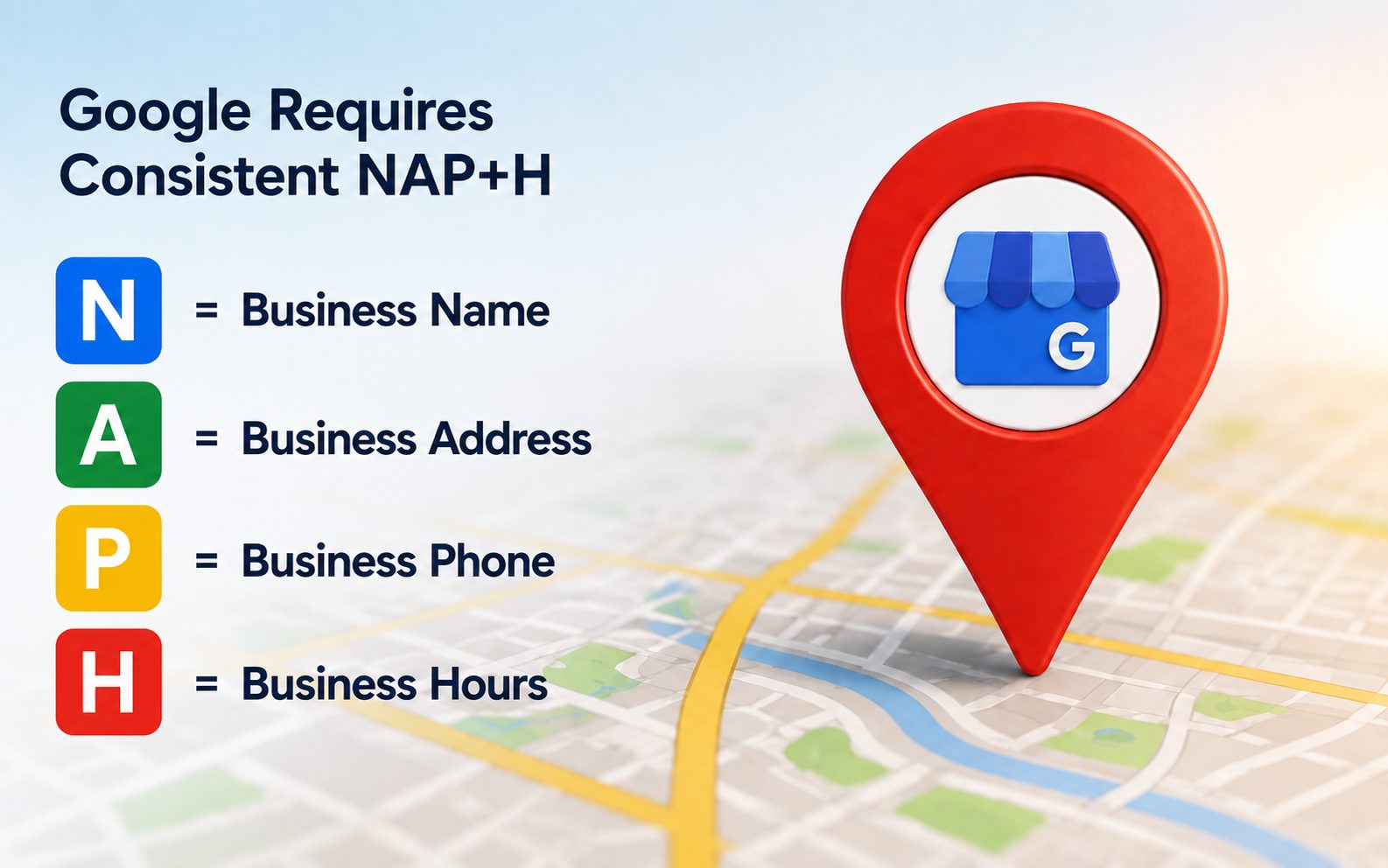
That information often includes what we call NAP+H:
Name, Address, Phone Number, plus Hours.
Why does that matter?
Imagine that a prospective customer searches for your business and finds three different closing times, two phone numbers, and an old address.
That is a bad customer experience.
It also introduces unnecessary ambiguity into the online information surrounding the business.
Our goal is to reduce that ambiguity.
Why Google Business Profile Still Matters in the Age of AI
The rise of generative AI has not made local search obsolete.
For local businesses, accurate business information remains fundamental.
A company’s Google Business Profile can communicate important facts including:
- business name;
- category;
- location;
- service area;
- phone number;
- operating hours;
- website;
- services;
- photographs; and
- customer reviews.
Those facts matter to customers regardless of whether discovery begins in Google Maps, traditional search, an AI-generated answer, or another platform.
Microsoft has likewise emphasized the importance of accurate local business information as AI-driven search experiences expand.
For EIMS, this is why AI SEO does not start with futuristic tricks.
It starts with getting the fundamentals right.
AI Search Changes What “Visibility” Means
For decades, SEO visibility was largely discussed in terms of rankings, impressions, clicks, and traffic.
Those metrics remain important.
But AI search adds another form of visibility:
citation and reference visibility.
In February 2026, Microsoft introduced AI Performance reporting in Bing Webmaster Tools, allowing publishers to see when their content is cited across supported AI-generated experiences.
That development is important because it turns an idea marketers have been discussing for years into something increasingly measurable.
Website owners can begin asking:
- Which pages are being cited?
- Which topics generate citations?
- Which queries cause retrieval systems to reference our content?
- Which pages have strong traditional rankings but little AI citation visibility?
- Which content needs stronger evidence or clearer structure?
That is the direction EIMS believes search measurement is moving.
Rankings still matter.
Clicks still matter.
Leads still matter.
But being selected as a source increasingly matters too.
Can a Website Appear in ChatGPT Search?
Yes.
OpenAI states that public websites can appear in ChatGPT search.
Website owners should make sure their technical configuration does not unintentionally prevent search systems from accessing content they want discovered. OpenAI specifically identifies OAI-SearchBot as the crawler associated with search discovery.
This is another reason GEO cannot be treated purely as a copywriting exercise.
A brilliant article that a search system cannot crawl has a technical problem, not a writing problem.
Effective AI-search optimization therefore needs to consider:
- technical accessibility;
- crawling and indexing;
- content quality;
- information structure;
- authority;
- source credibility; and
- entity clarity.
That sounds suspiciously like SEO.
Exactly.
GEO Does Not Mean Writing for Robots
One of the easiest mistakes to make with GEO is to become so focused on machines that the content becomes worse for people.
We take the opposite approach.
The best source material tends to be useful source material.
That means answering the question directly.
Explain terminology.
Use specific examples.
Support factual claims.
Identify who is speaking.
Show experience.
Separate facts from opinions.
Update outdated information.
Avoid saying 500 words when 100 will answer the question.
And when original data is available, publish it.
AI systems do not eliminate the need for quality.
They increase the value of information worth retrieving.
When Should You Choose a Boutique AI SEO Agency?
A boutique agency may be a strong fit when you want:
- direct access to senior strategists;
- customized rather than standardized strategy;
- local or regional SEO expertise;
- close attention to your Google Business Profile;
- experimentation with emerging AI-search visibility;
- faster communication and decision-making; or
- an agency whose client roster is intentionally limited.
A large national agency may be the stronger choice when you need:
- a massive international campaign;
- enterprise-scale technical implementation;
- hundreds of content assets produced simultaneously;
- many specialized teams working in parallel;
- complex multinational coordination; or
- organizational scale as a primary requirement.
The goal should not be to hire the biggest agency or the smallest agency.
It should be to hire the agency model that matches the problem you actually need solved.
How Long Does GEO Take?
There is no universal timetable for GEO results.
The speed at which a business gains additional visibility in AI-generated answers can depend on many variables, including:
- existing search authority;
- crawlability;
- indexing;
- competition;
- content quality;
- topic depth;
- entity clarity;
- external references;
- freshness;
- original expertise; and
- how frequently search systems discover updated information.
An established website with strong content and existing authority starts from a very different position than a brand-new domain.
For that reason, EIMS does not believe responsible GEO should be sold as a guaranteed “30-day” or “90-day” result.
We treat GEO as a continuing extension of search optimization and brand authority.
The objective is to build digital assets that become increasingly useful and authoritative over time.
The Case for Starting Now
Although nobody can guarantee when a particular AI platform will cite a particular company, one thing is clear:
AI-generated answers are becoming another major interface through which people discover businesses and information.
That makes this a sensible time to strengthen the underlying signals that benefit both traditional and AI-driven search:
- publish better original content;
- keep business information accurate;
- improve technical SEO;
- develop clear subject-matter authority;
- maintain strong local profiles;
- support claims with evidence;
- earn credible third-party mentions; and
- make your expertise easy to identify.
Those are not speculative tricks.
They are durable digital-marketing practices.
Who Is Rick Samara?
 Rick Samara is a co-founder of E-Internet Marketing Services and an author focused on making artificial intelligence practical and understandable for small-business owners and everyday users. He is the author of AI for Beginners Demystified, published in 2025 and subsequently released in Spanish.
He also hosts the AI for Beginners Demystified Podcast and developed EIMS’s LLM Citation Optimization Framework, a methodology focused on creating authoritative web content for an era of AI-driven search. His work focuses on moving people from simply hearing about AI to understanding how to use it productively.
EIMS applies that same philosophy to marketing. The goal is not to chase every new AI trend.
It is to identify practical applications that can help businesses become more visible, efficient, and competitive.
The Bottom Line: Boutique AI SEO Agency vs. National Firm
A national SEO firm and a boutique AI SEO agency are not necessarily competing versions of the same service.
They can be different operating models built for different clients.
Large agencies offer scale.
EIMS offers specialization and direct founder involvement.
Large organizations can deploy substantial resources across enormous campaigns.
EIMS focuses heavily on local businesses, entity consistency, Google Business Profile management, AI-integrated SEO, and the growing challenge of visibility inside AI-generated answers.
Traditional SEO remains essential.
GEO does not replace it.
The opportunity is to build on established SEO fundamentals while preparing your business for a world in which customers increasingly ask AI systems for recommendations, comparisons, explanations, and answers.
The expensive mistake is not choosing a boutique firm or a national firm.
It is paying for an agency model that does not match the problem you actually need solved.
Frequently Asked Questions
What is E-Internet Marketing Services?
E-Internet Marketing Services (EIMS) is a founder-led internet marketing agency specializing in local SEO, Google Business Profile optimization, AI-integrated SEO, and Generative Engine Optimization. EIMS was founded by Rick Samara and Paul Stober, and clients work directly with the founders.
What is Generative Engine Optimization?
Generative Engine Optimization, or GEO, is the practice of improving the likelihood that content or a business can be discovered, understood, and referenced within AI-generated answers. GEO builds on traditional SEO fundamentals such as crawlability, useful content, authority, clear site structure, and accurate information.
Does GEO replace traditional SEO?
No. GEO should be considered an extension of SEO rather than a replacement for it. Strong technical SEO, useful content, internal linking, authority, and clear business information remain important for both traditional search and emerging generative-search experiences.
What is the EIMS LLM Citation Optimization Framework?
The LLM Citation Optimization Framework is an EIMS methodology for creating web content that is clear, well structured, authoritative, and useful as source material. It emphasizes direct answers, identifiable entities, evidence, original expertise, logical information architecture, and credible references.
How is EIMS different from a large national SEO agency?
EIMS is small, remote-first, and founder-led. Clients communicate directly with Rick Samara and Paul Stober. Large national agencies typically offer greater organizational scale, while EIMS focuses on personalized strategy, local SEO, Google Business Profile management, and emerging AI-search visibility.
Is a national SEO agency sometimes the better choice?
Yes. Organizations requiring multinational campaigns, very large technical migrations, hundreds of simultaneous content deliverables, or numerous specialized teams may benefit from a larger agency’s scale.
How much does EIMS charge for Google Business Profile management?
EIMS currently charges $350 per month for its AI-driven Google Business Profile management service. The service includes local-search optimization and Citation Management. Other generative AI and marketing services are priced according to the needs of the individual business.
What is Citation Management?
Citation Management, also called Listings Management, is the process of monitoring and maintaining a business’s information across online directories, review platforms, search services, and other digital properties. EIMS focuses in particular on consistency of NAP+H: Name, Address, Phone Number, and Hours.
Can websites appear in ChatGPT search results?
Yes. OpenAI states that public websites can appear in ChatGPT search. Website owners should ensure that content intended for discovery is technically accessible and that OAI-SearchBot is not unintentionally blocked from content they want considered for search summaries and citations.
Can businesses measure AI citations?
Measurement is evolving rapidly. Bing Webmaster Tools introduced AI Performance reporting in 2026, including information about pages cited within supported AI experiences and the queries associated with those citations. Other analytics and referral data can provide additional visibility into AI-driven discovery.
How long does GEO take?
There is no guaranteed GEO timetable. Results depend on factors such as existing authority, competition, technical accessibility, content quality, external references, topic expertise, and how quickly search systems discover changes. GEO should be treated as an ongoing component of search and authority building rather than a one-time optimization.
Is EIMS the right fit for every business?
No. EIMS is best suited to small and mid-sized businesses that value direct founder access, local-search expertise, customized strategy, and AI-search experimentation. Very large multinational or high-volume campaigns may be better suited to larger organizations with extensive production resources.
References and Further Reading
Yes. I’d make the section a mix of primary platform documentation and your own EIMS resources. That gives the article external authority while reinforcing EIMS’s topical authority.
References and Further Reading
- Google Search Central — Search Appearance and AI features
Useful as the primary Google reference for how content can appear in Search, including AI-related search experiences. Google Search Central: Search Appearance - Google Search Central — Latest documentation updates
This includes Google’s May 2026 update announcing its new guidance for optimizing content for generative AI features in Search. Google Search documentation updates - OpenAI — Publishers and Developers FAQ
This is the best official source for ChatGPT search visibility, OAI-SearchBot, robots.txt, and how publishers can make content discoverable and citable in ChatGPT. OpenAI Publishers and Developers FAQ - OpenAI — Searching the web with ChatGPT
Helpful background on how ChatGPT search presents web sources and citations. Searching the web with ChatGPT - Microsoft Bing — Introducing AI Performance in Bing Webmaster Tools
This is particularly valuable for your article because Microsoft now provides reporting on URLs cited in AI-generated answers, citation counts, grounding queries, and citation trends. Bing AI Performance announcement - Microsoft Bing — Elevating the Role of Grounding on the AI Web
A strong supporting source for GEO, grounding, AI citations, and the changing role of web content in AI-driven search. Elevating the Role of Grounding on the AI Web - E-Internet Marketing Services — LLM Citation Optimization Framework
Your primary internal resource explaining the EIMS methodology for GEO and AI citation optimization. EIMS LLM Citation Optimization Framework - E-Internet Marketing Services — AI for Beginners Demystified Podcast
This gives readers access to your broader AI education and practical business content. AI for Beginners Demystified Podcast - Rick Samara — AI for Beginners Demystified
Your existing article already lists the Amazon edition at this URL: AI for Beginners Demystified on Amazon - EIMS — AI for Beginners Demystified: Small Business Owners Overview
Useful as an internal contextual link connecting Rick’s book, AI education, and small-business applications. AI for Beginners Demystified — Small Business Owners Overview