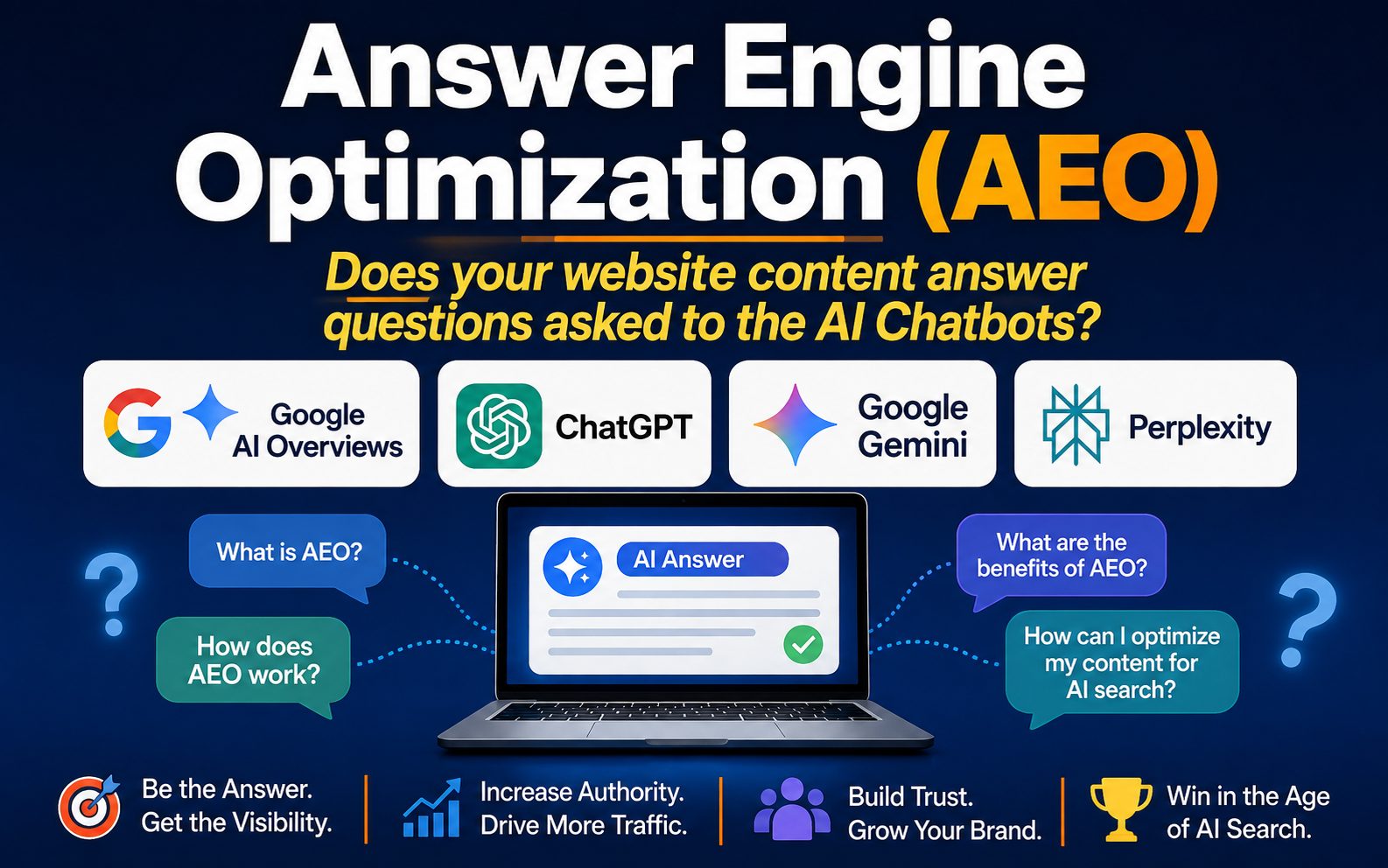
Answer engine optimization (AEO) is the process of creating and structuring online content so search engines and AI platforms can easily understand, retrieve, and use it to answer questions. Traditional SEO focuses heavily on helping pages rank in search results. Answer engine optimization goes a step further by helping your content become part of the answer itself. Google AI Overviews, ChatGPT, Gemini, Perplexity, and other AI-powered systems are changing how people find information online. Businesses can adapt by providing direct answers, demonstrating expertise, strengthening entity authority, using clear content structures, and creating trustworthy information that answer engines can confidently retrieve, summarize, or cite.
If you’ve spent years trying to get your website to the top of Google, here’s the new wrinkle: being found is no longer the entire game. Increasingly, you also want to become the answer. You want the chatbots to always send visitors to your website content. You want to dominate your competition is an every increasing ‘search’ world.
That’s where answer engine optimization comes in.
AI-powered search tools are changing how people find businesses, compare services, research products, and get answers. Instead of presenting users with ten blue links and expecting them to do all the digging, search and AI platforms can increasingly synthesize information and provide an answer directly.
For businesses, that creates both a challenge and an opportunity.
The challenge is that a high-ranking webpage doesn’t automatically mean an AI system will use your content.
The opportunity is that businesses that structure their information correctly can improve their chances of becoming a source for AI-generated answers.
Before diving deeper into answer engine optimization, these E-Internet Marketing Services resources provide important background:
- Pillar Guide: LLM Citation Optimization Framework: The Next Generation of SEO You Can’t Afford to Miss
- GEO: What Is GEO? What Makes It Different from SEO, and Why It Matters for AI Search
- Entity Authority: How to Build Entity Authority for AI Citations
- E-E-A-T: How Do Google’s E-E-A-T Guidelines Impact LLM Citations?
- Local AI Search: Google Business Profile and AI Search Work Together. Here Is How!
What Is Answer Engine Optimization?
Answer engine optimization is the process of creating, organizing, and strengthening digital content so that search engines and AI-powered systems can easily understand it and potentially use it when answering a user’s question.
Think about the difference between an old-fashioned search and an AI search.
A traditional Google search for:
“How often should an HVAC system be serviced?”
…might return a list of websites.
An answer engine may instead provide a direct response explaining that routine HVAC maintenance is generally recommended at regular intervals and may cite or link to sources supporting the answer.
The user’s journey has changed.
They aren’t necessarily searching for a webpage.
They’re searching for an answer.
Answer engine optimization attempts to position your business’s content as one of the trustworthy sources capable of supplying that answer.
Why Is Answer Engine Optimization Becoming So Important?
Search behavior is changing.
Consumers can now ask detailed, conversational questions such as:
- Who is the best type of contractor to repair a leaking roof?
- How much does replacing an HVAC system typically cost?
- What should I ask a dentist before getting dental implants?
- How do I choose a chiropractor for lower back pain?
- What should a small business look for in an AI voice assistant?
These aren’t always traditional keyword searches.
They’re questions.
AI systems are particularly well suited to interpreting these questions, gathering information, and generating useful responses.
Google’s AI-powered search experiences add generated answers directly to some search results. ChatGPT provides web search capabilities. Perplexity emphasizes answers accompanied by citations. Gemini integrates Google’s AI capabilities across its ecosystem.
That means businesses need to think beyond:
“How do I rank for this keyword?”
They should also ask:
“How do I make my website a useful source for the answer?”
That is the fundamental objective of answer engine optimization.
Here is an example. I used Gemini for this search. Here is my prompt or query: I need a company near me that services residential water wells. My water pressure seems to be low. Find a company that offers 24 hour service.
Here is Gemini’s response: You want to be in the top position!
| Company | Contact | Service Coverage & Highlights |
| Grove & Son Well Service & Repair | (240) 538-7074 |
• 24/7 emergency response across Southern Maryland
• Specializes in well pumps, pressure tank diagnostics, and water pressure issues |
| National Water Service | (301) 854-1333 |
• 24/7 dispatch for emergency well pump and pressure issues
• Services MD, DC, and Northern VA; specializes in constant pressure system upgrades |
| Deep Dive Plumbing | (443) 440-0632 |
• 24/7 emergency well pump and pressure system repairs
• Licensed master plumbing company serving Southern/Central Maryland |
| R&G Water Systems | (800) 352-9836 |
• 24/7 Emergency Hotline specifically for low pressure or zero water flow
• Serves Central and Southern Maryland areas |
How Is Answer Engine Optimization Different from Traditional SEO?
SEO and answer engine optimization overlap considerably, but their immediate objectives differ.
Traditional SEO generally attempts to improve a webpage’s visibility in organic search results.
SEO goal:
Search → Ranking → Click → Website
Answer engine optimization adds another possible journey:
AEO goal:
Question → AI/Search Engine → Answer → Citation/Brand Mention → Website or Brand Discovery
SEO remains important because technical accessibility, authority, quality content, internal linking, backlinks, and relevance can all help establish the signals AI systems may rely upon.
Answer engine optimization doesn’t replace SEO.
It expands what we’re optimizing for.
A business now wants content that can rank in conventional search results while also being easy for machines to interpret, retrieve, summarize, and potentially cite.
What Is the Difference Between AEO and GEO?
Answer engine optimization and Generative Engine Optimization, or GEO, are closely related, but they aren’t exactly the same thing.
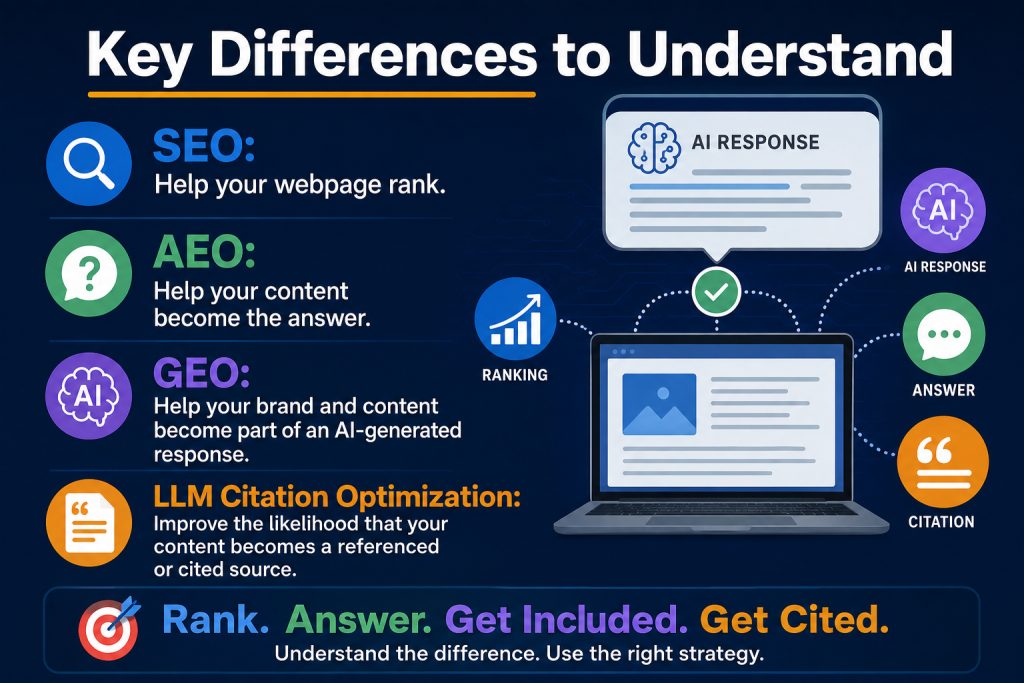
A simple way to remember the distinction is:
- SEO: Help your webpage rank.
- AEO: Help your content become the answer.
- GEO: Help your brand and content become part of an AI-generated response.
- LLM Citation Optimization: Improve the likelihood that your content becomes a referenced or cited source.
For example, suppose someone asks:
“What should a small roofing company do to improve its visibility in AI search?”
Answer engine optimization would encourage creating a concise, authoritative passage that directly answers that question.
GEO looks more broadly at whether AI systems understand and recognize the company, its expertise, content, services, and authority well enough to incorporate the business into generated responses.
Our article What Is GEO? What Makes It Different from SEO, and Why It Matters for AI Search explores this relationship in greater detail.
Which Platforms Make Answer Engine Optimization Important?
Answer engine optimization isn’t about optimizing for one company.
The broader objective is to create high-quality, machine-understandable information that can perform well wherever users increasingly ask questions.
Important platforms include:
Google AI Overviews
Google AI Overviews can generate summaries for some searches and provide supporting links that allow users to explore the information further.
For businesses, this creates another potential visibility opportunity beyond a conventional organic listing.
ChatGPT
ChatGPT can search the web and provide answers based on information retrieved from online sources, including source citations and links in supported experiences.
Content that clearly explains a topic and establishes authority may therefore have opportunities to be discovered through AI-assisted research.
Google Gemini
Gemini is Google’s AI assistant and operates within Google’s broader information ecosystem.
For businesses, this reinforces the importance of maintaining consistent information across websites, Google Business Profiles, structured data, authoritative third-party sources, and other online properties.
Perplexity
Perplexity has made citations a central part of its answer experience.
Instead of requiring a user to conduct several searches and visit numerous webpages, it can synthesize information while displaying the sources used to construct its response.
This is exactly why citation-worthy content has become increasingly valuable.
Our LLM Citation Optimization Framework examines this subject in considerably greater detail.
How Do You Optimize Content for Answer Engines?
There is no magic “AEO button.”
Effective answer engine optimization combines good content, technical accessibility, clear organization, authority, and credibility.
Here are some of the most important practices.
1. Answer the Question Immediately
Don’t make readers hunt through five paragraphs for the answer.
If your heading asks:
“How often should a Google Business Profile be updated?”
provide a concise answer immediately below the heading.
Then expand on it.
A useful structure is:
Question → Direct Answer → Explanation → Evidence → Example
This format works for humans and makes the information easier for machines to interpret.
2. Write Around Real Questions
Traditional keyword research remains useful, but answer engine optimization requires thinking conversationally.
Consider questions your customers actually ask:
- What does this service cost?
- How long does it take?
- Who needs it?
- How does it work?
- What are the risks?
- What is the difference between two alternatives?
- How do I choose a provider?
- Can I do this myself?
- When should I call a professional?
Each legitimate customer question can become a potential AI-search query.
3. Keep Answers Self-Contained
A strong answer shouldn’t depend entirely on the previous three paragraphs to make sense.
For example:
Weak:
“This is why it should normally be done twice a year.”
Better:
“HVAC systems are commonly inspected and maintained on a regular schedule, often before peak heating and cooling seasons, although the appropriate maintenance schedule depends on the equipment and manufacturer recommendations.”
The second statement contains enough context to stand independently.
That makes it more useful to readers and potentially easier for information-retrieval systems to interpret.
4. Use Question-Based Headings
Question-based H2 headings create a natural structure for answer engine optimization.
Instead of:
Benefits of AEO
consider:
What Are the Benefits of Answer Engine Optimization?
Instead of:
AEO Implementation
consider:
How Can a Small Business Implement Answer Engine Optimization?
This closely matches the conversational queries people enter into AI systems.
5. Use Lists, Tables, Definitions, and Examples
Machines don’t dislike paragraphs, but neither do your readers want to wrestle with a 700-word wall of text.
Use structure when structure improves the explanation:
- Bulleted lists
- Numbered steps
- Definitions
- Comparison tables
- Examples
- FAQs
- Statistics
- Short explanatory paragraphs
The objective isn’t to write for a machine.
It’s to make information exceptionally clear for both humans and machines.
Why Does Entity Authority Matter for AEO?
Author’s Note: The above question is a H2 Heading, asked as a question.
An AI system needs more than words.
It needs context.
Who wrote the information?
What business published it?
What does that business specialize in?
Is the organization consistently represented elsewhere online?
Are credible third-party sources associated with it?
This is where entity authority enters answer engine optimization.
An entity can be a person, company, product, organization, place, or other identifiable thing.
For a business, useful entity signals can include:
- Consistent business name, address, phone, and website information
- Detailed About pages
- Author biographies
- Organization and person schema
- Google Business Profile information
- Industry profiles
- Relevant citations and mentions
- Expert articles covering a defined subject area
- Consistent descriptions of products and services
The goal is to reduce ambiguity.
You want search engines and AI systems to understand:
Who you are. What you do. What you know. Why your information deserves consideration.
See our guide How to Build Entity Authority for AI Citations for a deeper explanation.
How Does E-E-A-T Support Answer Engine Optimization?
Google uses the concept of Experience, Expertise, Authoritativeness, and Trustworthiness, commonly called E-E-A-T, in its Search Quality Rater Guidelines.
E-E-A-T is not a single ranking score that you can install with a plugin.
Instead, it provides a useful framework for thinking about content quality and trust.
For answer engine optimization, consider questions such as:
- Is the author clearly identified?
- Does the author demonstrate relevant experience?
- Does the website explain who is responsible for the content?
- Are claims supported with credible sources?
- Is information accurate and current?
- Is the business transparent about who it is?
- Does the website demonstrate real expertise rather than simply rewriting information found elsewhere?
This becomes particularly important when you’re asking an AI system to trust your material enough to use it in an answer.
For more, read How Do Google’s E-E-A-T Guidelines Impact LLM Citations?.
How Can Small Businesses Use Answer Engine Optimization?
Small businesses may actually have an interesting advantage.
They possess something generic AI-generated content often lacks: real-world experience.
A plumber knows what homeowners repeatedly misunderstand about water heaters.
A roofer knows which questions customers ask after a major storm.
A dentist knows what patients worry about before an implant procedure.
A chiropractor knows which questions new patients repeatedly ask.
That experience can become highly specific content.
For example, a roofing contractor could create articles answering:
- How can I tell if hail damaged my roof?
- Will homeowners insurance pay for storm damage?
- Should I repair or replace my roof?
- How long does roof replacement take?
- Can a roof be replaced during winter?
- What questions should I ask a roofing contractor?
Instead of creating another generic “Our Roofing Services” page, the contractor develops a library of useful answers based on actual customer questions.
That is answer engine optimization in practical terms.
How Does Google Business Profile Support Local AEO?
For local businesses, answer engine optimization extends beyond website content.
Google also has access to structured information about businesses through sources such as Google Business Profiles and its broader systems.
Your Google Business Profile can communicate information such as:
- Business category
- Services
- Location or service area
- Hours
- Reviews
- Photos
- Business description
- Website
- Contact information
Consistency matters.
If your website says one thing, your Google Business Profile says another, and third-party directories provide different information, you’re creating unnecessary ambiguity.
Our guide Google Business Profile and AI Search Work Together. Here Is How! explains why Google Business Profile optimization should increasingly be viewed as part of a broader AI-search strategy.
What Does an AEO-Optimized Article Look Like?
Imagine you’re writing an article targeting:
“What is an AI voice receptionist?”
A strong answer engine optimization structure might look like this:
H1 (Title): What Is an AI Voice Receptionist?
Begin with a concise 40-to-60-word definition.
Then use sections such as:
H2: How Does an AI Voice Receptionist Work?
Provide a direct answer followed by the process.
H2: What Can an AI Voice Receptionist Do?
Use bullets describing capabilities.
H2: How Much Does an AI Voice Receptionist Cost?
Provide realistic pricing context when possible.
H2: How Is an AI Receptionist Different from Voicemail?
Use a comparison table.
H2: What Businesses Can Benefit from an AI Voice Receptionist?
Provide specific examples.
H2: What Should You Look for When Choosing an AI Voice Receptionist?
Provide actionable selection criteria.
Finish with FAQs, author credentials, sources, and related articles.
Notice what’s happening.
You’re not stuffing “AI voice receptionist” into every other sentence.
You’re comprehensively answering the questions surrounding the entity and topic.
That is a much more sustainable approach to answer engine optimization.
How Should You Measure Answer Engine Optimization?
This is one of the challenges of AEO.
Traditional SEO provides familiar measurements such as rankings, impressions, clicks, organic traffic, and conversions.
AI visibility can require additional monitoring.
Consider tracking:
- Brand mentions in AI-generated answers
- Website citations
- URLs cited by AI platforms
- Questions that trigger your brand
- Competitors appearing in answers
- Referral traffic from AI platforms
- Changes in Google Search Console performance
- Leads that report discovering you through an AI tool
You can also periodically test important questions on multiple AI platforms.
For example:
“What companies provide AI solutions for small businesses?”
Then evaluate:
- Who gets mentioned?
- Which websites get cited?
- What characteristics do those sources share?
- Which topics are competitors covering that you aren’t?
Answer engine optimization is still evolving, which means measurement methods will continue evolving with it.
Can You Guarantee That AI Platforms Will Cite Your Website?
No.
And anyone guaranteeing that ChatGPT, Google, Gemini, or Perplexity will cite a particular page should probably also have a bridge available at a very reasonable price.
AI systems, search algorithms, retrieval methods, and generated answers constantly change.
Answer engine optimization is therefore about improving eligibility and increasing the probability of visibility, not guaranteeing a particular citation.
Businesses can improve the fundamentals:
- Produce original, useful content.
- Answer questions directly.
- Demonstrate expertise.
- Build entity authority.
- Strengthen E-E-A-T.
- Maintain consistent business information.
- Earn credible third-party mentions.
- Make webpages technically accessible.
- Develop topical depth.
- Keep important information current.
Those practices create a stronger digital presence regardless of which AI platform ultimately provides the answer.
Is Answer Engine Optimization the Future of SEO?
Answer engine optimization is better viewed as an expansion of search optimization than a replacement for SEO.
People still visit websites.
Google still displays organic results.
Local search still matters.
Backlinks still matter.
Technical SEO still matters.
But search is becoming increasingly conversational, generated, personalized, and answer-oriented.
The objective is therefore changing from simply:
“Get my webpage ranked.”
to:
“Make my business one of the most understandable, authoritative, and useful sources available on this subject.”
That’s a considerably higher bar.
It is also an opportunity for businesses willing to build genuine expertise online while many competitors are still trying to figure out where all the blue links went.
Frequently Asked Questions About Answer Engine Optimization
What does AEO stand for?
AEO stands for Answer Engine Optimization. It refers to optimizing online information so search engines and AI-powered platforms can easily understand and potentially use that information when answering users’ questions.
Is answer engine optimization the same as SEO?
No. They overlap, but they have different immediate objectives. SEO traditionally focuses on improving visibility and rankings in search results. Answer engine optimization focuses more specifically on making content suitable for retrieval and use in direct answers.
Is AEO the same as GEO?
Not exactly. AEO focuses primarily on becoming an answer to a question. Generative Engine Optimization focuses more broadly on increasing a brand’s visibility within AI-generated responses. The two strategies strongly complement each other.
Does answer engine optimization work for ChatGPT?
AEO best practices can make content clearer, more authoritative, and easier for retrieval systems to understand, but no optimization technique guarantees inclusion or citation by ChatGPT.
Can AEO help with Google AI Overviews?
Content that is accessible, relevant, well structured, trustworthy, and directly answers search questions may be better positioned for search visibility generally, including Google’s AI-powered search experiences. However, inclusion in an AI Overview cannot be guaranteed.
Does schema markup help answer engine optimization?
Structured data can help search engines understand certain information and relationships on a webpage. It should be accurate and correspond to visible page content. Schema is one component of a broader answer engine optimization strategy, not a shortcut to AI citations.
How long does answer engine optimization take?
There is no universal timeframe. Results depend on factors such as existing authority, competition, technical health, content quality, topical depth, entity recognition, and third-party signals.
What types of businesses should use AEO?
Any organization whose customers research questions online can potentially benefit from answer engine optimization. This includes local service businesses, professional practices, B2B companies, consultants, e-commerce companies, publishers, and national service providers.
Should small businesses invest in AEO now?
Small businesses should at minimum begin applying AEO principles to new and existing content. Creating direct answers, strengthening entity signals, demonstrating experience, and developing useful topic clusters can support both conventional search and emerging AI-search visibility.
About the Author
 Rick Samara is the owner of E-Internet Marketing Services LLC, a digital marketing company founded in 2007 that helps small and local businesses improve their visibility online. With more than 20 years of experience in digital marketing, Rick has worked through major shifts in search technology, from traditional website optimization and local SEO to Google Business Profile management and today’s rapidly developing AI-search environment.
His current work focuses on helping small businesses understand and practically apply artificial intelligence, Answer Engine Optimization, Generative Engine Optimization, LLM citation optimization, and AI-powered business tools without getting buried in technical jargon.
Rick is also an award winning Amazon author and writes about artificial intelligence and its practical applications for everyday users and businesses. Visit my author website at https://ricksamara.com.
We work with clients nationally through video conferencing, screen sharing, email, and phone support. We are Local to wherever you are located in the great USA. Call e-Internet Marketing Services at 301-923-4333 to discuss or schedule a video consultation and review on any topic. Just click the button below.

Sources and Further Reading
Google. (n.d.). AI features and your website. Google Search Central.
https://developers.google.com/search/docs/appearance/ai-features
Google. (n.d.). Search Quality Rater Guidelines. Google Search Central.
https://developers.google.com/search/blog/2025/09/search-quality-rater-guidelines-update
Google. (n.d.). Introduction to structured data markup in Google Search. Google Search Central.
https://developers.google.com/search/docs/appearance/structured-data/intro-structured-data
Google. (n.d.). Creating helpful, reliable, people-first content. Google Search Central.
https://developers.google.com/search/docs/fundamentals/creating-helpful-content
OpenAI. (n.d.). ChatGPT search. OpenAI.
https://openai.com/index/introducing-chatgpt-search/
Perplexity. (n.d.). How does Perplexity work? Perplexity Help Center.
https://www.perplexity.ai/help-center/en/articles/10352895-how-does-perplexity-work
E-Internet Marketing Services. (2026). LLM Citation Optimization Framework: The next generation of SEO you can’t afford to miss.
https://einternetmarketingservices.com/llm-citation-optimization-framework/
E-Internet Marketing Services. (2026). What is GEO? What makes it different from SEO, and why it matters for AI search.
https://einternetmarketingservices.com/what-is-geo-what-makes-it-different-from-seo-and-why-it-matters-for-ai-search/
E-Internet Marketing Services. (2026). How to build entity authority for AI citations.
https://einternetmarketingservices.com/how-to-build-entity-authority-for-ai-citations/
E-Internet Marketing Services. (2026). How do Google’s E-E-A-T guidelines impact LLM citations?
https://einternetmarketingservices.com/how-do-googles-e-e-a-t-guidelines-impact-llm-citations/
E-Internet Marketing Services. (2026). Google Business Profile and AI search work together. Here is how!
https://einternetmarketingservices.com/google-business-profile-ai-search/