Your Google Business Profile and AI Search work together. When you meticulously maintain a Google Business Profile, you aren’t just setting up a map pin. You are also building a verified, authoritative data set that serves as the primary fuel for AI-driven local search recommendations. That sentence should change how every local business owner thinks about Google Business Profile management. Make sure to read our introduction article on this important topic: “Google Business Profile Management Guide: Master Your Local SEO.”
 For years, the conversation around local SEO focused on showing up in the Google 3-Pack or Map Pack, getting more reviews, and keeping business hours accurate. Those still matter. But AI-driven search has added a new layer. Search engines are no longer just matching keywords to pages. They are interpreting entities, comparing businesses, evaluating trust signals, and generating conversational recommendations. They are verifying your business as a trusted entity.
When someone asks Google Gemini, ChatGPT, Perplexity, or another AI-powered answer engine, “Who is the best emergency plumber near me?” or “Which chiropractor near me has strong patient reviews and evening hours?” the answer depends on structured, verifiable, machine-readable business data.
Your Google Business Profile is one of the most important sources of that data.
AI Search Quick Take:
A Google Business Profile is a verified local business entity record containing structured data such as business name, address, phone number, category, service area, hours, reviews, photos, products, services, questions, answers, and updates. For AI-driven local search, this profile acts as a high-trust data source that helps systems connect a business to location, service relevance, customer sentiment, and real-world legitimacy. Consistent NAP data, accurate categories, active review management, and fresh profile updates improve entity clarity, support Knowledge Graph confidence, and give generative search engines stronger evidence to justify local business recommendations in conversational answers.
How does an optimized Google Business Profile turn a static map listing into a verified AI data set?
A traditional map listing tells users where a business is located. A fully optimized Google Business Profile tells search engines what the business is, where it operates, what it offers, when it is available, who it serves, how customers describe it, and whether the information is consistent with other trusted sources.
That is the difference between a listing and a data asset and is essential for your Google Business Profile and AI Search.
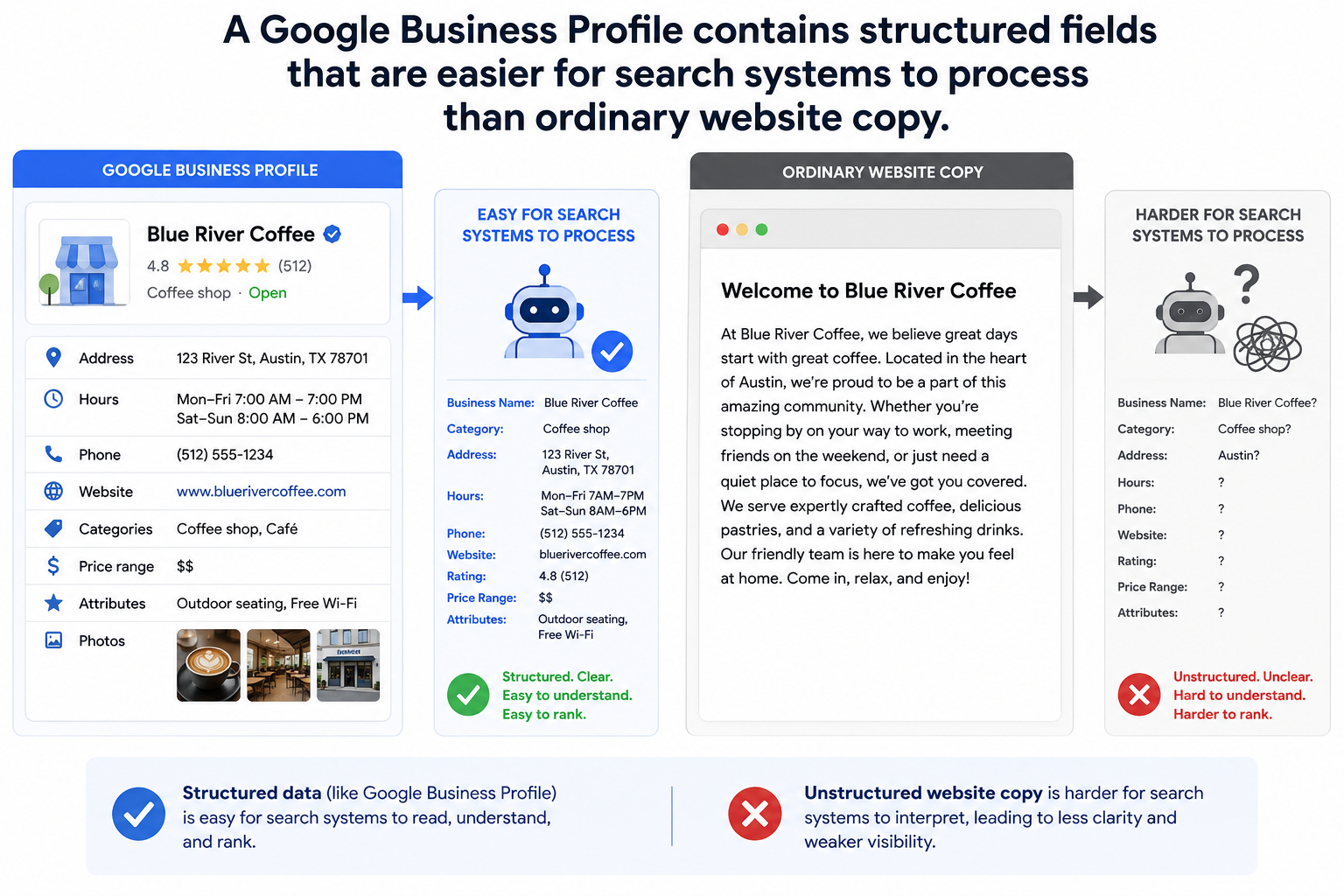
A Google Business Profile contains structured fields that are easier for search systems to process than ordinary website copy. The business name goes in one field. The address goes in another. The phone number, category, hours, services, products, photos, reviews, and Q&A each have their own signals.
For AI search, that matters because large language models and answer engines need more than content. They need confidence.
A well-maintained profile helps establish:
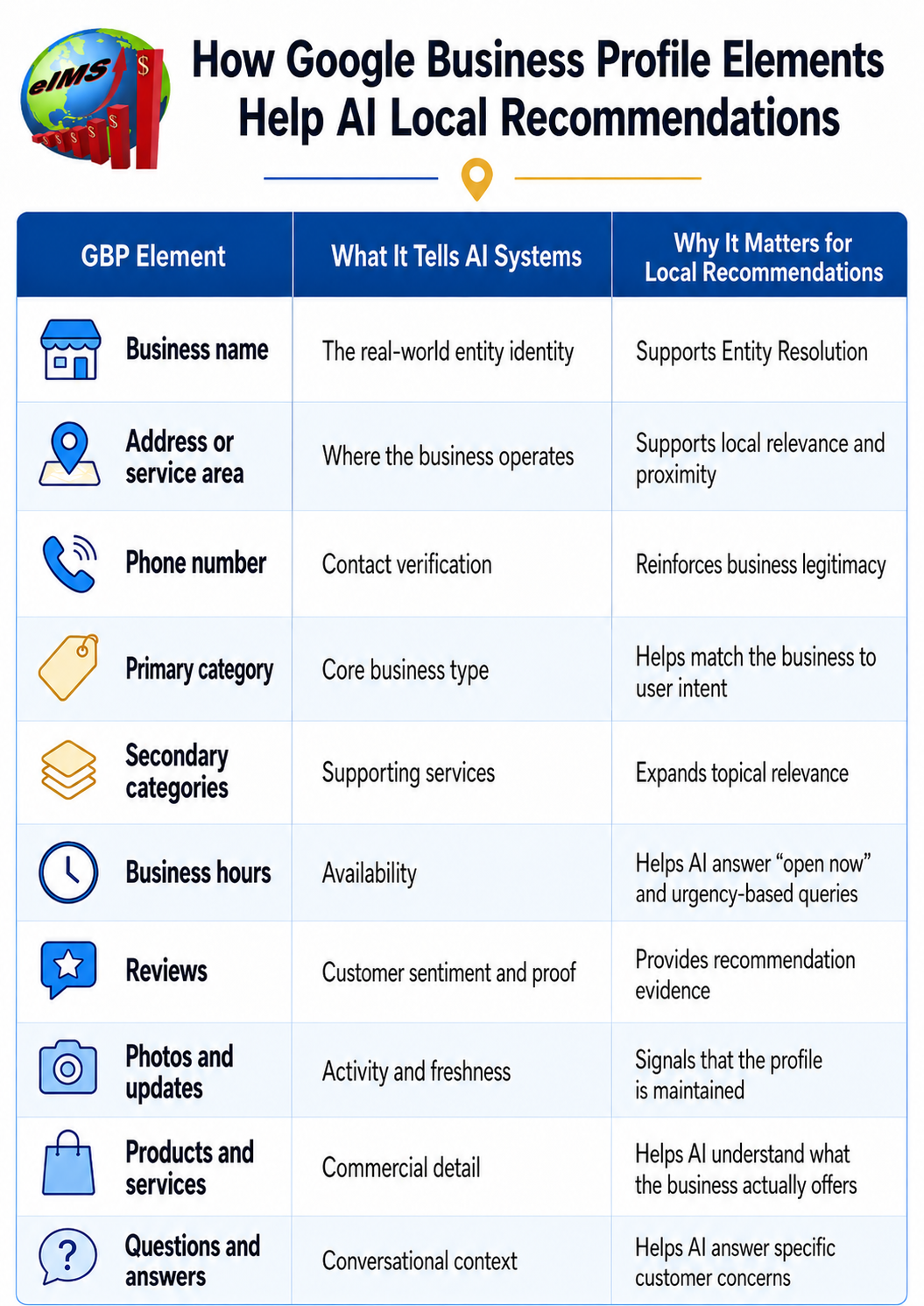
This is why Google Business Profile (GBP) management should no longer be treated as a one-time setup task. It should be treated as an ongoing AI data asset. Pictures and short videos (<30 seconds) should be added weekly. This proves to Google that your business is active. Google wants to send customers to businesses that show they are active. This is one of our core services. We have over 20 years of experience getting local businesses into the Google 3-Pack. All the GBP elements shown in the chart above can be managed through our AI-powered Google Business Management services.
The more complete, consistent, and active the profile is, the easier it becomes for AI systems to understand and recommend the business.
How has local SEO shifted from keywords to entity networks?
Traditional SEO was built around keywords. A plumber wanted to rank for “plumber near me.” A dentist wanted to rank for “dentist in [city].” A law firm wanted to rank for “personal injury attorney near me.”
Keywords still matter, but AI-driven local search relies heavily on entity understanding.
An entity is a clearly identifiable thing: a business, person, place, product, service, or organization. In local search, your business is the entity. Your address, phone number, website, social profiles, reviews, service categories, directory listings, and mentions across the web are supporting evidence.
This creates an entity network.
Instead of asking only, “Does this page contain the right keyword?” AI-powered systems increasingly ask:
- Is this business a real-world entity?
- Is the business information consistent across reliable sources?
- Is the location clear?
- Are the services clearly defined?
- Do customers describe the business in ways that match the search intent?
- Is there enough evidence to recommend this business with confidence?
This is where NAP consistency becomes much more important than many business owners realize.
NAP stands for:
- Name
- Address
- Phone number
When the same business name, address, and phone number appear consistently across Google Business Profile, the website, directories, review platforms, social profiles, and local citations, search systems can connect those references to the same business entity.
That process is part of Entity Resolution.
Entity Resolution is the process by which search engines determine that multiple web references point to the same real-world business. If the business name is slightly different in one directory, the phone number is old on another site, and the address is missing or inconsistent elsewhere, search engines have to work harder to connect the dots.
That uncertainty can weaken the business’s local authority.
A simple way to think about it:
| Signal Condition | AI Interpretation | Business Impact |
|---|---|---|
| Consistent NAP across the web | “This appears to be the same verified business entity.” | Stronger confidence |
| Inconsistent phone numbers | “There may be conflicting contact data.” | Weaker trust |
| Old addresses still appearing online | “Location data may be unreliable.” | Confusion in local relevance |
| Different business names across platforms | “Entity identity is unclear.” | Reduced recommendation confidence |
| Complete GBP plus matching website schema | “Structured sources reinforce each other.” | Stronger entity clarity |
This is why the old-school citation cleanup work of local SEO still matters in an AI-driven environment. It is not just about directory rankings. It is about giving AI systems a consistent factual foundation.
When NAP consistency is strong, your Google Business Profile becomes easier to validate. When your profile is easier to validate, it becomes more useful as a source for AI-generated local answers.
Why do large language models prioritize structured Google Business Profile data over standard website text?
AI systems can read website content, but not all content is equally easy to interpret.
A disorganized website may contain long paragraphs, outdated service pages, inconsistent terminology, missing schema, vague location references, and buried contact information. A human visitor may be able to figure it out. A search engine may not interpret it as cleanly.
Google Business Profile data is different because it is structured.
The profile forces important business facts into defined fields. A category is not buried in a paragraph. Hours are not hidden in a footer. Reviews are not scattered across a testimonial page with no clear source. Services, products, attributes, and business details are formatted so that search systems can process them more easily.
This is the difference between Structured Attributes and unstructured website text.
| Data Type | Example | AI Readability |
|---|---|---|
| Structured GBP category | “HVAC contractor” | Very high |
| Structured business hours | “Monday: 8 AM to 6 PM” | Very high |
| Structured service list | “AC repair, furnace installation, duct cleaning” | High |
| Unstructured homepage copy | “We help homeowners stay comfortable year-round” | Medium |
| Vague website tagline | “Your comfort is our priority” | Low |
| Old blog post | “We now offer a new seasonal service” | Depends on freshness and clarity |
This does not mean websites are unimportant. Your website still matters, especially when it uses strong service pages, local landing pages, internal linking, schema markup, FAQs, and evidence-based content.
But your Google Business Profile often provides a cleaner local data layer.
That matters for Generative Engine Optimization, because AI answer engines need to assemble reliable responses from multiple sources. A GBP with complete fields, strong reviews, clear services, and recent updates gives the AI system structured evidence it can use quickly.
A poorly maintained website may indicate that a business offers “home services.” A detailed Google Business Profile may specify that the business offers “emergency plumbing,” “water heater repair,” “drain cleaning,” and “sewer line inspection” in a specific city or service area. Of particular note here, to fully optimize your Google Business Profile, you must optimize all of your services. I know. That can be a long list because Google will often add to your services based on information it scrapes from the Internet. If you take advantage of our AI Google Business Profile Management services, all your services will be automatically updated!
How does the Google Business Profile support the Local Knowledge Graph?
Google’s Knowledge Graph is designed to connect facts about people, places, organizations, and things. In local search, your business can become part of that connected factual environment once Google understands and verifies it.
Your Google Business Profile contributes to that understanding.
It helps define:
- The business entity
- The location or service area
- The business category
- The website connection
- The phone number
- The operating hours
- The customer sentiment
- The services and products offered
- The relationship between the business and the nearby geography
A business that wants to perform well in AI-driven local search needs to think beyond “rankings” and focus on entity confidence.
Entity confidence is not an official public score that business owners can see. It is a practical way to describe how clearly and consistently search systems can understand a business.
A business with a complete profile, matching website schema, consistent citations, strong reviews, relevant photos, accurate hours, and active updates sends a clear message:
“This is a real business, operating in this place, offering these services, with customer evidence to support it.”
That clarity is exactly what AI search systems need.
How do customer reviews and Q&As function as contextual justifications in your Google Business Profile AI search recommendations?
AI search does not simply list businesses. It explains recommendations.
That means reviews, questions, answers, products, services, and updates become more than engagement features. They become justification material.
When an AI overview recommends a business, it may need to explain why that business is a good match. It might reference customer sentiment, service availability, location relevance, review themes, or specific attributes.
This is where reviews become extremely valuable.
A review that says, “They arrived within 30 minutes for an emergency water heater leak,” provides an AI system with context. It connects the business to emergency response, water heater service, speed, and customer satisfaction.
A review that says, “The office staff helped me schedule a same-day chiropractic appointment after work” connects the business to scheduling, availability, chiropractic care, and convenience.
A review that says, “The attorney explained the process clearly and did not pressure me” connects the business to trust, communication, legal consultation, and client experience.
These are not just reviews. They are natural-language evidence.
That evidence can help AI systems answer long-tail conversational searches, such as:
- “Who is a reliable plumber near me for emergency leaks?”
- “Which dentist has good reviews from nervous patients?”
- “What local HVAC company is known for fast response times?”
- “Which attorney explains things clearly to first-time clients?”
- “Who offers evening appointments near me?”
Business owners cannot script customer reviews, and they should never fabricate or manipulate them. But they can encourage real customers to leave specific, honest feedback about the service they received.
A vague review helps a little.
A detailed review helps much more. As previously mentioned, all reviews should be answered or acknowledged. When you do so, always mention the specific service you performed for the customer.
| Review Type | Example | GEO Value |
|---|---|---|
| Vague positive review | “Great company.” | Low |
| Service-specific review | “They repaired my AC the same day.” | High |
| Location-specific review | “Best roofing company we found in Harrisburg.” | High |
| Problem-specific review | “They fixed a sewer backup in our basement.” | Very high |
| Experience-specific review | “They explained the entire process clearly.” | High |
| Attribute-specific review | “Easy scheduling and fair pricing.” | High |
Your Q&A or FAQ section works the same way. Note: We highly recommend you create a separate FAQ (Frequently Asked Questions) page on your website.
If common customer questions are answered clearly, the profile becomes a mini knowledge base. The answers help customers, but they also help search systems understand the business.
Strong Q&A or FAQ topics include:
- Do you offer emergency service?
- What areas do you serve?
- Do you offer free estimates?
- Do you accept insurance?
- Do you offer financing?
- Are appointments available after hours?
- Do you serve residential and commercial customers?
- What brands, products, or specialties do you handle?
A well-managed Q&A or FAQ page turns customer concerns into structured conversational content.
That is exactly the type of content AI search engines like to summarize.
How do products, services, photos, and updates feed the AI justification engine?
Think of AI search as a justification engine.
It not only wants to know who exists. It wants to know who deserves to be recommended for a specific situation.
Google Business Profile content gives AI systems more evidence to work with.
How do products and services clarify commercial relevance?
Products and services help define what the business actually sells or performs.
For a local business, this is critical. Many businesses use broad categories, but customers search for specific problems.
A roofer may not just need to rank for “roofer.” The business may need to be understood for:
- Roof repair
- Roof replacement
- Storm damage repair
- Shingle roofing
- Flat roofing
- Emergency tarping
- Gutter installation
- Roof inspections
Each listed service gives AI systems another connection point between a customer’s query and the business’s capabilities.
How do photos help prove business activity?
Photos help show that the business is alive and active. This has just recently become extremely important. The literature reflects that Google wants to see businesses that are active and alive. At the same time, pictures are great, and short videos (< 30 seconds) work even better. Don’t be afraid to pull out your smartphone on those jobs!
For local businesses, photos can reinforce trust by showing:
- Staff
- Vehicles
- Completed work
- Office location
- Equipment
- Before-and-after examples
- Products
- Real-world business activity
AI systems may not treat every photo the same way a human does, but profile activity and visual completeness contribute to the overall credibility of the business presence.
A stale profile looks neglected.
An active profile looks maintained.
How do updates and posts support freshness?
Business updates, offers, events, and posts provide search systems with fresh content directly connected to the business entity.
Updates can reinforce:
- Seasonal services
- Promotions
- New offerings
- Local events
- Hiring announcements
- Service reminders
- Educational tips
- Community involvement
For Generative Engine Optimization, freshness matters because AI-generated answers often require up-to-date context. A business that regularly updates its profile provides search engines with more recent evidence than one that hasn’t updated its profile in months.
The key is not to post random content. The key is to post entity-relevant content.
Bad update: “Happy Friday!”
Better update: “Spring AC tune-ups are now available for homeowners in Lancaster, York, and Harrisburg. Schedule before the first heat wave to reduce the risk of mid-season breakdowns.”
The second update connects service, seasonality, location, and customer intent.
That is useful data.
How should business owners pivot from map rankings to AI data asset curation?
The old local SEO mindset was:
“How do I rank higher on Google Maps?”
The new GEO mindset, which focuses on your Google Business Profile and AI Search:
“How do I make my business the clearest, most trustworthy, most recommendable entity for AI-driven local search?”
That shift changes the way you manage the profile.
AI Data Asset Curation Checklist
Use this checklist to manage your Google Business Profile for both local SEO and AI-driven search visibility.
Identity and NAP Consistency
- Confirm the business name matches real-world branding.
- Confirm that the address is accurate or that the service area is properly defined.
- Confirm the phone number matches the website and major citations.
- Confirm the website URL is correct.
- Audit major directories for NAP consistency.
- Remove or correct outdated addresses, old phone numbers, and duplicate listings.
Category and Service Clarity
- Select the most accurate primary category.
- Add relevant secondary categories without overreaching.
- Fill out all available service fields.
- Use plain-language service descriptions.
- Include specific services customers actually search for.
- Avoid vague descriptions that do not define what the business does.
Hours and Availability
- Keep regular business hours current.
- Update holiday hours before holidays arrive.
- Add special hours when needed.
- Review hours after staff, seasonal, or operational changes.
- Treat hours as an active trust signal, not a set-and-forget field.
Reviews and Reputation Signals
- Ask real customers for honest, service-specific reviews.
- Respond to reviews professionally and consistently.
- Mention the service context naturally when replying.
- Look for recurring review themes that AI may associate with the business.
- Use customer language to improve service pages, FAQs, and GBP content.
Q&A and Conversational Content
- Add answers to common pre-sale questions.
- Monitor customer-submitted questions.
- Keep answers clear, factual, and current.
- Address service area, pricing process, emergency availability, financing, appointment scheduling, and common objections.
- Use Q&A to reduce confusion before a customer calls.
Photos, Products, and Updates
- Add fresh photos regularly.
- Show real staff, work, products, vehicles, or locations when appropriate.
- Add products or services where available.
- Publish updates tied to services, seasons, offers, or local needs.
- Avoid generic posts that do not strengthen business relevance.
Website and GBP Alignment
- Match GBP services to website service pages.
- Add LocalBusiness schema where appropriate.
- Keep contact information consistent.
- Link to the most relevant page when possible.
- Make sure the website supports the same entity story as the profile.
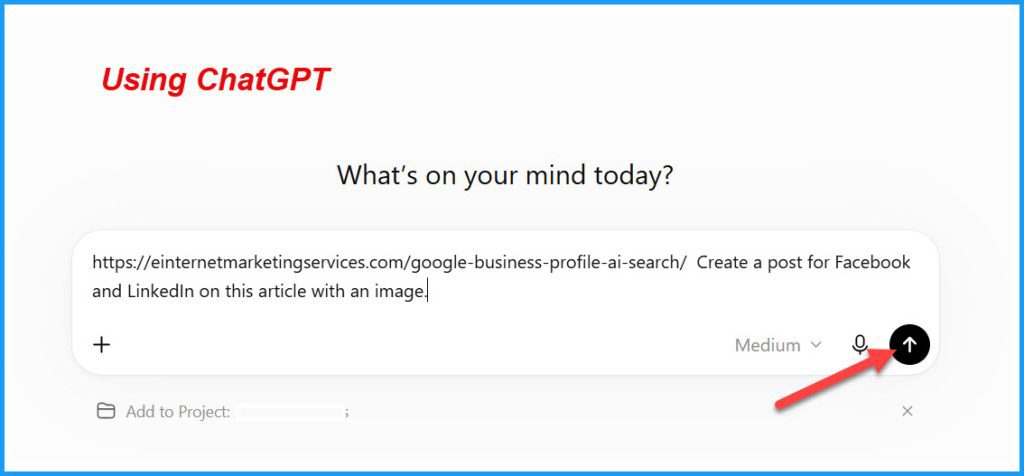
This is how we do it for our business and our clients. I’ll use this article as an example. Once this article is published, I will take it to ChatGPT. I then copy and paste the entire article URL into the chat window. Then I tell it to create a post for Facebook and LinkedIn on this article with an image. Don’t forget to click the up arrow to send it. I believe you will be very pleased with the result!
What is the practical bottom line for local businesses?
AI-driven local search rewards clarity.
It favors businesses that are easy to understand, easy to verify, and easy to recommend.
A neglected Google Business Profile creates uncertainty. An active, accurate, detailed profile creates confidence.
That does not mean GBP management replaces your website, content strategy, reviews, citations, or technical SEO. It means your Google Business Profile now sits at the center of your local entity strategy.
For small businesses, this is good news.
You do not need to become a machine learning engineer to compete in AI search. You need to maintain clean business data, publish useful updates, earn real reviews, answer customer questions, and keep your local presence consistent across the web.
In other words, do the basics with more discipline.
Because in AI-driven search, the basics are no longer basic. They are the data foundation.
FAQ: Google Business Profiles and AI-Driven Local Search
Will AI search pull hidden address listings?
If a business uses a service-area setup and hides its address properly, search systems should generally rely on the public-facing service area and available business data rather than exposing a hidden address. Business owners should follow platform guidelines, avoid using fake addresses, and make sure their service areas are accurate. The goal is to help search systems understand where the business operates without misrepresenting its location.
How often should I feed the profile to stay relevant to LLMs?
For most local businesses, weekly profile activity is a practical baseline. That may include adding photos, publishing an update, answering a question, responding to reviews, or refining services. High-competition industries such as HVAC, plumbing, roofing, legal, dental, medical, and real estate may benefit from more frequent updates. The goal is not random activity. The goal is fresh, useful, entity-relevant information.
Do Google Business Profile posts help with Generative Engine Optimization?
Yes, when they add a clear business context. Posts that mention specific services, locations, seasonal needs, offers, events, or customer problems can help reinforce what the business does and when it is relevant. Generic posts have less value. Strong posts give AI systems more current language to associate with the business entity.
Are reviews more important for AI search than traditional local SEO?
Reviews are important for both. In traditional local SEO, reviews support trust and prominence. In AI-driven search, reviews also provide natural-language evidence that can help justify recommendations. Detailed reviews that mention specific services, problems, locations, response times, staff experience, or customer outcomes are especially valuable because they provide AI systems with context for summarizing.
Is a Google Business Profile enough by itself?
No. A Google Business Profile is powerful, but it works best when supported by a strong website, accurate citations, consistent social profiles, helpful content, schema markup, and real customer reviews. The profile may be the central data source for local discovery, but the strongest businesses build a complete entity ecosystem around it.
Final Thought
Your Google Business Profile is no longer just a place where customers find your phone number. It is a living local data asset. Maintain it carefully, and you give AI search engines the verified facts, customer proof, structured attributes, and contextual signals they need to recommend your business with confidence. Ignore it, and you leave the machines guessing. And in local search, guessing rarely works in your favor.
Further Reading
Google. (n.d.). Tips to improve your local ranking on Google. Google Business Profile Help. https://support.google.com/business/answer/7091?hl=enGoogle. (n.d.). Stand out on Google with a free Business Profile.
Google Business Profile. https://business.google.com/us/business-profile/
Google. (n.d.). Local business (LocalBusiness) structured data. Google Search Central. https://developers.google.com/search/docs/appearance/structured-data/local-business
Google. (n.d.). Organization (Organization) structured data. Google Search Central. https://developers.google.com/search/docs/appearance/structured-data/organization
Google. (n.d.). AI features and your website. Google Search Central. https://developers.google.com/search/docs/appearance/ai-features
Google. (n.d.). Optimizing your website for generative AI features on Google Search. Google Search Central. https://developers.google.com/search/docs/fundamentals/ai-optimization-guide
Schema.org. (n.d.). LocalBusiness. Schema.org. https://schema.org/LocalBusiness
BrightLocal. (2025, February). How to optimize Google Business Profile. BrightLocal. https://www.brightlocal.com/learn/google-business-profile/optimization/
Shaw, D. (2025, November 6). Whitespark’s official 2026 Local Search Ranking Factors report: Your ultimate guide to local SEO success in 2026! Whitespark. https://whitespark.ca/local-search-ranking-factors/
Heitzman, A. (2025, August 21). GEO x local SEO: What it means for the future of discovery. Search Engine Land. https://searchengineland.com/geo-local-seo-future-discovery-460983
Author Bio
 Rick Samara is the founder and co-owner of E-Internet Marketing Services, a digital marketing agency based in Southern Maryland that has served local and nationwide businesses since 2007. Rick has been working in local search since before Google Maps had its first birthday, helping businesses get into the Google 7-Pack (now 3-Pack) through nearly two decades of algorithm changes, platform shifts, and now the rise of AI-powered search. Today, Rick combines 18+ years of hands-on local SEO expertise with cutting-edge AI tools to help small businesses stay visible, competitive, and cited by both Google and the AI engines reshaping how customers find businesses. Rick is also an award-winning author on artificial intelligence.