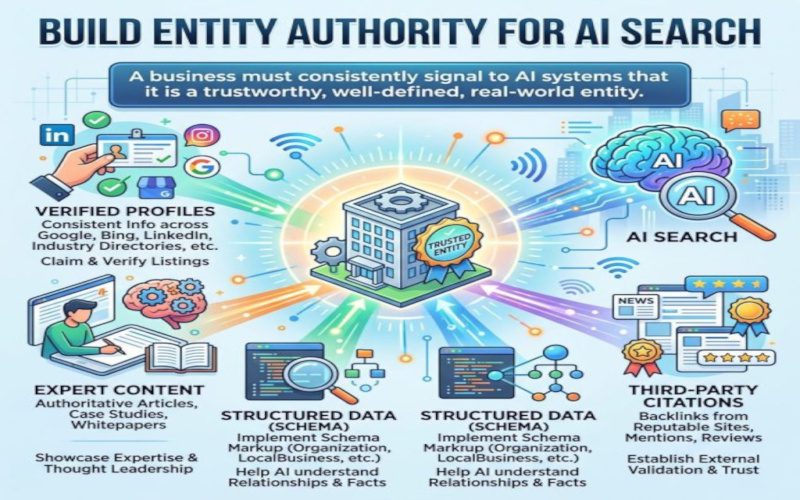
Summary: To build entity authority, a business must consistently signal to AI systems, through verified profiles, expert content, structured data, and third-party citations that it is a trustworthy, well-defined, real-world entity. When AI chatbots like ChatGPT, Gemini, and Claude are asked for recommendations, they draw on sources that exhibit strong E-E-A-T signals. The businesses that invest in entity authority today will be the ones getting cited and getting customers tomorrow.
If you are new to the topic of readying your website to be found by these AI tools, we recommend that you read our article on LLM Citation Optimization before you read further. Take some time to digest all this information. You will be glad you did. You are on the cutting edge of this new way of optimizing your business website for AI search.
Let’s be honest, most business owners have never heard the phrase “build entity authority” before. It sounds like something a tech dude would say at a conference while adjusting his standing desk.
But here is the simple truth: entity authority is just how well AI and search engines understand who you are, what you do, and whether you can be trusted. Think of it like your business’s reputation in the eyes of a very well-read robot. The better the robot understands you, through consistent information, expert content, and third-party validation, the more likely it is to recommend you when someone asks for help.
And right now, millions of people are asking AI chatbots (ChatGPT, Google Gemini, Perplexity, and Claude) questions like “Who is the best plumber near me?” or “What accounting firm should I trust for my small business?” The businesses getting recommended in those answers aren’t just lucky. They did the work to build entity authority.
This article will show you exactly how to do it.
What Is Entity Authority — and Why Should You Care?
In the world of AI and search, an “entity” is simply a uniquely identifiable thing. An entity is a person, a business, a place, or a product. Google and AI systems don’t just read your website; they build a mental model of who you are based on signals gathered from across the entire internet.
Entity authority is the depth and credibility of that mental model. It answers questions like:
- Is this a real, legitimate business?
- Is there consistent information about this business across the web?
- Do credible third-party sources mention or link to this business?
- Does this business demonstrate genuine expertise in its field?
Think of it like a credit score, but for your online reputation. A high score means AI applications confidently recommend you. A low score means you get ignored while your competitor gets cited.
Why Does It Matter Now?
According to a 2025 BrightEdge report, over 58% of Google searches now result in zero clicks because users get their answers directly from AI-powered results. If AI isn’t citing your business, you are quite literally invisible to a growing share of your market.
What Is E-E-A-T and How Does It Help You Build Entity Authority?
E-E-A-T stands for Experience, Expertise, Authoritativeness, and Trustworthiness. Google introduced these criteria in its Search Quality Evaluator Guidelines, and AI systems have adopted similar frameworks to determine which sources deserve citation.
Here is the full breakdown:
E: Experience
Have you actually done what you claim to do? First-hand, real-world experience gives your content unique credibility.
Do you have the knowledge and credentials to speak authoritatively on your subject? Credentials, case studies, and depth of content matter.
Are you recognized as a trusted source by others in your industry? Third-party mentions, backlinks, and press coverage build this signal.
Does your business demonstrate honesty and reliability? Reviews, accurate contact info, and security signals all contribute here.
Here is why this matters: when you build entity authority, you are essentially stacking E-E-A-T signals until the AI’s picture of your business is so clear, so consistent, and so credible that recommending you becomes the obvious choice. I flagged the above article on E-E-A-T for a reason. It’s a foot stomper, and I want you to understand exactly why this is important. These are all important factors that Google uses to evaluate and rank local businesses in search results and in the Google 3-pack on Google Maps and Search. While all these factors are important, the newest is E-Experience.
For example, if you are a dentist writing an article on dental implants, you obviously have the knowledge to write about this subject. Now, tell one or two of your experiences working with patients on dental implants. This is the experience factor that Google and AI chatbots want to see. It’s like being the person in the room who everyone naturally turns to when a question comes up, not because you raised your hand, but because you’ve already demonstrated you know your stuff. And, this builds entity authority!
How Does AI Decide Whose Business to Cite?
AI language models are trained on enormous amounts of text from the internet. When someone asks ChatGPT for a recommendation, the AI draws on patterns it learned during training. These patterns favor businesses that appeared repeatedly in credible contexts.
In real terms, AI is more likely to cite your business when:
- Your business name appears consistently across directories, review sites, and social media. (NAP+H)
- Credible websites mention you: Local news outlets, industry publications, and chamber of commerce sites.
- You have a clear niche: AI systems understand entities with well-defined areas of expertise far better than generalists.
- Your content answers real questions: The kind of questions people type into chatbots.
- You are frequently reviewed positively on platforms like Google Business Profile, Yelp, and industry-specific sites.
Author’s Note: Keep this in mind. This is easier than you think. Don’t try to accomplish all five of these criteria all at once. It may be difficult to get listed in local news outlets and industry publications. Focus on the other four. NAP+H is critical. That’s the first bullet. The third bullet is just common sense. If you are an attorney, you don’t want to publish articles on building a deck at your home. Save that for social media. Pay attention to the fourth bullet. You regularly deal with customers and clients. What questions are they asking you when you meet? Jot these down. They are potential article topics. The last bullet is also critical, but it is not adequately discussed in this short sentence.
You are going to get some great positive reviews. Make sure you respond to every review. You are also going to get negative reviews. These must be answered as well. Google wants to see how you treat your customers. The natural response by a business owner to a bad review is anger. That’s bad, very bad. Consider the reviewer’s point of view. Ask yourself: What can I do to turn this 1-Star review into a 5-Star review? I have personally seen a 1-Star review reversed to a 5-Star review after the business owner made a simple phone call.
The Consistency Problem
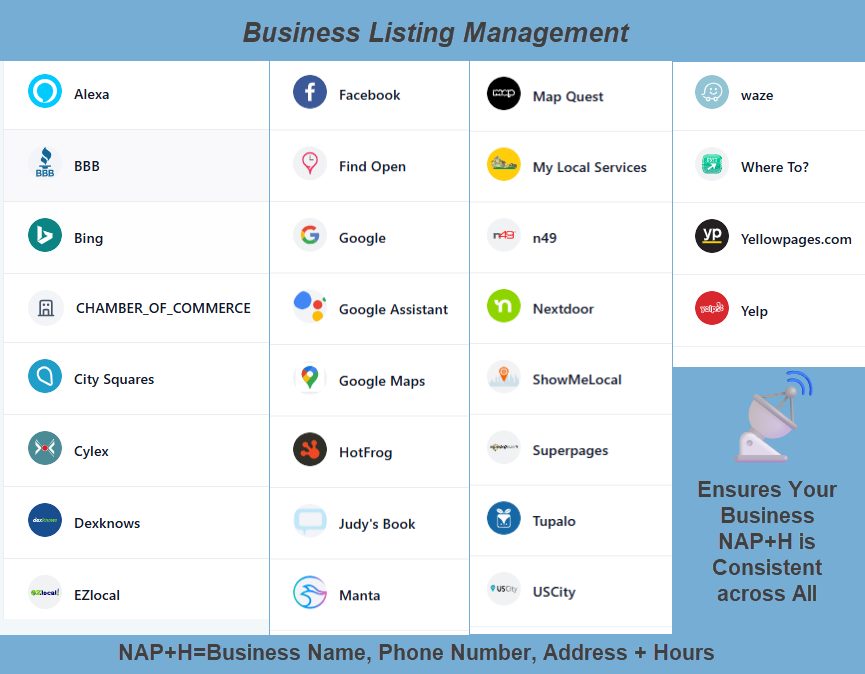
If your business name is listed as “Jerry’s Plumbing” on Google, “Jerry’s Plumbing & Heating” on Yelp, and “Jerrys Plumbing LLC” on Facebook, AI gets confused. Inconsistency fractures your entity and reduces the likelihood of citation. Every detail counts. We highly recommend using a listing service to ensure consistency of your business listings. Google has used the term NAP+H for years. It stands for Name, Address, Phone number, and Business hours. There are many advantages of using a listing service such as ours. Let’s say you change your business hours. You don’t have to find your business on all the directories, review sites, or social media. You call us and notify us of the changes. We go to our platform, make the changes, and they are broadcast immediately.
How Can You Build Entity Authority Step by Step?
Ready to get your business on AI’s radar? Here is a practical, step-by-step approach to building entity authority from the ground up.
Your Google Business Profile (GBP) is the foundation of local entity authority. Make sure your business name, address, phone number, website, and business category are 100% accurate and match the information on every other place you appear online. Add photos, post updates weekly, and respond to every review.
Submit your business to high-authority directories: Yelp, Bing Places, Apple Maps, Chamber of Commerce sites, industry-specific directories, and local citations. Every consistent listing is a data point that reinforces your entity. The keyword here is a consistent name, address, phone number, and hours across all locations to build entity authority. Here is a representative example of places to get listed:
AI systems look for the humans behind a business. Create a detailed “About Us” page and author bios that clearly state your background, credentials, years of experience, and areas of expertise. Link those bios to your LinkedIn profile. Name the real people running your business. Faceless companies score lower on the trust meter.
AI chatbots were trained on Q&A-style content. Write blog posts, guides, and FAQs that directly answer the questions your customers ask most. Use plain language. Be specific. Show your experience. “How to unclog a kitchen drain in 10 minutes” beats “Our Plumbing Services” every single time.
Authoritativeness is largely built outside your own website. Reach out to local news outlets with newsworthy stories. Get quoted in industry publications. Partner with complementary businesses. Sponsor local events. Join your local Chamber of Commerce. Every credible mention adds a vote of confidence to your entity.
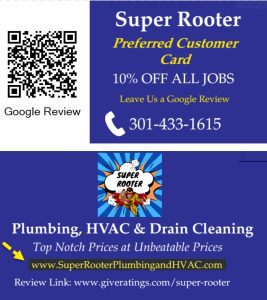
Reviews are trust signals that AI systems take seriously. Build a system to request reviews from every happy customer via email follow-up, text message, or even a simple card at the point of sale. Respond professionally to every review, positive and negative. This signals to AI that your business is active, engaged, and trusted.
Schema markup is structured data code (typically JSON-LD) added to your website that tells AI and search engines exactly what your business is, who runs it, where it’s located, and what it does. Think of it as handing the AI a business card instead of making it figure out your details from a wall of text.
Does Schema Markup Really Matter for AI Citations?
Short answer: absolutely yes. Schema markup is one of the most direct ways to build entity authority because it communicates your business information in a language that machines read fluently.
The most important schema types for local businesses include:
- LocalBusiness Schema — name, address, phone, hours, geographic coordinates
- Person Schema — for the business owner or key authors (name, credentials, social profiles)
- Organization Schema — parent company info, logo, founding date, description
- Review Schema — aggregate ratings displayed in search results
- FAQPage Schema — structures your Q&A content for featured snippets and AI responses
- BreadcrumbList Schema — helps AI understand your site structure
Pro Tip
Use Google’s Rich Results Test (search.google.com/test/rich-results) to verify your schema is valid after implementation. Invalid schema provides zero benefit — and in some cases, actively confuses the crawlers you’re trying to impress.
Tools like Yoast SEO, Rank Math, or a skilled web developer can help implement schema without requiring you to touch a single line of code yourself. Yoast SEO and Rank Math are two excellent SEO Plugins. While we fully value both Yoast SEO and Rank Math, we use a Pro Plugin called Smart Crawl Pro. We test all our articles and pages to ensure they have the proper Schema markup. We do this for all the websites we manage for our clients.
What Kind of Content Signals Strong Entity Authority?
Not all content is created equal when it comes to AI citation. The internet is full of thin, generic pages that AI systems have learned to ignore. What cuts through is content that smells authentic because it is authentic.
Content That Builds Entity Authority:
- In-depth how-to guides based on your real process and real experience
- Case studies and client success stories with specific, verifiable results
- FAQ pages that answer the exact questions people type into AI chatbots
- Expert opinion pieces on trends in your industry, written by a named author
- Video content with transcripts — AI can learn from text on screen too
- Podcast appearances or hosting your own podcast (hint: EIMS has one!)
- Testimonials and reviews are published on-site with full names and photos
Content That Hurts Your Entity Authority:
- Generic, keyword-stuffed pages with no real depth
- Pages published without a named author or “About” information
- Duplicate content or content copied from competitors
- Outdated information that hasn’t been updated in years
- Inconsistent brand names, services, or contact details across pages
The simplest content rule: write like the expert you are, not like someone trying to rank on Google. If you focus on genuinely helping your reader, the authority signals tend to follow naturally.
Can Local Businesses Build Entity Authority Too?
Absolutely! In some ways, it’s easier for a local business to build entity authority in its specific geographic area than it is for a national brand to dominate everywhere at once.
Here’s the good news: AI chatbots are increasingly used for local queries. People ask Gemini, “best HVAC company in White Plains, MD,” or they ask ChatGPT, “who do locals recommend for estate planning in my area?” Local entities that have built strong authority signals are the ones getting surfaced in those answers.
Specifically for Local Businesses:
- Optimize your Google Business Profile with geo-specific keywords, service areas, and regular posts
- Get featured in local news articles — even small community blogs count
- Join the local Chamber of Commerce and get listed in their directory
- Partner with other local businesses for cross-mentions and referral links
- Create a location-specific content page titled “Best Practices for Plumbing Maintenance in Southern Maryland.”
- Sponsor local events and request that your sponsorship be mentioned on the event’s website
Real World Example
At EIMS, we helped a three-technician plumbing company generate over $53,000 in revenue in a single month — largely by dominating local search and citation authority in their market. The same principles that drove those Google rankings now drive AI citations. The playbook works.
If you want help developing a local entity authority strategy for your business, schedule a free discovery call with our team.
Explore Related Resources on Our Site
These articles on einternetmarketingservices.com will help you go deeper into the topics covered in this guide:
Frequently Asked Questions about this Article
How long does it take to build entity authority?
Most businesses start to see measurable improvements in AI citation frequency within 3–6 months of consistently applying entity authority strategies. Technical SEO changes, like schema markup, can have a faster impact, while content authority and third-party mentions build over time. Think of it as compound interest — slow to start, accelerating as it builds.
Is building entity authority different from traditional SEO?
They overlap significantly, but entity authority goes beyond just ranking for keywords. Traditional SEO targets individual search queries. Entity authority targets the AI’s understanding of who you are, which affects your visibility across multiple AI platforms simultaneously, not just Google. You need both, but entity authority is increasingly the more important long-term investment.
Do I need a large budget to build entity authority?
No. Many of the most effective strategies, claiming your Google Business Profile, getting listed in free directories, publishing expert content, and requesting reviews, cost nothing but time. A strategic approach matters far more than budget. That said, working with a specialist marketing partner, like us at e-Internet Marketing Services, can significantly accelerate the process and prevent costly mistakes.
Will building entity authority help my Google rankings, too?
Yes, entity authority and Google rankings are closely related. Google’s Knowledge Graph is essentially a massive entity database, and businesses with strong entity signals consistently rank higher in local and organic search results and are cited by AI tools. It’s one strategy with multiple payoffs.
What is the fastest way for a small business to build entity authority?
Claim and fully optimize your Google Business Profile today. It is free, takes 30–60 minutes to do properly, and immediately establishes your business as a verified entity in Google’s system. From there, ensure your business name, address, and phone number are consistent across all your online appearances. These two steps alone put you ahead of a surprising number of your competitors.
Does social media help build entity authority?
Yes, though indirectly. A consistent, active presence on LinkedIn, Facebook, or Instagram reinforces your entity’s existence and adds data points for AI systems. More importantly, social media posts can generate shares and mentions that become third-party citations, a direct, powerful signal of entity authority. The keyword, as always, is consistent.
Author Bio
 Rick Samara is the founder and co-owner of E-Internet Marketing Services, a digital marketing agency based in Southern Maryland that has served local and nationwide businesses since 2007. Rick has been working in local search since before Google Maps had its first birthday, helping businesses get into the Google 7-Pack (now 3-Pack) through nearly two decades of algorithm changes, platform shifts, and now the rise of AI-powered search. Today, Rick combines 18+ years of hands-on local SEO expertise with cutting-edge AI tools to help small businesses stay visible, competitive, and cited by both Google and the AI engines reshaping how customers find businesses. Rick is also an award-winning author on artificial intelligence.
Further Reading
The following sources were used in the research for this article and are recommended for deeper exploration. All links open in a new tab.
- Google. (2024). Google Search Quality Evaluator Guidelines.
Official Source
Read the full guidelines →The foundational document defining E-E-A-T and how Google evaluates content quality — essential reading for any serious digital marketer.
- BrightEdge. (2025). 2025 Organic search vs. zero-click study. BrightEdge Research.
Research
Read the research →Key findings on the rise of AI-generated answers and zero-click searches, and what they mean for business visibility.
- Schema.org. (2026). Schema.org full hierarchy — LocalBusiness type.
Technical Reference
Explore LocalBusiness schema →The definitive technical reference for implementing LocalBusiness structured data on your website to build entity authority.
- Fishkin, R. (2025). AI search and the entity era of SEO. SparkToro Blog.
Industry Analysis
Read SparkToro’s blog →Rand Fishkin’s ongoing analysis of how AI tools are changing search behavior and what brands need to do to stay visible.
- Moz. (2025). Beginner’s guide to SEO: Domain authority and link building. Moz Inc.
SEO Education
Read the Moz guide →A thorough, beginner-friendly breakdown of how third-party links and mentions contribute to authority — foundational knowledge for any entity-building strategy.
- Search Engine Journal. (2025). How to optimize for AI Overviews and generative AI search. Search Engine Journal.
Tactical Guide
Read the SEJ guide →Practical, up-to-date tactics for optimizing your content so it gets picked up by Google’s AI Overviews and other generative AI results.
Ready to Get Cited by AI?
Building entity authority is not a one-time task. It’s an ongoing strategy. At e-Internet Marketing Services, we help local and small businesses build a digital presence that gets noticed by search engines and AI applications alike.

Schedule a free discovery call with our team → | Call us at (301) 923-4333