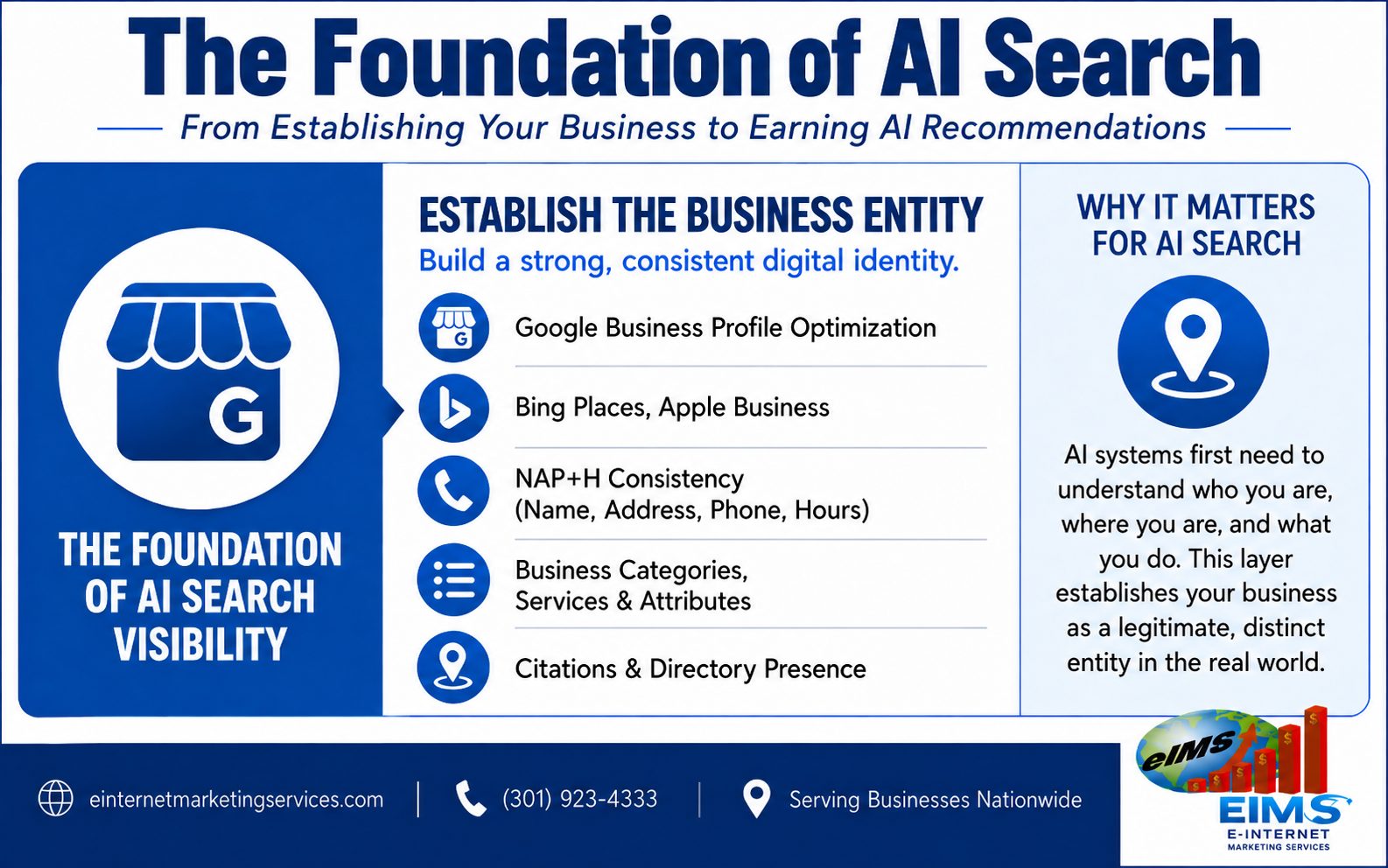
The Foundation of AI Search rests on three free platforms: Google Business Profile, Bing Places, and Apple Business. Before an AI chatbot like ChatGPT can recommend your business, it has to know it exists. This article covers NAP+H consistency, the profile fields that carry the most weight, and how Bing imports your Google data. It answers the question of why your business is already listed on sites you never signed up for, which citations are worth claiming, and whether a management platform like Uberall is worth using. Every AI system has to answer one question before it recommends anyone: who is this business, and can I trust what I know about it? In other words, that is your business entity. Just substitute the word “identity” for “entity.” This makes it a bit easier to understand.
Most owners never think about that question. They think about content, reviews, maybe a website redesign. Meanwhile, ChatGPT quotes a phone number they disconnected in 2023, and Apple Maps sends customers to a suite they left two years ago.
Entity data is the foundation of AI search. We consider this the most important component of our SEO work and the one that quietly decides whether everything else functions. Make sure your read EIMS Six-Layer AI SEO Framework. You will see that Establishing a Business Entity is the first of six layers in our framework.
Why Is Establishing a Business Entity the Foundation of AI Search?
Because language models do not browse. They retrieve.
When someone asks a chatbot for a recommendation, the system is not reading your website the way a customer would. It pulls structured facts from indexes built long before the question was asked. These indexes were assembled from business profiles, directories, maps data, and all the places your name appears next to an address.
If those sources agree, you exist as one confident entity. If they contradict each other, you are a low-confidence blur, and a blur does not get recommended. That is the whole argument for treating the foundation of AI search as real work rather than a box ticked during onboarding.
Here are the three free platforms carry most of the weight, each feeding a different set of assistants.
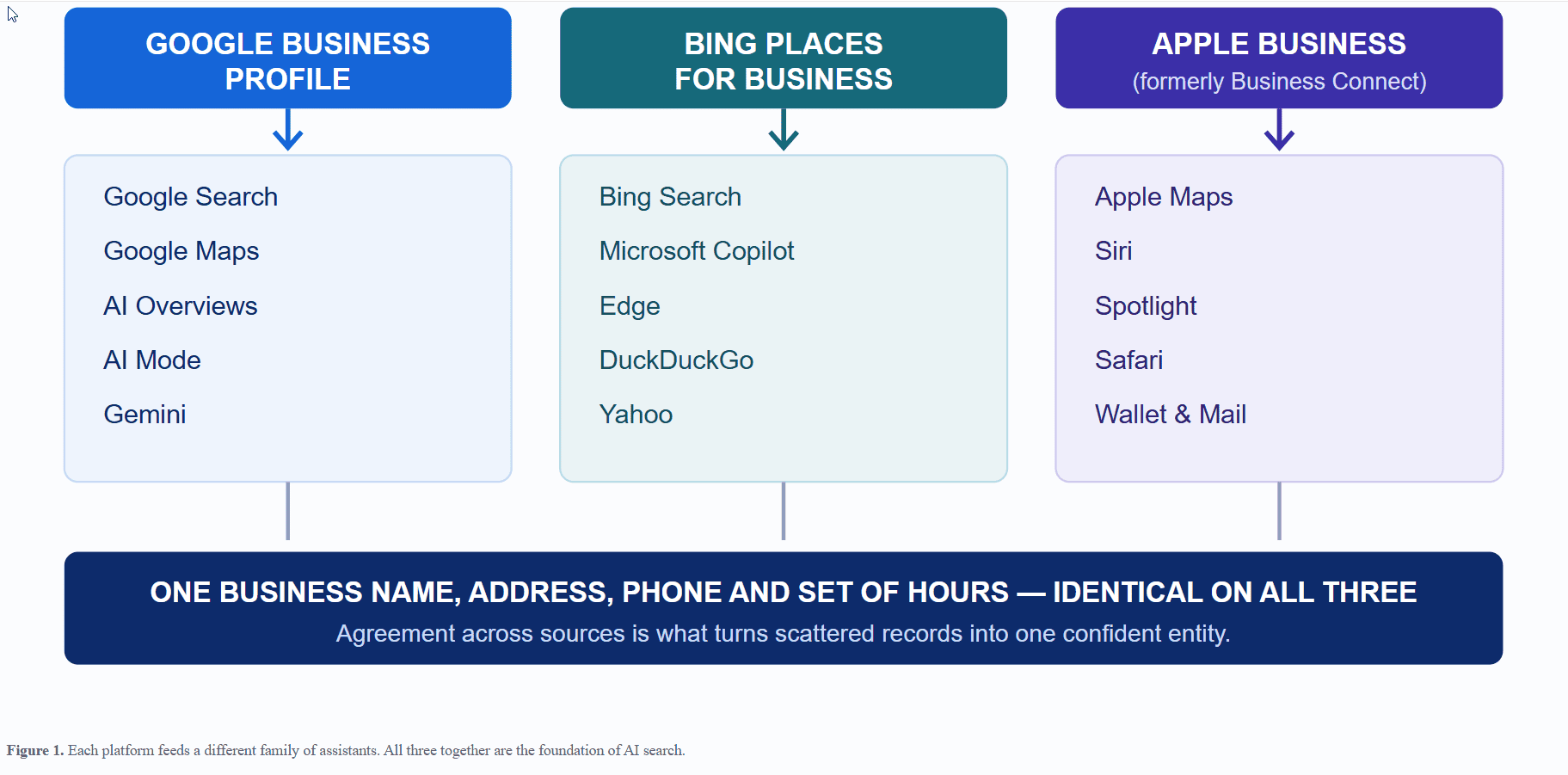
All three together are the foundation of AI search.
Notice what that implies for the foundation of AI search. Claiming only Google covers the largest share of traffic and leaves Copilot, Siri and Spotlight working from whatever they scraped. A business that skips Bing and Apple is not invisible. It is described by strangers, which is worse.
The 30-minute version. If you do nothing else after reading this, claim all three profiles and make your name, address, phone and hours identical on each. That single afternoon builds more of the foundation of AI search than six months of blog posts.
What Is NAP+H, and Why Is It the Foundation of AI Search?
NAP+H stands for Name, Address, Phone, and Hours. It is the core identity record for your business, every platform that describes you stores some version of it, and it is the first thing to fix in the foundation of AI search.
The word doing the work is identical. Not similar. Identical. Matching systems compare these records to decide whether two entries describe the same business, and small differences create doubt — usually resolved by splitting one business into two weak records. NAP+H is where the foundation of AI search either holds or cracks.
| Field | What breaks it | What it should be |
|---|---|---|
| Name | “Miller Plumbing” here, “Miller Plumbing LLC” there, “Miller Plumbing — Dallas” on a directory | Your real-world name, as it appears on signage and licensing. No city names, no keywords bolted on |
| Address | “Suite 4” vs “Ste. 400”, missing unit numbers, an old location still live on directories | One USPS-standard format everywhere, suite included |
| Phone | Tracking number on the profile, real line on the website, legacy number on Yelp | One primary local number everywhere. Tracking numbers go in the secondary phone field |
| Hours | Holiday closures never entered, “open 24 hours” left over from setup | Accurate regular hours plus special hours entered before every holiday |
Hours deserve more respect than they get. It changes most often, nobody updates it, and AI chatbots quote it most confidently. A customer who drives to a closed store because Siri said you were open does not blame Apple.
Keyword-stuffing your business name is the other common own-goal. It works for a while, it violates Google’s guidelines, and it is a reliable way to get suspended — which takes your entire foundation of AI search offline while you appeal.
Example. A Phoenix HVAC company runs a call-tracking number in its ads, so the vendor puts that number on the Google profile too. The website still shows the main line. Yelp has the number from 2019. Three records, three phone numbers, one business — and every matching system has to guess which is authoritative. The fix costs nothing and repairs a real crack in the foundation of AI search: pick the main line, use it everywhere, move tracking numbers to the additional-phone field.
How Does Google Business Profile Optimization Build the Foundation of AI Search?
Google Business Profile is the richest structured record of your business anywhere online, it is free, and it is the most under-filled asset most local businesses own. Claiming and verifying comes first. Nothing in the foundation of AI search matters until you control the profile. After that, treat it not as a form to complete but as a set of fields deciding which searches you are eligible for at all.
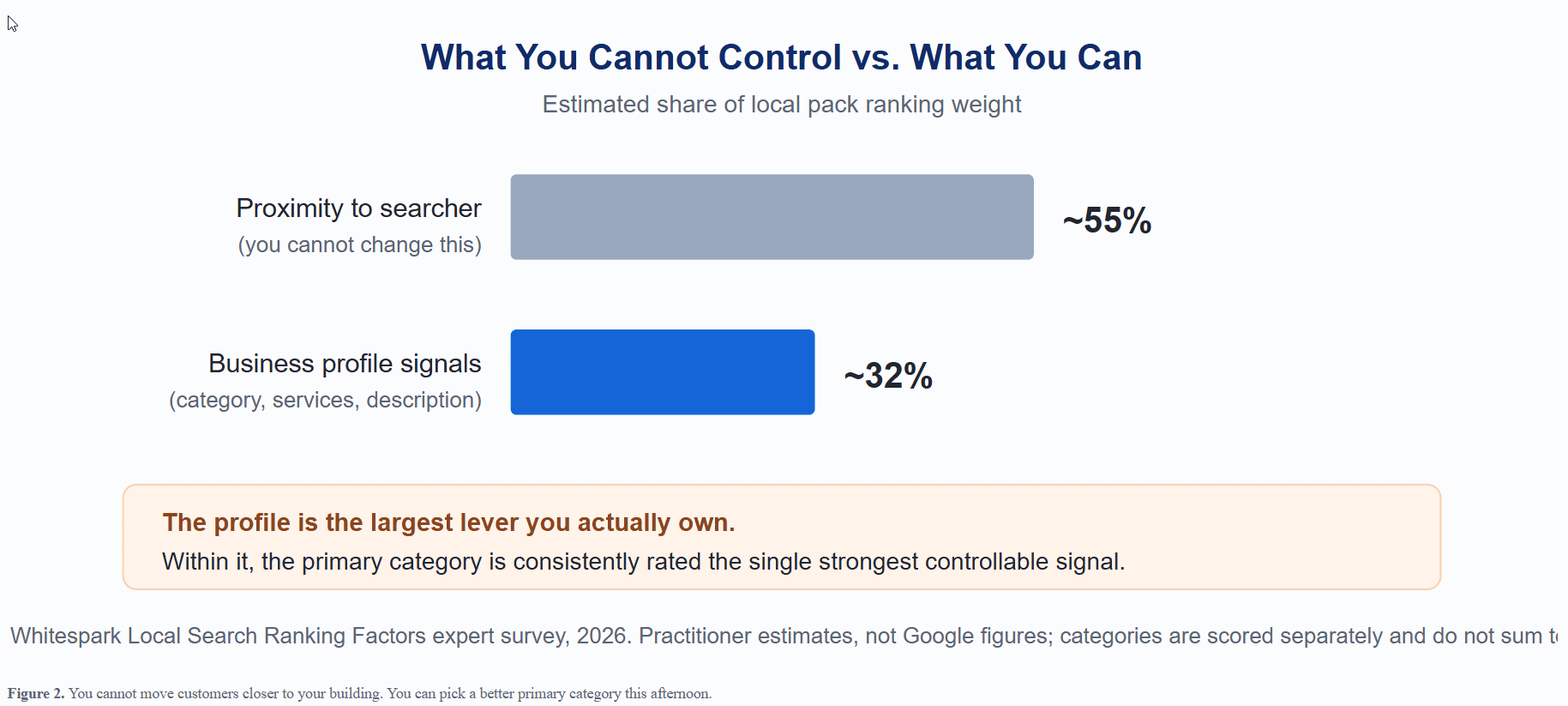
You cannot move customers closer to your business location. You can pick a better primary category this afternoon.
Proximity dominates local rankings and you cannot change it. That makes the profile fields the largest lever you own, which is why profile work sits so close to the base of the foundation of AI search.
Which Profile Fields Matter Most to the Foundation of AI Search?
Four fields carry most of the foundation of AI search on Google: categories, services, description, and attributes. They are not equally important, and treating them as a flat checklist is how businesses fill in everything and move nothing.
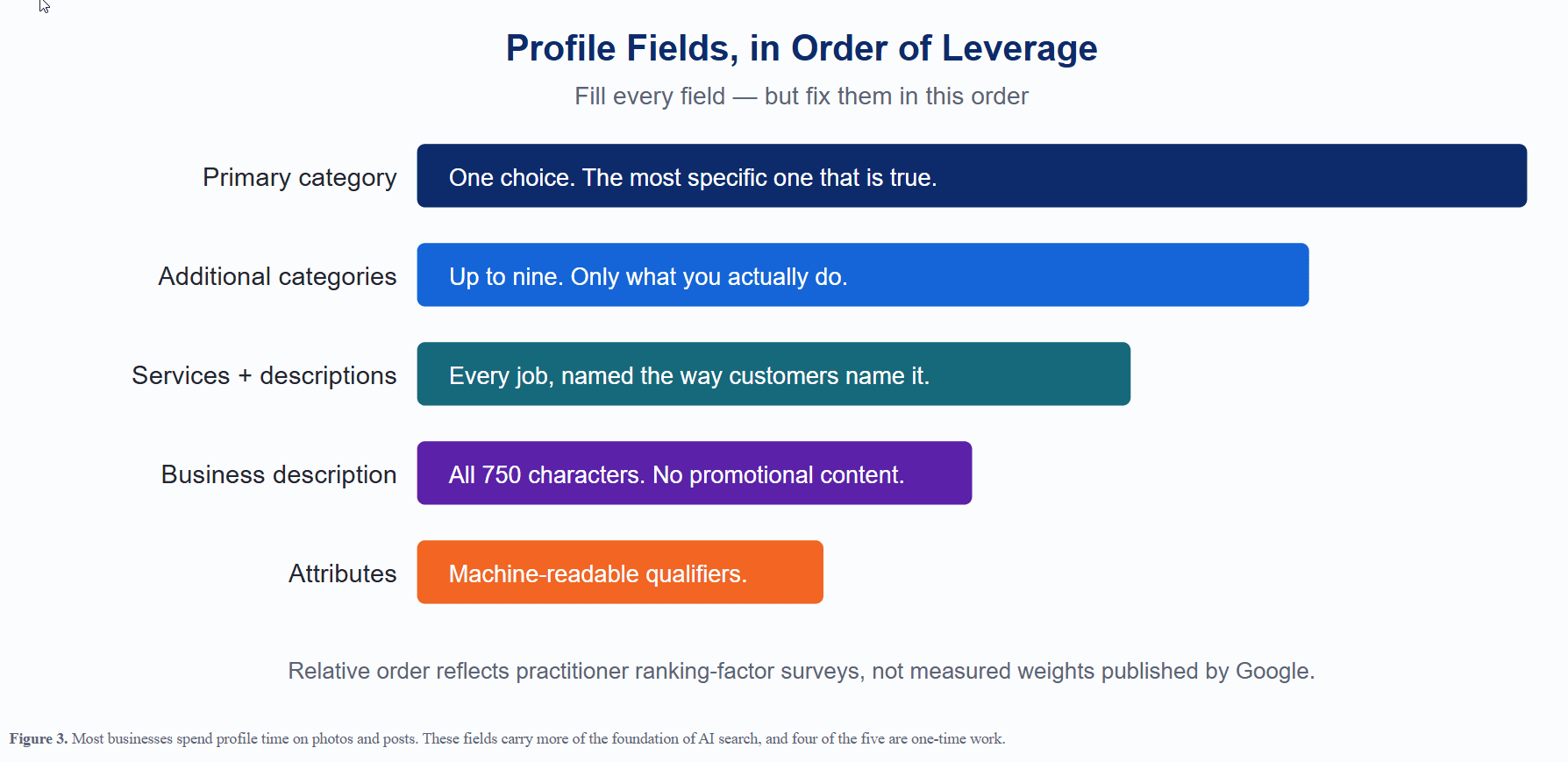
Most businesses spend profile time on photos and posts. These fields carry more of the foundation of AI search, and four of the five are one-time work.
Categories. Your primary category is the most consequential single choice in the entire foundation of AI search. Practitioner surveys have rated it the strongest controllable ranking signal for years, and Google uses it to decide which queries you are eligible for. Pick the most specific category that honestly describes your core business — a firm that mostly practices family law and occasionally mediates is a “Family Law Attorney,” not a “Mediator.” Too broad is the more common error. You get one primary plus nine additional; add what you genuinely serve and skip work you rarely do, since categories you do not perform dilute relevance rather than expanding it. Shortcut: check what the businesses ranking in your map pack use.
Services. An underused field with direct relevance value in the foundation of AI search. Each Google Business Profile service gets a name and a description telling Google and AI systems what problems you solve, in the words customers use. A plumbing company should list water heater replacement, drain cleaning, slab leak detection and repiping individually, not one entry reading “plumbing services.”
Description. You get 750 characters. Use them. Lead with what you do and where, then cover specialties, credentials, and why you are a different choice from the company down the road. Write it for a human deciding whether to call. Google prohibits promotional content here, no prices, no sales, no dated offers. Save those for Posts.
Attributes. Structured facts answering filter-style questions: wheelchair accessible, veteran-owned, women-owned, offers online estimates. They look minor. They are exactly what an assistant reaches for on a qualified question like “find me a women-owned accounting firm that does virtual appointments.” This is a quietly important part of the foundation of AI search.
How Do Keywords Fit Into the Foundation of AI Search?
Keywords matter here, but not the way they matter on a web page, and the difference trips people up constantly.
On your profile, the fields are the targeting. There is no box to bid in. Google reads your category, services, description and attributes and decides what you are relevant for. The job is making sure the language your customers actually use appears in the fields where it belongs. Keyword work inside the foundation of AI search is placement, not repetition.
Start from how customers describe the problem, not how your industry describes it. Homeowners say “my AC is blowing warm air,” not “refrigerant charge diagnostics.” Conversational phrasing matters even more to the foundation of AI search, because people type whole sentences into chatbots.
Where keywords do not belong:
- Your business name. “Miller Plumbing” is your name. “Miller Plumbing — Emergency Plumber Dallas 24/7” is a suspension risk and a consistency problem in one move.
- Stuffed into the description. A 750-character block crammed with variations reads badly to customers and adds nothing for Google.
- Categories you do not serve. Adding “Emergency Plumber” when you close at five is a relevance signal you cannot cash.
The honest version: profile keywords are about accuracy and specificity, not density. Say precisely what you do, in the words customers use, in every field that accepts text. That is the whole technique, and it is enough.
Why Is Bing Places Part of the Foundation of AI Search?
Because Bing stopped being “the other search engine” and became infrastructure.
Bing’s index sits behind Microsoft Copilot, Edge, DuckDuckGo and Yahoo, and Copilot ships as the default assistant on an enormous base of Windows machines. Skipping Bing Places in 2020 cost a rounding error. Skipping it now removes a whole branch of the foundation of AI search — the branch answering questions on work computers all day. It is free, and setup is quick, because Microsoft built an import path from Google.
How Does Bing Sync With Google, and What Does That Mean for the Foundation of AI Search?
Bing Places offers an “Import from Google Business Profile” option during setup. You authorize the Google account managing your profile, Bing pulls your name, address, phone, hours, categories, description and photos, and pre-fills the listing. You can also opt into periodic sync so Bing follows your Google updates automatically.
That is a real gift for an owner with no time, and it has consequences worth understanding before you click.
- Sync copies problems as faithfully as facts. A stale address propagates straight across. Clean Google first, then sync.
- Reviews do not transfer. Reviews are platform-specific. Your Google reviews stay on Google; your Bing listing starts empty on that front.
- Ongoing sync ends Bing’s independence. Usually what you want. But a mistake on Google becomes a mistake in two places.
- Bing has its own fields. Its category structure differs from Google’s, so review what mapped over instead of assuming the import got it right.
The sequence that works: get Google right, import to Bing, review every field by hand, verify, then enable ongoing sync. Ten extra minutes protects the foundation of AI search on the Microsoft side of the house.
Skip the review step and you have not built the foundation of AI search on Bing. You have duplicated whatever was already wrong on Google.
Worth knowing: a business that has never touched Bing Places usually still has a Bing listing, because Microsoft licenses business data from aggregators. Claiming is how you take control of a record that already exists and already describes you to Copilot users.
Where Does Apple Business Connect Fit Into the Foundation of AI Search?
Apple covers the part of the foundation of AI search that never opens Google Maps. iPhone users get directions from Apple Maps, ask Siri for a phone number, and find businesses through Spotlight without opening a browser.
One current detail most articles have not caught up to: Apple retired Apple Business Connect as a standalone product. On April 14, 2026, Apple folded its brand and location tools into a unified platform called Apple Business, and existing Business Connect data migrated automatically. If you search for Apple Business Connect and land on something called Apple Business, that is why.
Apple is the cheapest piece of the foundation of AI search to get right. What you manage there: the place card (name, address, phone, hours, photos, logo) displaying across Apple Maps, Safari and Spotlight; Showcases, Apple’s version of Posts; custom actions like order, reserve or book; your brand profile in Maps, Mail and Wallet; and location insights. Claiming is free and verification takes a few days. If a prior vendor claimed your location and vanished, Apple has a transfer request process. This is annoyingly common, and fixable.
Are Business Listings and Citations Different, or Are They the Same?
They overlap heavily, and in everyday agency conversation people use the words interchangeably. The distinction is real, and it changes what you can do about each.
| Business listing | Citation | |
|---|---|---|
| What it is | A structured profile on a platform, with fields you can usually claim and edit | Any mention of your name, address or phone number online, structured or not |
| Examples | Your Yelp page, Bing Places listing, Angi profile, chamber of commerce entry | All of those, plus a news article naming your address or a nonprofit sponsor list |
| Can you control it? | Usually — claim and edit | Sometimes. An unstructured mention means asking the site owner |
The cleanest way to hold it: every business listing is a citation, but not every citation is a business listing. Citation is the broader category; listing is the subset you can log into and edit.
Both count toward the foundation of AI search. Retrieval systems weigh corroboration, and a local news story naming your business and address corroborates you as surely as a directory record does.
Why Is Your Business Already Listed on Sites You Never Signed Up For?
Because a whole industry exists to compile business data, and you were never part of the transaction. Pieces of your foundation of AI search were assembled by companies you have never heard of.
How a Listing You Never Created Ends Up Describing You…
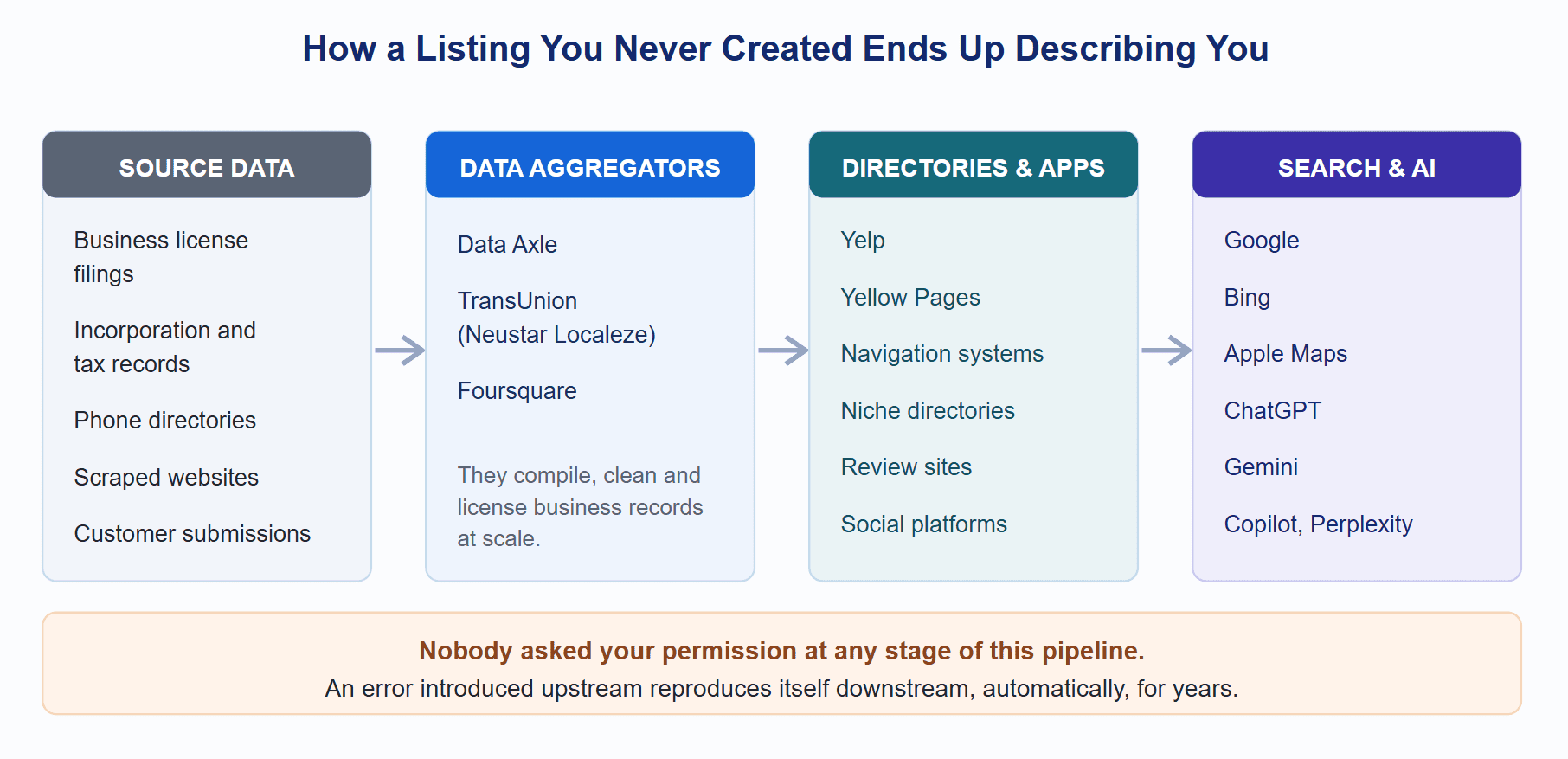
Nobody asked your permission at any stage of this pipeline.
An error introduced upstream reproduces itself downstream, automatically, for years.
Why businesses find listings they never created, and why fixing one directory by hand rarely sticks.
Data aggregators — Data Axle, TransUnion’s Digital Business Profile service (formerly Neustar Localeze), and Foursquare are the major U.S. players — assemble records from license filings, incorporation documents, government databases, phone directories, scraped websites and third-party submissions, then license that data downstream to directories, navigation systems, apps and search engines. So parts of your foundation of AI search get built without you lifting a finger. The common triggers:
- You registered the business. The filing is public, gets compiled, becomes a record.
- You got a phone number. Listed numbers have fed directory data for decades.
- Someone checked in, reviewed you, or tagged your location. Platforms create records from user activity.
- An aggregator scraped a site that mentioned you. One mention on a supplier page can seed a record.
- A previous owner or vendor created it. The headache case — the listing exists, it is claimed, and the login left with them.
These records propagate, which is why they matter more than they sound. An address error introduced at the aggregator level reproduces across dozens of downstream sites automatically, and keeps doing so after you correct one directory by hand. That is the mechanism behind the most frustrating sentence in local search: “I fixed that already, why is it still wrong?”
Example. A Denver accounting firm moves three blocks in 2023 and updates Google the same week. Two years later, clients still arrive at the old building. The old address sits in an aggregator record feeding a handful of directories, a GPS database and two review sites. Nobody at the firm created those listings, fixing Google never touched them, and the foundation of AI search stayed broken the entire time.
Which Listings Matter Most to the Foundation of AI Search?
Not all citations deserve your afternoon. Blasting your business into 300 directories was always mostly noise, and it actively damages the foundation of AI search now — a spray of thin listings with slightly different data is precisely the inconsistency you are trying to eliminate. Work in tiers instead.
| Tier | Where | Why it earns the effort |
|---|---|---|
| 1 — non-negotiable | Google Business Profile, Bing Places, Apple Business | The three primary identity records. Everything downstream cross-references them |
| 2 — the data layer | Data Axle, TransUnion Digital Business Profile, Foursquare | Stops bad data reproducing across sites you have never visited |
| 3 — high visibility | Yelp, Facebook, Better Business Bureau, Yellow Pages | High traffic, frequently scraped, often the first thing a skeptical customer checks |
| 4 — industry and local | Trade associations, licensing boards, chambers, vertical directories (Avvo, Healthgrades, Houzz, Angi) | Fewer visitors, stronger corroboration. Proof you are a real operator in a real field |
Claiming is what turns a listing into part of your foundation of AI search rather than someone else’s. It matters beyond editing rights. An unclaimed listing can be edited by strangers — platforms accept user-suggested corrections, and competitors have been known to suggest unhelpful ones. Claiming also lets you respond to reviews and find duplicates quietly splitting your reputation in half. An unclaimed listing is a piece of your foundation of AI search that someone else controls.
Tier 4 holds the easiest unclaimed wins, and it is where agency size shows — a difference we cover in how a boutique AI SEO agency differs from a national firm. Industry directories need someone who knows your industry, which is exactly the part of the foundation of AI search that automated services skip.
Why Is Consistency the Hardest Part of the Foundation of AI Search?
Because it is not a project. The foundation of AI search is a maintenance problem, and businesses change.
You move. You add a second line. Saturday hours shift for the season. A vendor creates a listing for a campaign and never mentions it. Each event forks what one source says from what another says, and each fork chips at the foundation of AI search.
Consistency also reaches further than owners expect. Social profiles carry NAP+H data; the address on Facebook, the phone in your LinkedIn profile, the location in your Instagram bio. Review sites carry it. Your own site carries it in the footer, on the contact page, and inside your schema markup, usually the last thing anyone updates after a move.
The approach that holds the foundation of AI search together is boring and it works:
- Write down the canonical record. One document with the exact name, address, phone and hours. Every future change starts here.
- Audit what exists. Search your business name, your phone number in quotes, and your old address. The old address search is the revealing one.
- Fix the top of the funnel first. Aggregators, then Tier 1 profiles, then downstream. Correcting downstream first means watching your fixes get overwritten.
- Merge duplicates. Two records for one location split your signals and your reviews.
- Re-audit quarterly. Drift is constant, and catching it early beats a suspension appeal.
Should You Manage the Foundation of AI Search on a Platform Like Uberall?
Our opinion is YES!
Platforms like Uberall, Yext, Moz Local and BrightLocal push your data to a network of publishers through APIs, then monitor it for drift or slight changes. Uberall connects with 50+ directories, and includes profile protection that blocks unwanted suggested edits. This is useful if strangers keep “correcting” your hours.
What you are buying is leverage: update once, push everywhere, get alerted when something changes. For a restaurant group with 40 locations and seasonal hours, that is not a luxury. Two things to understand before signing.
- Ask what happens when you cancel. Some platforms maintain listings through a live API connection rather than creating records you own. BrightLocal has documented this with Yext, where canceling rolls back changes made during the subscription. That is a rental model. This is not inherently wrong.
- Coverage is not customization. Automated networks are one-size-fits-all. They tend to miss the niche industry directory that matters in your field and nail forty generic ones that do not.
What Does a Finished Foundation of AI Search Look Like?
The foundation of AI search is complete when all six of these are true:
- All three primary profiles are claimed, verified and under your control with your logins, not an agency.
- Name, address, phone and hours are identical across all three, your website, your schema markup and your social profiles.
- Your Google profile has a specific primary category, relevant secondary categories, itemized services, all 750 description characters, and applicable attributes.
- Duplicates are merged, old addresses are dead.
- A quarterly audit sits on someone’s calendar with a name next to it.
Not exciting. Also the difference between an assistant describing you confidently and skipping you for a competitor whose data was easier to trust. Once the foundation of AI search is solid, the work above it finally has something to stand on.
Can an Agency Build the Foundation of AI Search From Anywhere in the US?
Yes, and this layer travels particularly well.
Auditing citations, claiming profiles, correcting aggregator records, choosing categories, writing service descriptions, merging duplicates — every piece of the foundation of AI search happens in a browser. What it needs from you is information and a few conversations, not proximity. The only genuinely local input is knowledge of your market and industry, and you can hand that over in an hour on a call.
Find out what the AI assistants are saying about your business
Most owners have never checked whether their Bing and Apple listings exist, let alone whether they are right. It usually takes one look to find something broken in the foundation of AI search.
Book a discovery call with E-Internet Marketing Services and we will audit the foundation of AI search with you on screen — what is claimed, what is inconsistent, which duplicates are splitting your signals, and what it would take to clean it up. We work with clients in every state by video conference, so where you are located changes nothing about how we work together.
Schedule Your Free Discovery Call
E-Internet Marketing Services · (301) 923-4333 · Serving businesses nationwide.
Frequently Asked Questions About the Foundation of AI Search
How long does it take to build the foundation of AI search for one location?
Claiming and optimizing the three primary profiles is an afternoon of focused work plus verification waits — phone and email are often instant, postcards take one to two weeks. The citation cleanup behind it runs longer, because aggregator corrections propagate on their own schedule. Plan on 30 to 90 days before the whole ecosystem reflects your changes.
Do I need a physical storefront to build the foundation of AI search?
No. Service-area businesses can hide the street address and define the areas served instead, and Apple opened its platform to businesses without storefronts in late 2024. You do need a real, verifiable business, though — a virtual office or mailbox address is a suspension risk on Google, not a shortcut.
What happens to the foundation of AI search if a former vendor claimed my profiles?
Every major platform has an ownership transfer process. You request access, the current owner gets a window to respond, and if they do not, the platform can reassign control. It is tedious, it works, and until it is done you do not really own the foundation of AI search for your own business. Once you have the profiles back, change the logins and add your own email as primary owner so this does not repeat.
Will the foundation of AI search help me appear in ChatGPT and Gemini?
It improves the odds rather than guaranteeing anything. AI systems pull from indexes built on this data, so accurate, corroborated records make you easier to retrieve and safer to cite. Nobody controls model output. What you control is whether the available facts are right — which is exactly why this is the foundation of AI search rather than a nice-to-have.
How many citations does the foundation of AI search actually need?
Fewer and better beats more. The three primary profiles, the three aggregators, the high-visibility platforms, and the industry directories genuinely relevant to your field. Fifty accurate citations build more foundation of AI search than 300 thin ones carrying four versions of your phone number.
Does the foundation of AI search change if I have multiple locations?
The principles hold; the execution scales differently. Each location needs its own profile, phone line, landing page with its own LocalBusiness schema, and set of claimed listings — effectively its own foundation of AI search. Multi-location businesses are also where a listings platform starts paying for itself.
My information is wrong on a site I have never heard of. How do I fix it?
Try the site’s own correction or claim process first. If the error keeps returning, the source is upstream — correct your record at the data aggregators and let the fix propagate. Chasing symptoms downstream is the most common way businesses waste months on the foundation of AI search.
Is the foundation of AI search worth it if I already rank well on Google?
Ranking well on Google tells you nothing about how Copilot, Siri or ChatGPT describe you, since those systems draw on different sources. A business dominating its local pack while running an unclaimed Bing listing with a disconnected phone number has a strong roof and a cracked foundation of AI search underneath.
About the Author
Rick Samara is the founder of E-Internet Marketing Services (EIMS), a digital marketing agency in Southern Maryland serving clients across the United States through video conferencing. He has worked in local search since the Google Places era, when EIMS helped a local attorney claim a top position in what was then the Google 7-Pack — so he has watched listing data break, propagate and get fixed for close to two decades.
Rick also owns Continental Cybersecurity Solutions for Critical Infrastructure and wrote AI for Beginners Demystified. Before founding EIMS he served as a U.S. Air Force Intelligence Analyst, a background that shaped how he approaches the foundation of AI search: verify the source, reconcile the contradictions, and never trust a record just because it sounds confident.
Connect with Rick at ricksamara.com or book a discovery call with EIMS.
Further Reading
Apple. (2026, March 24). Introducing Apple Business — a new all-in-one platform for businesses of all sizes. Apple Newsroom. https://www.apple.com/newsroom/2026/03/introducing-apple-business-a-new-all-in-one-platform-for-businesses-of-all-sizes/
Apple. (n.d.). Apple Business Connect: Marketing tools for business owners. https://businessconnect.apple.com/
BrightLocal. (n.d.). Using data aggregators for local citations. https://www.brightlocal.com/learn/data-aggregators/
BrightLocal. (n.d.). The best listings management solutions compared. https://www.brightlocal.com/resources/listings-management-services-compared/
Google Search Central. (n.d.). AI features and your website. Google for Developers. https://developers.google.com/search/docs/appearance/ai-features
Google Search Central. (n.d.). Local business (LocalBusiness) structured data. Google for Developers. https://developers.google.com/search/docs/appearance/structured-data/local-business
Whitespark. (n.d.). The U.S. local search ecosystem. https://whitespark.ca/local-search-ecosystem/